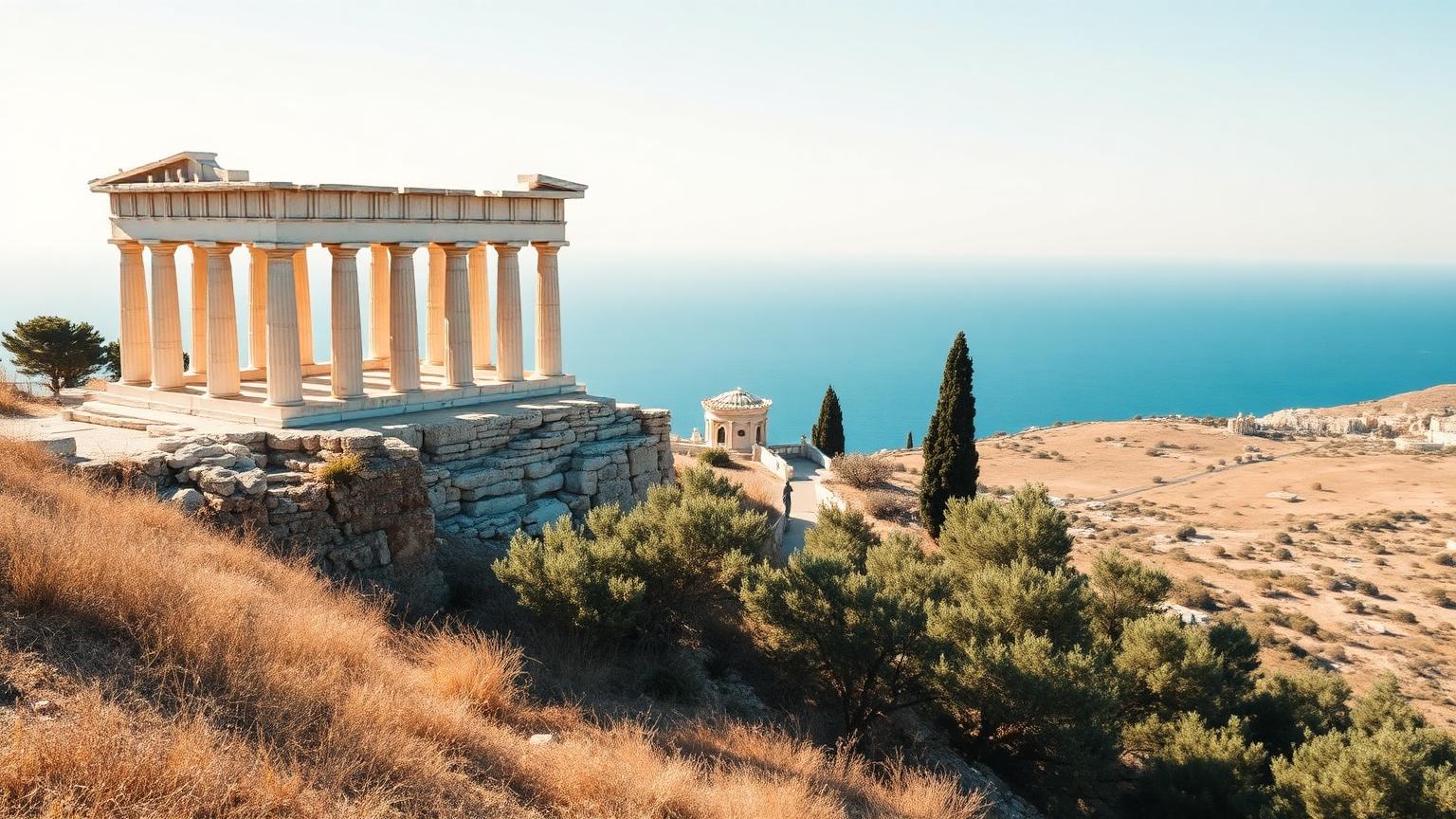
Greece
800 – 146 BCE
City-states, natural philosophy, and the first surviving works of history.
Every claim in this period carries its evidence with it.
A large surviving literary corpus, inscriptions, excavated sanctuaries and cities, coinage, and vase painting as a visual record.
- 01
Greek city-states developed distinct political systems, including documented democratic institutions at Athens.
- 02
Mathematics, medicine and natural philosophy were pursued as explicit methods with surviving argumentation.
- 03
Inscriptions record public accounts, decrees and tribute lists that check the literary narrative.
Each row states the method, what is actually measured, and — the part usually skipped — what the result does not settle.
| Method | Material | What it constrains |
|---|---|---|
| Epigraphy | Public decrees, accounts and casualty lists on stone | Contemporary institutional record. It preserves what a polis chose to publish permanently. |
| Manuscript transmission analysis | Medieval copies of classical texts and papyrus fragments | Reconstructs what survived and how; the corpus we have is a fraction of what was written. |
| Excavation of sanctuaries and settlements | Temples, agoras, houses and votive deposits | Provides material context that literary sources rarely describe. |
How historical is the Trojan War tradition?
Troy is a real, repeatedly destroyed site; matching a specific layer to the epic is not settled.
How representative was Athens?
Most surviving text is Athenian, which distorts our picture of the wider Greek world.
“Greek democracy resembled modern democracy.”
It excluded women, resident foreigners and an enslaved population, and used sortition over election for many offices.
“Classical statues were plain white marble.”
Pigment traces show they were painted; the white aesthetic is a survival artifact and a later taste.
- How much of the lost corpus is recoverable from papyri?
- What did non-elite life look like outside Athens?
- How did technical knowledge circulate between city-states?
Inscriptiones Graecae corpus
Berlin-Brandenburg Academy
Oxyrhynchus papyri publications
Egypt Exploration Society
Who was alive, and where
Mediterranean World
Sea-connected states that argued about their own history in writing.
The same centuries, side by side
Where Greece connects to the rest of the ancient record — the worlds it belongs to, the chapters it sits in, the documents that record it, and the questions still open.
Worlds
All worlds →Primary Sources
All primary sources →
Herodotus
Halicarnassus · c. 430 BCE
The first surviving work of systematic inquiry — and a running lesson in source evaluation.
Written in Greece

Plato
Athens · c. 399 – 347 BCE
Philosophical dialogues that also contain the earliest surviving mention of Atlantis.
Written in Greece
Evidence Files
All evidence files →Bronze Age Collapse
Eastern Mediterranean · c. 1200 – 1150 BCE
Why did an interconnected system of empires fail within roughly fifty years?
Open question in Greece
Antikythera Mechanism
Aegean Sea · c. 150 – 100 BCE
How advanced was Greek gearing, and why is there nothing else like it?
Unresolved in Greece
Atlantis
Textual · Described c. 360 BCE
Is there any evidentiary basis for Atlantis beyond two Platonic dialogues?
Unresolved in Greece