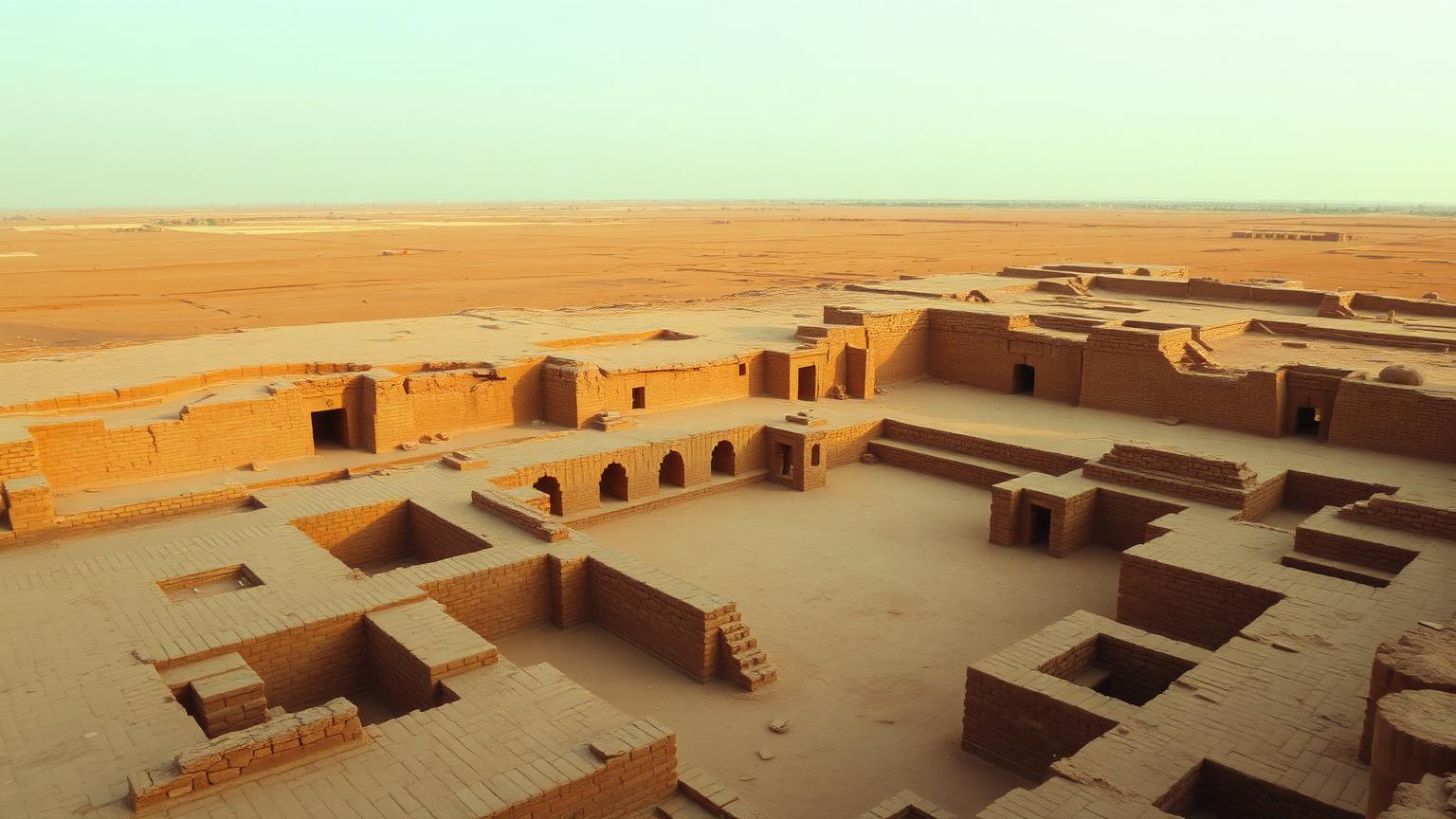
Indus Valley
3300 – 1300 BCE
Urban planning at scale — and a script still undeciphered.
Every claim in this period carries its evidence with it.
Excavated cities with standardized planning, seals bearing an undeciphered script, weights and measures, and an absence of the palace and temple monuments seen elsewhere.
- 01
Indus cities show standardized brick proportions, grid planning and extensive drainage systems.
- 02
A standardized weight system was in use across a very large area.
- 03
Trade contact with Mesopotamia is documented from both ends.
Each row states the method, what is actually measured, and — the part usually skipped — what the result does not settle.
| Method | Material | What it constrains |
|---|---|---|
| Urban survey and excavation | Street grids, drains, wells and craft areas | Establishes planning and civic infrastructure. Political structure remains unreadable without texts. |
| Metrology | Stone cubical weights from multiple sites | Demonstrates a shared standard, implying regulation of exchange. |
| Provenance analysis | Carnelian, lapis, shell and metal artifacts | Maps exchange networks; it does not identify who controlled them. |
Is the Indus script a full writing system?
Inscription lengths are very short, which is the core of the argument on both sides.
What caused decline — river shift, monsoon weakening, or reorganization?
Palaeoclimate and hydrology data support gradual change rather than a single catastrophe.
“The script has been deciphered.”
Numerous proposals exist; none produces consistent readings that other researchers can reproduce.
“An Aryan invasion destroyed the cities.”
The destruction-layer model was abandoned as excavation and climate data accumulated.
- What language or languages did the seals encode?
- How was such standardization enforced without evident central monuments?
- Where did the urban populations go?
Harappa and Mohenjo-daro excavation archives
Archaeological Survey of India / Harappa.com research reports
Indus script computational studies
Science / PNAS
Who was alive, and where
South Asia
Planned cities and a script that has still not been read.
The same centuries, side by side
Where Indus Valley connects to the rest of the ancient record — the worlds it belongs to, the chapters it sits in, the documents that record it, and the questions still open.