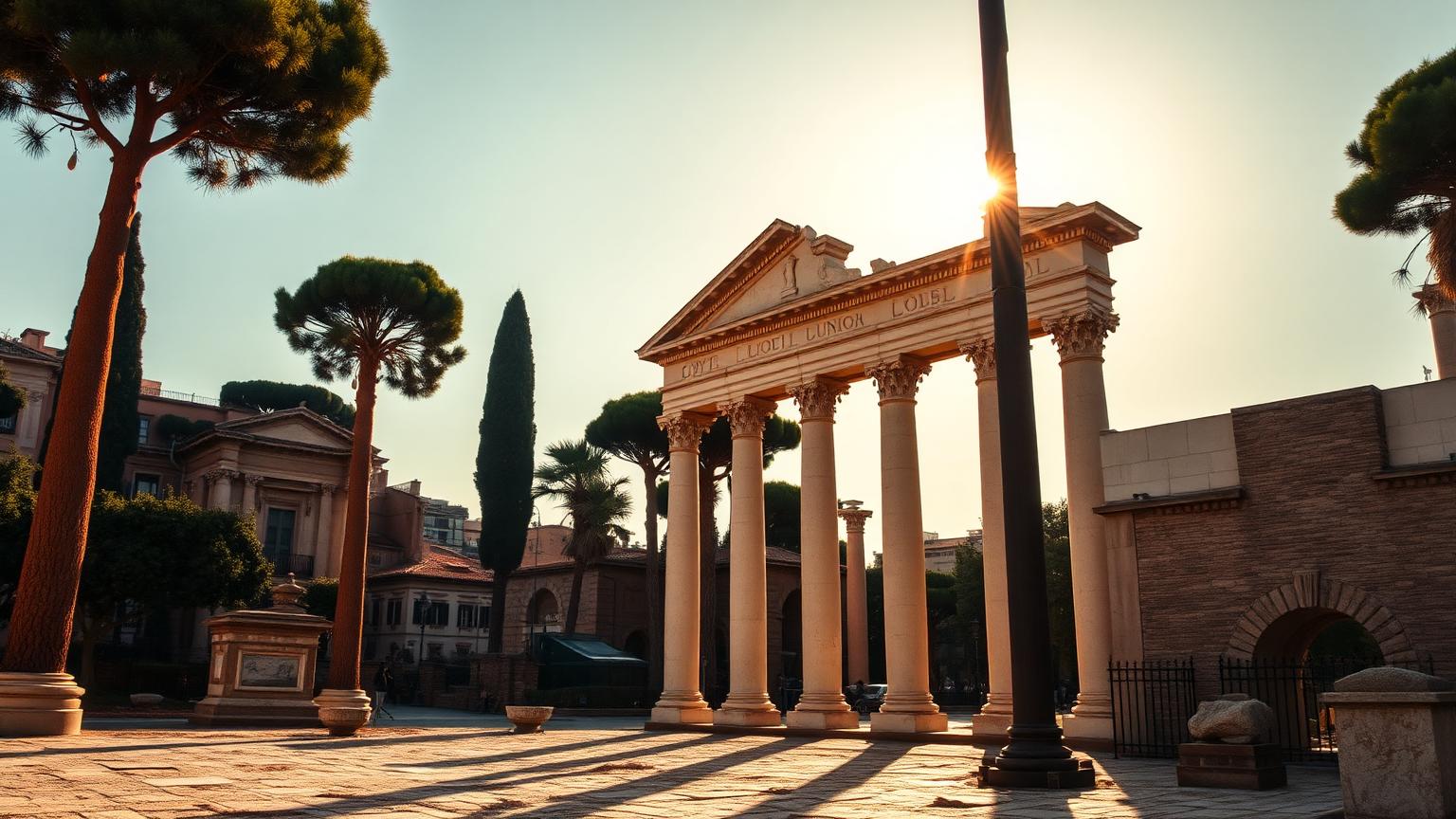
Rome
753 BCE – 476 CE
Engineering, law, and the administrative record of a Mediterranean empire.
Every claim in this period carries its evidence with it.
Standing architecture, an enormous inscription corpus, legal texts, coinage, historical narratives, and preserved sites such as Pompeii and Herculaneum.
- 01
Roman concrete using volcanic ash produced structures that remain standing, including unreinforced domes.
- 02
The empire operated an integrated legal, fiscal and logistical system across three continents.
- 03
The transition from republic to principate is documented from multiple contemporary and near-contemporary angles.
Each row states the method, what is actually measured, and — the part usually skipped — what the result does not settle.
| Method | Material | What it constrains |
|---|---|---|
| Materials science on ancient concrete | Core samples from Roman marine and structural concrete | Identifies mineral reactions behind durability. It does not recover the original recipe as written. |
| Epigraphy and numismatics | Inscriptions, milestones and dated coin issues | Anchors chronology and traces official messaging across the provinces. |
| Excavation of catastrophically preserved sites | Pompeii, Herculaneum and their organic remains | Preserves a single moment in exceptional detail. That moment is not typical of the whole empire. |
Why did the western empire fall?
Fiscal strain, military reorganization, migration pressure, plague and climate all have serious advocates.
How large was the Roman economy?
Proxy measures such as shipwreck counts and pollution in ice cores give ranges, not figures.
“Rome fell in a single year.”
Political authority in the west eroded over generations while the eastern empire continued for a millennium.
“The recipe for Roman concrete was lost.”
Its chemistry has been analyzed in detail; the modern challenge is cost and standards, not mystery.
- How much did climate variation shape imperial fortunes?
- What did rural provincial life look like beyond the villa record?
- How many texts remain unread in carbonised scroll form?
Corpus Inscriptionum Latinarum
Berlin-Brandenburg Academy
Roman concrete materials studies
American Mineralogist / Science Advances
Who was alive, and where
Mediterranean World
Sea-connected states that argued about their own history in writing.
The same centuries, side by side
Where Rome connects to the rest of the ancient record — the worlds it belongs to, the chapters it sits in, the documents that record it, and the questions still open.
Worlds
All worlds →Primary Sources
All primary sources →
Nag Hammadi Library
Upper Egypt · c. 350 CE (copies)
Thirteen codices that transformed the study of early Christian diversity.
Written in Rome
Josephus
Rome / Judaea · c. 75 – 94 CE
The single most-used narrative source for first-century Judaea, written by a participant with obvious interests.
Written in Rome
Tacitus
Rome · c. 98 – 117 CE
The sharpest surviving analyst of imperial Roman politics, working from senatorial records.
Written in Rome