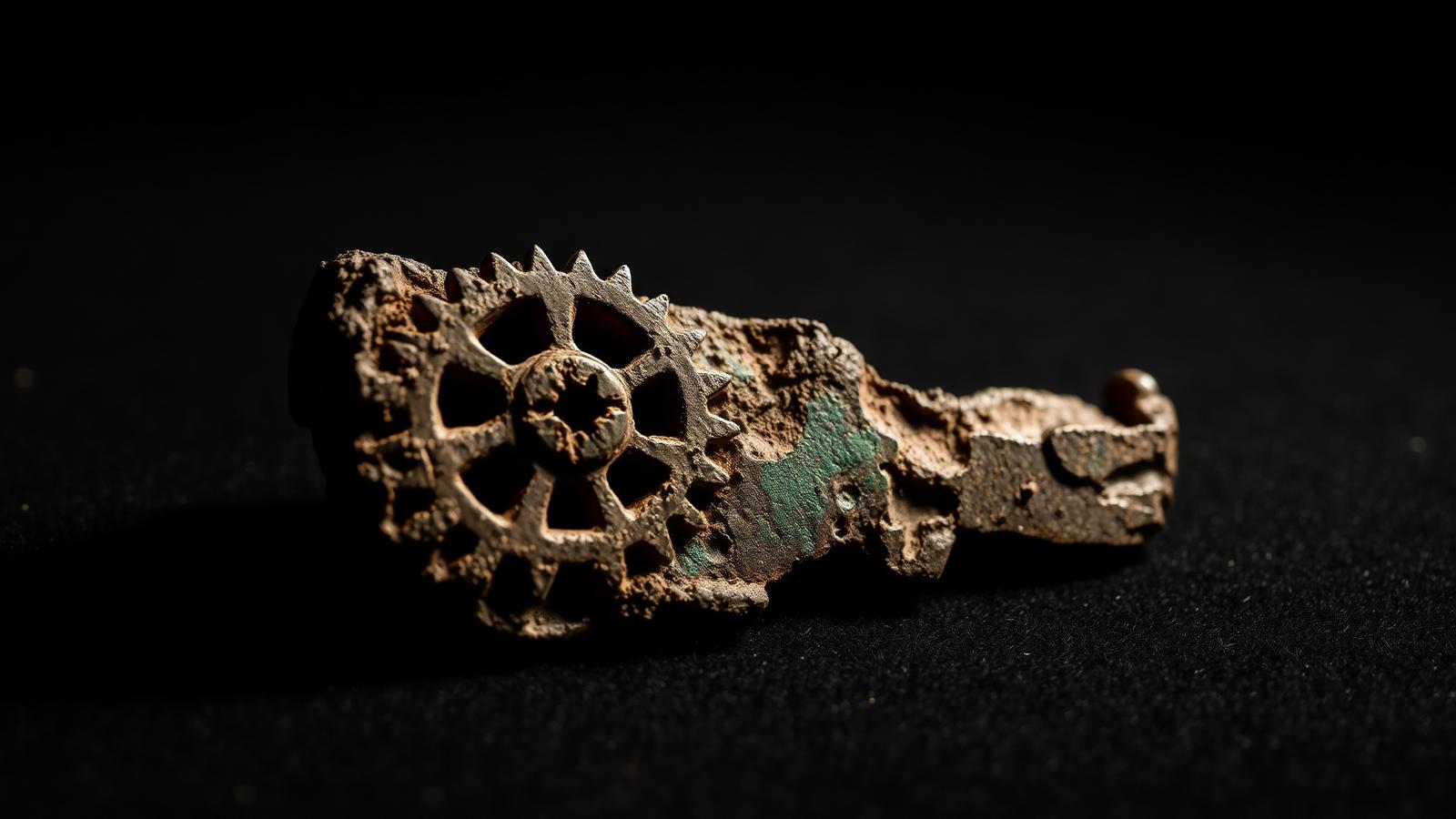
Corroded ancient bronze gear fragment with triangular teeth on a dark museum surface
Evidence File 10Archaeological Evidence

Antikythera Mechanism

Aegean Sea · c. 150 – 100 BCE

How advanced was Greek gearing, and why is there nothing else like it?

Chicago style · PDF or .txt

The Antikythera mechanism is the rarest kind of find: an object that is not mysterious in what it does — that has been decoded — but deeply mysterious in what it implies about everything we have not found.

A surviving gear fragment. Nothing of comparable complexity appears again for over a thousand years.

Historical record

Recovered from a shipwreck in 1901; ancient texts describe similar devices without surviving examples.

Current scientific consensus

A geared astronomical calculator predicting eclipses, planetary positions and games cycles.

What it is

Recovered from a Roman-era shipwreck off Antikythera in 1901, the mechanism is a geared bronze calculating device of at least thirty interlocking wheels. Microfocus X-ray computed tomography and surface imaging carried out from 2005 onward read the inscriptions and resolved the gear trains. It models the solar and lunar calendars, predicts eclipses using the Saros cycle, tracks the four-year athletic-games cycle, and reproduces the moon's variable speed using a pin-and-slot epicyclic arrangement.

That last feature matters: it is a mechanical implementation of a known astronomical irregularity. Someone translated a theory into gearing.


The real anomaly

A device this refined is not a first attempt. It implies a workshop tradition, prior prototypes, trained artisans, and customers. Almost none of that survives. Cicero mentions geared planetary devices attributed to Archimedes and Posidonius, which corroborates the tradition textually, but the material record is a single corroded lump.

Bronze is the likeliest reason. It is valuable, it is recyclable, and objects like this survive only when they are lost somewhere nobody can retrieve them — which is to say, by shipwreck.

What is still argued

The exact planetary display on the front face, the precise calibration date, and the workshop's location are all reconstructions with competing versions. These are technical disagreements between researchers working from the same CT data, not challenges to the device's authenticity or function.

Competing interpretations

One item in a lost but real tradition of Greek precision gearing.

Active Academic Debate
48% support

Specialists disagree. Competing interpretations are presented side by side.

A near-unique workshop product.

Active Academic Debate
48% support

Specialists disagree. Competing interpretations are presented side by side.

Support scores reflect the strength of the evidence class behind a claim, not how often you have heard it. Speculative entries appear because readers encounter them — never because we endorse them.

The dossier
Chicago style · PDF or .txt
The evidence base

82 corroded bronze fragments from a shipwreck, plus CT tomography and surface imaging of the internal gearing and inscriptions.

How it is dated

Each row states the method, what was measured, and — the part usually skipped — what the result does not settle.

MethodSampleResultWhat it constrains
Wreck contextAssociated ceramics and coinage from the Antikythera wreckShip lost in the first century BCEDates the loss. The device may already have been decades old.
Inscription analysisLetter forms and calendar names on the platesSecond-to-first century BCE, with Corinthian-family month namesPoints to origin region and date range, not to a named maker.
X-ray computed tomographyInternal gear trainsAt least 30 surviving gears, including a pin-and-slot lunar anomaly deviceReveals mechanism function; missing fragments leave the front display debated.
Competing readings, scored

The percentage is our editorial reading of how much of the surviving record each claim accounts for. It is a judgement, stated openly, not a consensus figure.

  • A geared astronomical calculator modelling lunisolar cycles and eclipses.

    Archaeological
    Explains the record94%
    Rests on
    • Tomography shows tooth counts matching the Metonic and Saros cycles.
    • The inscriptions read as an operating manual.
    Runs into
    • The exact planetary display, if any, is reconstruction.
  • Evidence of a wider lost tradition of Greek precision mechanics.

    Open Debate
    Explains the record58%
    Rests on
    • The execution is too assured to be a first attempt.
    • Ancient authors describe comparable geared spheres.
    Runs into
    • No second physical example has ever been recovered.
Where to check us
  • The Antikythera Mechanism Research Project

    Nature and subsequent papers

  • Collection record and imaging

    National Archaeological Museum, Athens

What would change this
  • A second geared device from any Mediterranean context would turn a singular object into a tradition.

What the record supports

  • CT imaging of internal gear trains
  • Inscribed user text on the plates
  • Cicero's references to similar devices

What remains open

  • Who built it, and where?
  • How many gear trains are still missing?
How this file was built

Function claims follow the published CT-based reconstructions and inscription readings. Reconstruction disputes are reported as disputes between specialists rather than resolved by preference.

What would settle it
  • Recovery of a second geared device from any securely dated context
  • Consensus reconstruction of the front-face planetary train
  • Workshop debris or tooling identifiable with the tradition