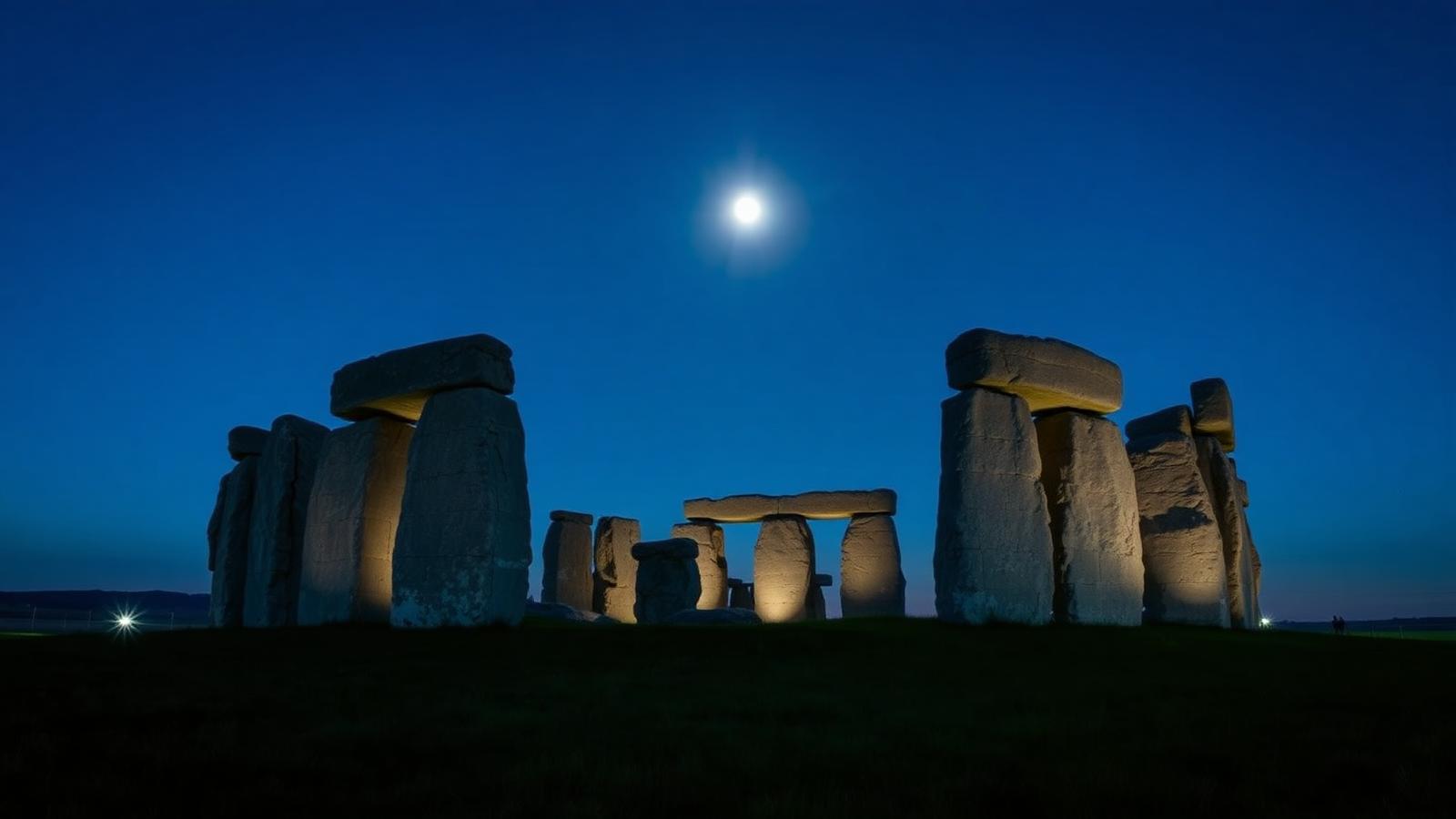
The sarsen circle at Stonehenge under a cold overcast sky
Evidence File 04Archaeological Evidence

Stonehenge

Wiltshire, England · c. 3000 – 1500 BCE

Why were bluestones moved 150 miles, and what was the monument for?

Chicago style · PDF or .txt

Ask what Stonehenge was for and the honest answer is: for which century? The site was rebuilt repeatedly across a millennium and a half, and the people who raised the sarsens were not the people who dug the first ditch.

Stonehenge is not one monument. It is roughly fifteen hundred years of revisions to the same site.

Historical record

Prehistoric — no written sources. Interpretation rests entirely on excavation and geochemistry.

Current scientific consensus

A multi-phase monument with solstitial alignment and a significant funerary component.

A sequence, not a building

The earliest phase, around 3000 BCE, is a circular ditch and bank with cremation burials — one of the largest Neolithic cremation cemeteries known in Britain. The bluestones arrive later. The great sarsen trilithons, the phase everyone pictures, come later still, around 2500 BCE. The avenue, the pits, and the surrounding monuments each belong to their own moment.
What provenance work has settled

Geochemical fingerprinting has tied most of the sarsens to West Woods in the Marlborough Downs, about 25 km north. The bluestones trace to specific outcrops in the Preseli Hills of west Wales, roughly 250 km away, and excavation at Craig Rhos-y-felin and Carn Goedog has found quarry faces with Neolithic dates. Human transport is now the supported reading; glacial transport has lost ground.

Isotope analysis of cremated remains indicates some of the earliest people buried at the site spent their final years in western Britain — consistent with the stones and the mourners travelling together.

The open part

The solstitial alignment is unambiguous and precise. What that alignment meant — calendar, funerary procession, healing site, political theatre, or all of these across different centuries — is inference from analogy, not from evidence internal to the monument. Any single-purpose explanation is almost certainly too narrow for a site that was in use for fifty generations.

Competing interpretations

Primarily a burial and ancestor site.

Active Academic Debate
48% support

Specialists disagree. Competing interpretations are presented side by side.

A healing destination drawing distant pilgrims.

Active Academic Debate
48% support

Specialists disagree. Competing interpretations are presented side by side.

A dismantled earlier Welsh circle rebuilt on Salisbury Plain.

Active Academic Debate
48% support

Specialists disagree. Competing interpretations are presented side by side.

Support scores reflect the strength of the evidence class behind a claim, not how often you have heard it. Speculative entries appear because readers encounter them — never because we endorse them.

The dossier
Chicago style · PDF or .txt
The evidence base

A multi-phase monument with excavated cremation burials, sourced stone, and geochemical provenance work on both sarsens and bluestones.

How it is dated

Each row states the method, what was measured, and — the part usually skipped — what the result does not settle.

MethodSampleResultWhat it constrains
RadiocarbonCremated bone and antler picks from ditch and pit contextsConstruction and use across several phases in the third millennium BCEDates activity episodes, giving a phased sequence rather than one build date.
Geochemical provenanceSarsen core sample analysisMajority of sarsens traced to West Woods, Marlborough DownsEstablishes source and therefore haulage distance, not the haulage method.
PetrologyBluestone lithologySources identified in the Preseli hills, west WalesHuman transport is the prevailing reading; glacial transport remains a minority argument.
Competing readings, scored

The percentage is our editorial reading of how much of the surviving record each claim accounts for. It is a judgement, stated openly, not a consensus figure.

  • A ceremonial and funerary monument aligned on the solstitial axis.

    Archaeological
    Explains the record85%
    Rests on
    • Cremation burials in the earliest phase.
    • Axis alignment on midsummer sunrise and midwinter sunset.
    Runs into
    • Alignment alone does not establish what the ceremonies were.
  • A precision astronomical instrument for predicting eclipses.

    Speculative
    Explains the record18%
    Rests on
    • Some post-hole arrangements can be fitted to cyclical counts.
    Runs into
    • The fits are retrospective and tolerate wide error margins.
    • The monument's phases change geometry, which a working instrument would not tolerate.
Where to check us
  • Stonehenge Riverside Project publications

    Antiquity and associated volumes

  • Sarsen provenance analysis

    Science Advances · 2020

What would change this
  • Isotopic work on more of the cremated individuals, which would show how far people travelled to be buried here.

What the record supports

  • Preseli bluestone sourcing
  • Isotope data on cremated remains
  • Durrington Walls feasting deposits

What remains open

  • How were the sarsens raised?
  • How many phases are still unrecognized?
How this file was built

Phased by radiocarbon sequence rather than treated as a single build. Provenance claims are reported only where geochemical matching has been published.

What would settle it
  • Further isotope work on the cremation assemblage to establish origin patterns
  • Securely dated evidence of the transport route or method
  • Excavation of contemporaneous settlement tied directly to the sarsen phase