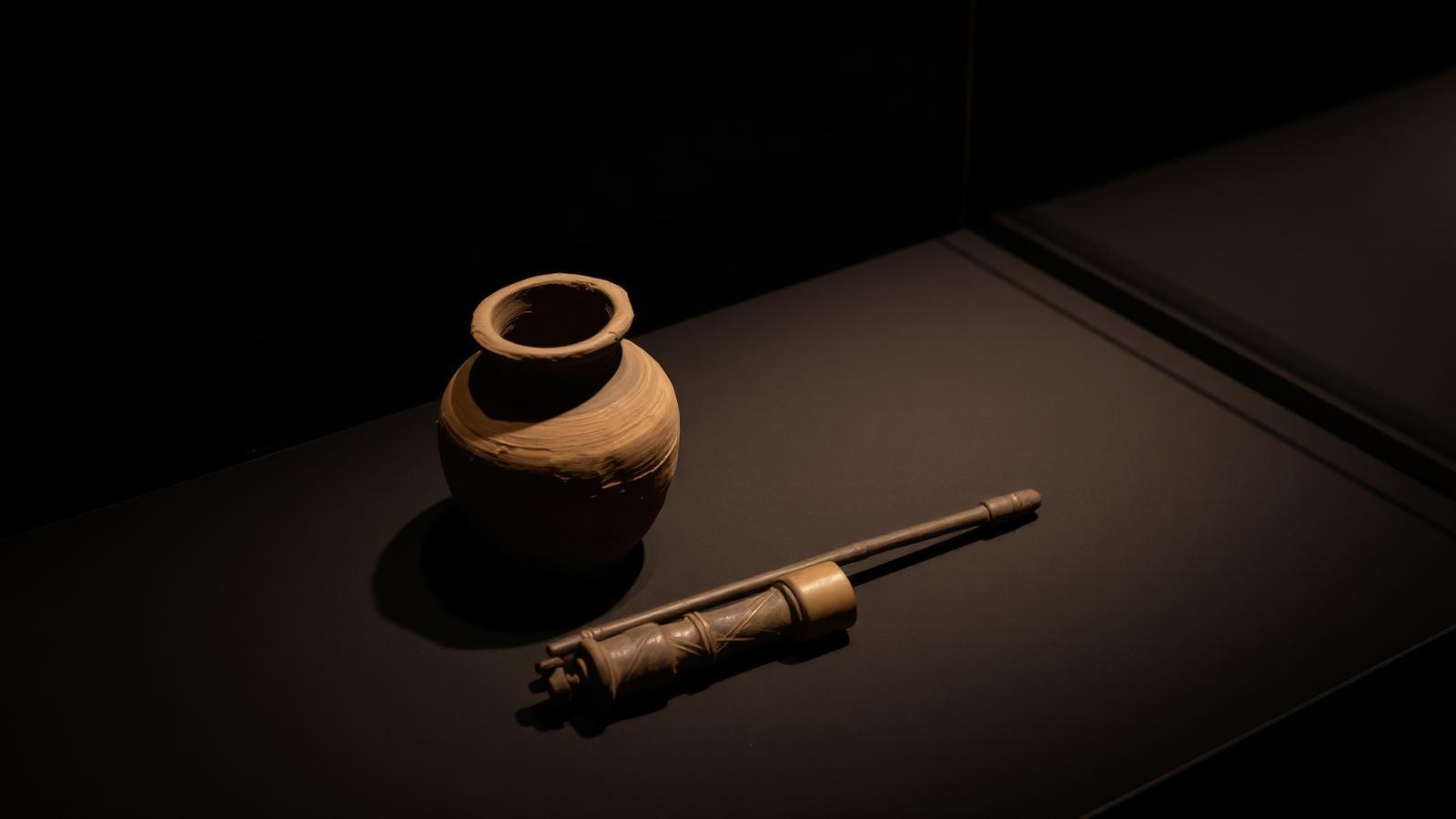
Small ancient clay jar beside a copper cylinder and iron rod on a dark museum surface
Evidence File 11Active Academic Debate

Baghdad Battery

Khujut Rabu, Iraq · c. 250 BCE – 250 CE

Were these jars electrochemical cells, or storage vessels misread by modern expectations?

Chicago style · PDF or .txt

A clay jar, a copper tube, an iron rod. Replicas filled with vinegar produce around half a volt, and that single demonstration has carried a claim about ancient electricity for eighty years. The demonstration is real. The claim does not follow from it.

The vessel, cylinder and rod. Replicas generate a small voltage — which is not the same as evidence of use.

Historical record

No ancient text describes electrical use of such objects.

Current scientific consensus

Most specialists read them as scroll or storage vessels; the battery reading is unsupported by context.

The object

The assemblage was identified in the late 1930s and is generally attributed to the Parthian or Sasanian period. The components fit together: a rolled copper cylinder sealed with asphalt, an iron rod suspended inside, housed in a small ceramic vessel. Fill it with an acidic electrolyte and you have a rudimentary galvanic cell.


What the evidence does not include

No conductors. No wires, no terminals, no connectors, no evidence anywhere in the archaeological record of a circuit these could have driven. No electroplated objects from the period whose plating cannot be explained by fire-gilding or leaf application. No text describing anything resembling the effect. The object is capable of the function; nothing indicates the function was ever the point.

The much better-supported reading is mundane: sealed cylinder assemblages of this general form are known as storage containers for rolled scrolls or sacred texts. Corroded metal and asphalt sealing fit that use without requiring a lost technology.

Why we keep the file open anyway

Because 'no positive evidence' is a different verdict from 'disproven', and because the object is genuinely interesting for what it says about how a single televised replication can outrun its own conclusion for decades. It is a useful case study in evidence tiering, which is why it stays in the registry.

Competing interpretations

Sealed storage jars for organic material.

Scientific Consensus
80% support

The mainstream position across the relevant scientific literature today.

Electroplating or ritual tingling device.

Speculative Theory
10% support

Proposed but unsupported by accepted evidence. Reported, never endorsed.

Support scores reflect the strength of the evidence class behind a claim, not how often you have heard it. Speculative entries appear because readers encounter them — never because we endorse them.

The dossier
Chicago style · PDF or .txt
The evidence base

A ceramic jar with a copper cylinder and an iron rod, recovered near Baghdad, plus comparable vessels and the experimental replications built since.

How it is dated

Each row states the method, what was measured, and — the part usually skipped — what the result does not settle.

MethodSampleResultWhat it constrains
Typological datingVessel form and associated findsBroadly Parthian or Sasanian in stylePlaces the object in a period. Excavation records for the original find are thin, which limits context.
Experimental replicationReconstructed assemblies with an acidic electrolyteProduces a small voltage when filled with vinegar or similarShows the configuration can generate current. It does not show anyone did so, or intended to.
Comparative artefact studySimilar jars from the region containing rolled scrolls or organic residueClosely comparable vessels served as storage for documentsProvides a mundane, attested function for the same object type.
Competing readings, scored

The percentage is our editorial reading of how much of the surviving record each claim accounts for. It is a judgement, stated openly, not a consensus figure.

  • A storage vessel for rolled scrolls or organic material.

    Archaeological
    Explains the record72%
    Rests on
    • Comparable jars from the region were used exactly this way.
    • No wires, conductors or connected devices were found with it.
    Runs into
    • The metal assembly is an unusual container fitting.
  • A galvanic cell used for electroplating or a ritual sensation.

    Speculative
    Explains the record15%
    Rests on
    • Replicas do generate a small current.
    Runs into
    • No plated objects from the period show evidence of electrochemical rather than fire gilding.
    • No conductors, circuits or texts describing the practice exist.
  • Evidence of a suppressed ancient electrical technology.

    Speculative
    Explains the record3%
    Rests on
    • Rests entirely on the replication demonstration.
    Runs into
    • A technology leaves an industry behind it. There is no industry.
Where to check us
  • Original publication and subsequent museum assessments

    National Museum of Iraq / museum technical bulletins

  • Ancient gilding technique analyses

    Journal of Archaeological Science

What would change this
  • A period object showing electrochemical plating, or a text describing the process.

What the record supports

  • Absence of associated conductors
  • Parallel scroll jars from the region
  • Reconstructions produce under a volt

What remains open

  • What organic residue survives in originals?
  • Where are the original artifacts now?
How this file was built

Assessed by separating capability (demonstrated) from use (undemonstrated). Replication experiments are treated as evidence about physics, not about behaviour.

What would settle it
  • Period conductors or circuit components in excavated context
  • Analysis showing electrodeposited plating on securely dated regional metalwork
  • Contemporary textual reference to the effect
Across the archive

Where Baghdad Battery connects to the rest of the ancient record — the worlds it belongs to, the chapters it sits in, the documents that record it, and the questions still open.