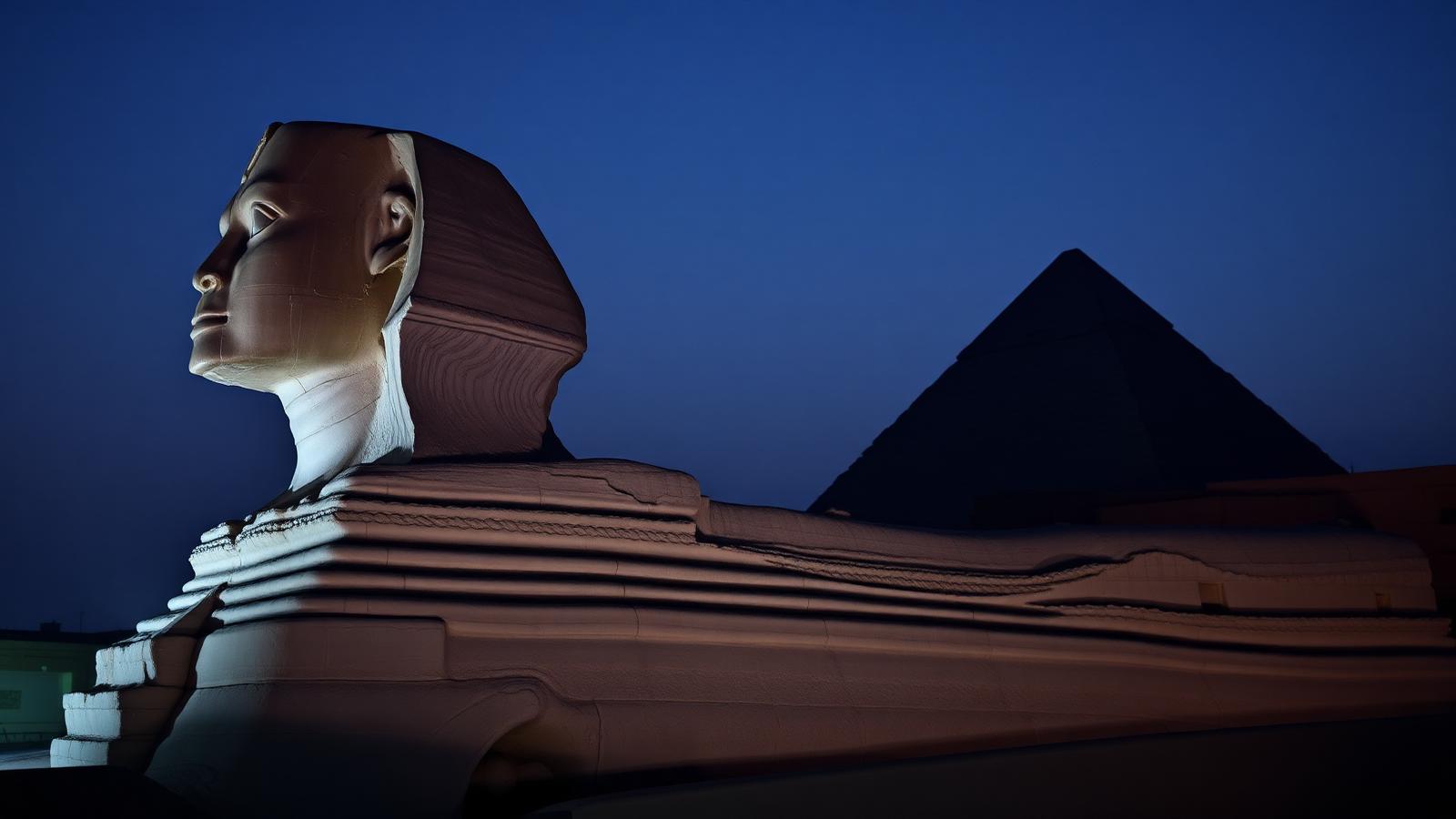
The Great Sphinx of Giza in raking light, weathering visible along its enclosure walls
Evidence File 03Active Academic Debate

Great Sphinx

Giza, Egypt · c. 2500 BCE (consensus)

When was the Sphinx carved, and what caused the weathering on its enclosure walls?

Chicago style · PDF or .txt

Everything about the Sphinx is agreed except its birthday. The dating argument is a geology argument wearing an archaeology costume, and it has never been resolved on the terms either side would accept.

The Sphinx enclosure. The argument is about what cut those channels, and how fast.

Historical record

No contemporary inscription names its builder; the Dream Stele is roughly a thousand years later.

Current scientific consensus

Fourth Dynasty, most often attributed to Khafre on architectural and contextual grounds.

The conventional dating

Mainstream Egyptology assigns the Sphinx to Khafre's Fourth Dynasty building programme, roughly 2500 BCE. The case is contextual: the monument sits inside a quarry that supplied his pyramid, the causeway alignment integrates with his complex, and the associated temple architecture matches the period's construction methods block for block.

The weathering challenge

A minority position argues that the vertical, rounded channels in the enclosure walls indicate prolonged rainfall erosion, which would push the carving back to a wetter North African climate — thousands of years earlier. The counter-argument is that the enclosure is cut through alternating hard and soft limestone members, that salt weathering and haloclasty produce similar profiles, and that comparable channels appear on securely dated Old Kingdom tombs nearby.

This is a genuine disagreement between disciplines rather than a fringe claim, and it is stuck for a specific reason: weathering rates are not a clock. Without an independent date on the carved surface itself, the geology can be read either way.

What is not in dispute

There is no archaeological horizon at Giza — no settlement, no tools, no burials, no ceramics — for a civilisation capable of monumental stone carving thousands of years before the Old Kingdom. A much older Sphinx requires not just an older monument but an older society, and that society has left nothing else. That absence is the strongest argument in the conventional case.

Competing interpretations

Weathering reflects salt and wind action on variable limestone layers.

Scientific Consensus
80% support

The mainstream position across the relevant scientific literature today.

Water erosion indicates a far older, pre-dynastic date.

Speculative Theory
10% support

Proposed but unsupported by accepted evidence. Reported, never endorsed.

Support scores reflect the strength of the evidence class behind a claim, not how often you have heard it. Speculative entries appear because readers encounter them — never because we endorse them.

The dossier
Chicago style · PDF or .txt
The evidence base

A monument carved from bedrock rather than assembled from dated blocks, its enclosure walls, the causeway and temples beside it, and the geology of the limestone itself.

How it is dated

Each row states the method, what was measured, and — the part usually skipped — what the result does not settle.

MethodSampleResultWhat it constrains
Architectural associationSphinx temple, causeway and the Khafre pyramid complexConstruction consistent with the Fourth Dynasty complex it is integrated intoTies the monument to a building programme. It does not date the stone directly, because carved bedrock cannot be radiocarbon dated.
Quarry and block correlationCore blocks in the adjacent temples against the enclosure the Sphinx sits inTemple blocks match stone removed from the Sphinx enclosureLinks carving and temple construction to the same operation.
Weathering analysisErosion profiles on the enclosure wallsVertical fissuring some read as rainfall-drivenDescribes weathering pattern. Attributing it to one climate regime requires excluding salt, groundwater and layered rock hardness.
Competing readings, scored

The percentage is our editorial reading of how much of the surviving record each claim accounts for. It is a judgement, stated openly, not a consensus figure.

  • Carved during the Fourth Dynasty as part of the Giza complex.

    Consensus
    Explains the record84%
    Rests on
    • Physical integration with the causeway and temples of the same complex.
    • Quarry debris and construction sequence tie the works together.
    Runs into
    • No contemporary inscription names the builder explicitly.
  • A far older monument, later reworked, indicated by rainfall erosion.

    Open Debate
    Explains the record18%
    Rests on
    • The enclosure weathering pattern differs from nearby tombs of assumed same age.
    Runs into
    • The limestone beds differ in hardness, which alone produces differential weathering.
    • A pre-dynastic culture capable of the work leaves no other trace at Giza.
  • A lost civilisation built it before the last glacial ended.

    Speculative
    Explains the record5%
    Rests on
    • Relies on the same erosion reading extended much further back.
    Runs into
    • Requires an entire missing material record: quarries, tools, settlement, waste.
Where to check us
  • Giza Plateau Mapping Project reports

    Ancient Egypt Research Associates

  • Sphinx geology and weathering debate literature

    KMT / geoarchaeology journals

What would change this
  • A securely dated occupation layer at Giza predating the Old Kingdom by millennia.

What the record supports

  • Causeway alignment with Khafre's complex
  • Geological layering of the enclosure
  • Absence of Old Kingdom attribution texts

What remains open

  • Can the carving be dated directly?
  • Was the head recarved later?
How this file was built

We treat the dating dispute as unresolved rather than dismissing it, and separate the geological observation (real) from the civilisational inference (unsupported by any other find at the site).

What would settle it
  • A direct absolute date on the carved bedrock surface
  • Excavation of a pre-Old-Kingdom occupation horizon on the Giza plateau
  • Controlled weathering-rate study on dated Giza limestone of the same members