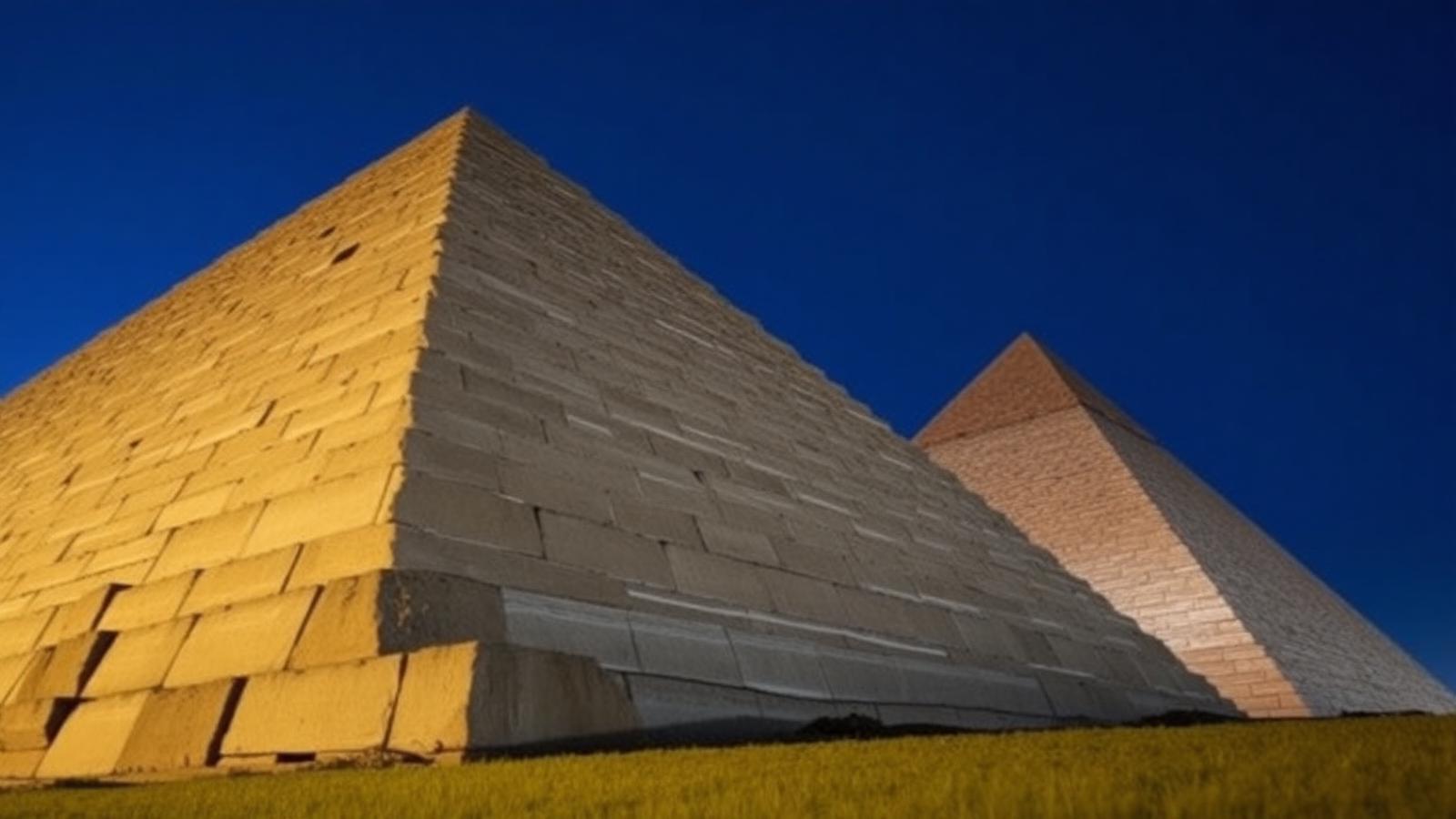
The Great Pyramid of Giza at low sun, its limestone courses in sharp relief
Evidence File 02Documented Historical Record

Great Pyramid

Giza, Egypt · c. 2560 BCE

How was a 2.3-million-block monument organized, supplied, and raised in roughly two decades?

Chicago style · PDF or .txt

The Great Pyramid is not a mystery about whether humans could build it. It is a mystery about scheduling — how a Bronze Age state moved 2.3 million blocks, fed the people who moved them, and finished inside a single reign.

Giza. The logistics problem is larger than the engineering problem, and better documented.

Historical record

The Merer papyri record limestone shipments to Giza; worker settlements and bakeries have been excavated.

Current scientific consensus

A state-organized project using paid, fed, rotating labor — not slaves — with ramps and levers.

The record we did not have until recently

In 2013 a French–Egyptian team excavating at Wadi al-Jarf on the Red Sea coast recovered the earliest inscribed papyri yet found in Egypt. Among them is the logbook of an official named Merer, who ran a boat crew ferrying fine limestone from Tura to Giza. It records journeys, crew sizes, and delivery cycles. It is an administrative document, not a monument inscription, and it is the closest thing to a project schedule that survives.

On the plateau itself, excavation at Heit el-Ghurab exposed bakeries, breweries, dormitory blocks, and cattle bone in quantities that indicate a fed, organised, rotating workforce. Gang graffiti inside relieving chambers name work crews. The picture is bureaucratic, not miraculous.


What remains contested

Ramp geometry. An external straight ramp long enough to reach the upper courses becomes absurdly large; a spiralling external ramp obstructs the corner sightlines needed to keep the structure true; an internal spiral ramp has been proposed on the basis of density anomalies and remains unconfirmed. Each version has advocates and each has a mechanical objection. No ramp survives in situ at Giza in a form that decides it.

The ScanPyramids muon-tomography programme identified a large void above the Grand Gallery. Its existence is now accepted; its function is not. It may be a construction relief space, a corridor, or a chamber. Nobody has been inside it.

Where the fringe claims fail

Proposals involving lost technology or non-human agency are not rejected because they are exotic. They are rejected because they make no prediction that the excavated evidence confirms and they ignore evidence that already exists: the quarries, the copper tool marks, the abandoned blocks, the workers' cemetery with healed fractures set by physicians. The unglamorous record is unusually complete.

Competing interpretations

Internal spiral ramp construction.

Active Academic Debate
48% support

Specialists disagree. Competing interpretations are presented side by side.

External straight or zigzag ramps.

Active Academic Debate
48% support

Specialists disagree. Competing interpretations are presented side by side.

Lost or exotic lifting technology.

Speculative Theory
10% support

Proposed but unsupported by accepted evidence. Reported, never endorsed.

Support scores reflect the strength of the evidence class behind a claim, not how often you have heard it. Speculative entries appear because readers encounter them — never because we endorse them.

The dossier
Chicago style · PDF or .txt
The evidence base

A standing structure, quarry and worker-settlement archaeology, and administrative papyri recovered at Wadi al-Jarf documenting stone transport.

How it is dated

Each row states the method, what was measured, and — the part usually skipped — what the result does not settle.

MethodSampleResultWhat it constrains
TextualWadi al-Jarf papyri, logistics of a limestone delivery teamRecords dated within the reign of KhufuDirect documentary evidence of Fourth Dynasty construction logistics.
RadiocarbonOrganic material in mortarOld Kingdom range, with scatter attributed to reused fuel woodConfirms the era. The scatter is a wood-age problem, not a date conflict.
Settlement archaeologyHeit el-Ghurab worker settlement, bakeries and rationsLarge organised labour force supplied by state provisioningSpeaks to workforce and supply, not to lifting method.
Competing readings, scored

The percentage is our editorial reading of how much of the surviving record each claim accounts for. It is a judgement, stated openly, not a consensus figure.

  • State-organised Fourth Dynasty construction using ramps, levers and river transport.

    Archaeological
    Explains the record92%
    Rests on
    • Contemporary administrative papyri describing stone shipments.
    • Quarries, harbour works and a provisioned labour settlement on site.
    Runs into
    • No single surviving ramp explains the full height; several designs remain possible.
  • A lost or non-Egyptian technology was required.

    Speculative
    Explains the record4%
    Rests on
    • Argues from the difficulty of the task rather than from evidence.
    Runs into
    • Every stage that has been tested — quarrying, transport, dressing — is reproducible with known Bronze Age methods.
    • The documentary and settlement record is Egyptian and contemporaneous.
Where to check us
  • The Wadi al-Jarf papyri (journal of the inspector Merer)

    Institut français d'archéologie orientale

    The oldest known inscribed papyri; direct logistics of Khufu's project.

  • Giza Plateau Mapping Project reports

    Ancient Egypt Research Associates

    Worker settlement, provisioning and site organisation.

What would change this
  • Physical remains of an internal or spiral ramp system would settle the method question.

What the record supports

  • Merer papyri (Wadi al-Jarf)
  • Heit el-Ghurab worker settlement
  • Quarry marks and gang graffiti

What remains open

  • What is inside the ScanPyramids 'Big Void'?
  • What was the exact ramp geometry?
How this file was built

Built on primary excavation publication and the Wadi al-Jarf papyri, with construction hypotheses weighted by whether they generate testable physical predictions. Muon-tomography findings are reported as instrument results, separately from their interpretation.

What would settle it
  • Direct inspection or imaging of the ScanPyramids void interior
  • An in-situ ramp foundation at Giza with datable material
  • Additional Merer-era administrative papyri covering the later construction phases