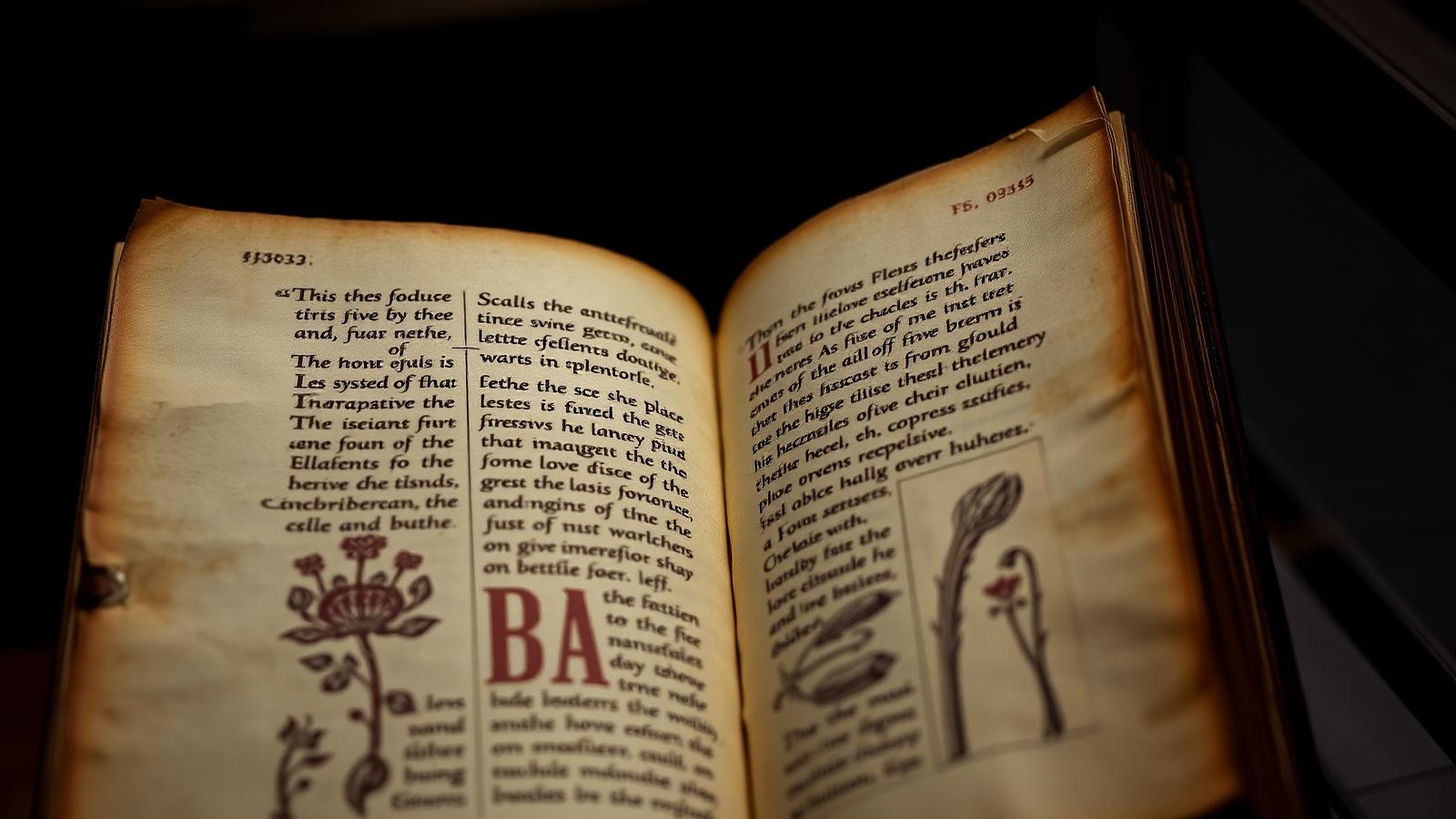
Open medieval vellum manuscript showing unfamiliar script and botanical drawings
Evidence File 15Active Academic Debate

Voynich Manuscript

Central Europe · c. 1404 – 1438 (vellum)

Is the Voynich text a real language, a cipher, or an elaborate fabrication?

Chicago style · PDF or .txt

The Voynich manuscript is the most tested undeciphered document in existence. Radiocarbon has dated the vellum, the inks have been analysed, cryptographers on both sides of the Second World War have failed on it, and a hundred solutions have been announced. None has held.

The manuscript is genuinely fifteenth century. What it says is the part nobody has established.

Historical record

Provenance traceable to the 17th century; vellum radiocarbon dated to the early 15th.

Current scientific consensus

Undeciphered. No proposed solution has been independently validated.

What is established

Radiocarbon dating of the vellum places its production in the early fifteenth century, roughly 1404–1438. Ink and pigment analysis is consistent with that period and shows no sign of modern materials. The physical object is not a nineteenth-century forgery by its rediscoverer — that hypothesis is closed.

The text has structure. Word-length distributions, entropy measurements and the presence of Zipf-like frequency behaviour indicate something more organised than random glyph-stringing. Sections are conventionally grouped by illustration type: herbal, astronomical, balneological, pharmaceutical, recipes.

Why every solution fails

Proposed decipherments — proto-Romance, abbreviated Latin, Hebrew anagram, Turkic, Nahuatl, and others — typically demonstrate a reading of a handful of words or a single page, then fail to extend. The test is simple and rarely passed: a real solution should decode arbitrary new passages into coherent, contextually appropriate text without new ad-hoc rules per line.

The plants are the other problem. Most are not identifiable with real species, which undermines any decipherment that depends on matching labels to a known herbal tradition.

The live hypotheses

Three remain reasonable. A natural language in an unknown script or heavy abbreviation. A constructed or cipher language. Or elaborate glossolalic nonsense produced for sale — which would still have to explain the statistical structure, and that is harder than it sounds.

Competing interpretations

An encoded natural language.

Active Academic Debate
48% support

Specialists disagree. Competing interpretations are presented side by side.

A constructed or synthetic language.

Active Academic Debate
48% support

Specialists disagree. Competing interpretations are presented side by side.

A meaningless hoax produced for sale.

Active Academic Debate
48% support

Specialists disagree. Competing interpretations are presented side by side.

Support scores reflect the strength of the evidence class behind a claim, not how often you have heard it. Speculative entries appear because readers encounter them — never because we endorse them.

The dossier
Chicago style · PDF or .txt
The evidence base

A single illustrated codex, radiocarbon-dated vellum, and a century of unsuccessful decipherment attempts recorded in print.

How it is dated

Each row states the method, what was measured, and — the part usually skipped — what the result does not settle.

MethodSampleResultWhat it constrains
RadiocarbonVellum leavesEarly fifteenth centuryDates the writing surface, not necessarily the moment the text was written.
Materials analysisInks and pigmentsConsistent with the period; no modern components identifiedWeighs heavily against a modern forgery.
Statistical linguisticsGlyph and word distributionsWord-length and entropy behaviour unlike ordinary European-language textConstrains what kind of system it can be; identifies no language.
Competing readings, scored

The percentage is our editorial reading of how much of the surviving record each claim accounts for. It is a judgement, stated openly, not a consensus figure.

  • An encoded or constructed-script text in a natural language.

    Open Debate
    Explains the record45%
    Rests on
    • Word structure shows language-like regularity rather than random glyphs.
    Runs into
    • A century of cryptanalysis, including by professional codebreakers, has failed.
  • A period hoax produced to be sold as an esoteric book.

    Open Debate
    Explains the record35%
    Rests on
    • The statistical profile can be reproduced by known generation techniques of the era.
    • The illustrations depict no identifiable real plants in most cases.
    Runs into
    • The labour and cost of the vellum are high for a bluff.
  • A specific named language has been decoded.

    Speculative
    Explains the record5%
    Rests on
    • Announced repeatedly, in press releases more than in replication.
    Runs into
    • No proposed solution has produced consistent readings across the manuscript.
Where to check us
  • MS 408 digital facsimile and curatorial record

    Beinecke Rare Book & Manuscript Library, Yale University

  • Voynich statistical analyses

    Cryptologia and related journals

What would change this
  • Any proposed reading that produces coherent text across multiple unseen folios.

What the record supports

  • Radiocarbon dating of the vellum
  • Statistical entropy analyses
  • Ink composition studies

What remains open

  • Do the illustrations map to real plants?
  • Who commissioned it?
How this file was built

Physical dating and materials analysis are reported as settled. Decipherment claims are assessed by a single criterion: whether the method extends to unseen passages without new special-case rules.

What would settle it
  • A decipherment that generalises to arbitrary passages under independent verification
  • Identification of a related document in the same script
  • Provenance evidence for the manuscript's first century of existence
Across the archive

Where Voynich Manuscript connects to the rest of the ancient record — the worlds it belongs to, the chapters it sits in, the documents that record it, and the questions still open.