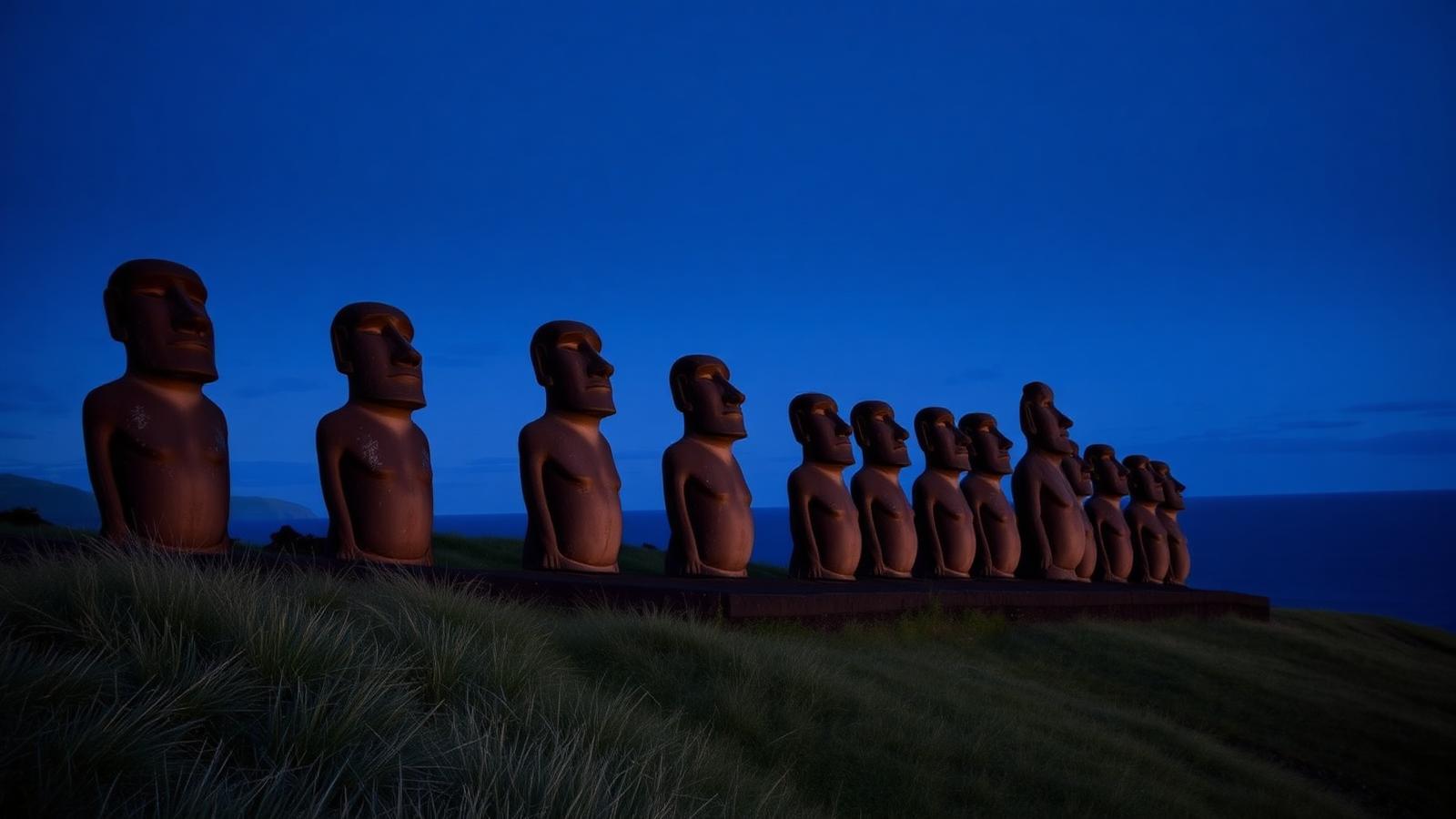
A row of moai statues silhouetted on a grassy ridge above the ocean at dusk
Evidence File 14Archaeological Evidence

Easter Island

Rapa Nui, Pacific · c. 1200 – 1600 CE

Did Rapa Nui society collapse from self-inflicted ecological failure, or is that narrative wrong?

Chicago style · PDF or .txt

For thirty years Rapa Nui served as the standard parable of self-inflicted ecological collapse. A large body of subsequent work has taken that story apart, and what replaced it is more interesting and far less comfortable for the people who told it.

Rapa Nui. The collapse narrative has aged worse than the statues.

Historical record

Oral tradition plus European contact accounts from 1722 onward.

Current scientific consensus

Deforestation is documented; the 'ecocide collapse' framing is now heavily contested.

The moai and how they moved

Nearly a thousand statues were carved, mostly from volcanic tuff at the Rano Raraku quarry, and transported across the island. Experimental work has demonstrated upright 'walking' transport using ropes and coordinated teams, consistent with island oral tradition that the moai walked. The base geometry of transport-phase statues supports it. Prone log-rolling remains a competing method for some cases.

What undid the collapse story

Deforestation is real: the island's palm forest was lost. But the causal chain matters. Polynesian rats, introduced with settlement, consumed palm seeds at a rate that alone accounts for much of the failure to regenerate. Meanwhile, radiocarbon evidence points to later settlement than the older model assumed, and obsidian hydration and land-use data suggest a stable, adapting population rather than a pre-contact crash.

Rock gardens — lithic mulching — show sophisticated soil management in a degrading environment. This is a population engineering around a problem, not one blindly consuming itself.

The demographic catastrophe on Rapa Nui is well documented and it is post-contact: introduced disease and Peruvian slave raiding in the nineteenth century reduced the population to roughly a hundred people. Attributing the collapse to the islanders' own ecological failure moved the blame in a direction the evidence does not support.

Still contested

The precise settlement date, the pre-contact population ceiling, and how much of the ecological change was rats versus clearance remain actively argued. The direction of travel in the literature has been consistently away from the simple collapse model.

Competing interpretations

Rat predation on palm seeds drove deforestation.

Active Academic Debate
48% support

Specialists disagree. Competing interpretations are presented side by side.

Population decline followed European contact and slave raids.

Active Academic Debate
48% support

Specialists disagree. Competing interpretations are presented side by side.

Classic self-inflicted collapse before contact.

Active Academic Debate
48% support

Specialists disagree. Competing interpretations are presented side by side.

Support scores reflect the strength of the evidence class behind a claim, not how often you have heard it. Speculative entries appear because readers encounter them — never because we endorse them.

The dossier
Chicago style · PDF or .txt
The evidence base

Moai and quarry archaeology at Rano Raraku, pollen cores, faunal and palaeoenvironmental records, and post-contact documentary history.

How it is dated

Each row states the method, what was measured, and — the part usually skipped — what the result does not settle.

MethodSampleResultWhat it constrains
RadiocarbonSettlement and ceremonial contextsPolynesian settlement most securely placed in the early second millennium CELater than older estimates; compresses the statue-building window.
Pollen and sediment coresCrater lake sequencesPalm forest decline over centuriesShows deforestation happened. Attribution of cause is a separate argument.
ZooarchaeologyRat-gnawed palm seeds and faunal remainsIntroduced Pacific rat present through the deforestation windowSupplies a mechanism competing with human clearance alone.
Competing readings, scored

The percentage is our editorial reading of how much of the surviving record each claim accounts for. It is a judgement, stated openly, not a consensus figure.

  • Ecological collapse caused by human overexploitation before European contact.

    Open Debate
    Explains the record40%
    Rests on
    • Documented forest loss and the end of large-scale statue transport.
    Runs into
    • Population-crash timing does not fit cleanly before contact.
    • Rat predation on palm seed explains much of the forest loss.
  • A resilient society reduced primarily by contact-era disease and slave raiding.

    Open Debate
    Explains the record66%
    Rests on
    • Nineteenth-century raiding and epidemics are documented.
    • Evidence of sustained agricultural adaptation, including rock gardening.
    Runs into
    • Does not by itself explain the earlier cessation of monument building.
  • Statues were transported upright by rocking teams.

    Open Debate
    Explains the record55%
    Rests on
    • Experimental replication succeeded; oral tradition says the moai walked.
    Runs into
    • Prone transport with sledges remains viable for some road contexts.
Where to check us
  • Rapa Nui settlement and chronology papers

    Journal of Archaeological Science / PNAS

  • Rapa Nui heritage records

    UNESCO World Heritage Centre

What would change this
  • Higher-resolution population proxies spanning the pre- and post-contact boundary.

What the record supports

  • Obsidian hydration dating
  • Palm seed casings with rodent damage
  • Moai transport experiments

What remains open

  • What was peak population?
  • How were moai actually walked?
How this file was built

Follows the revised radiocarbon chronology and land-use studies rather than the earlier collapse synthesis. Population claims separate pre-contact and post-contact evidence explicitly.

What would settle it
  • Tighter radiocarbon constraint on initial settlement
  • Quantitative apportionment of deforestation between rat predation and clearance
  • Island-wide palaeodemographic modelling from dated occupation sites