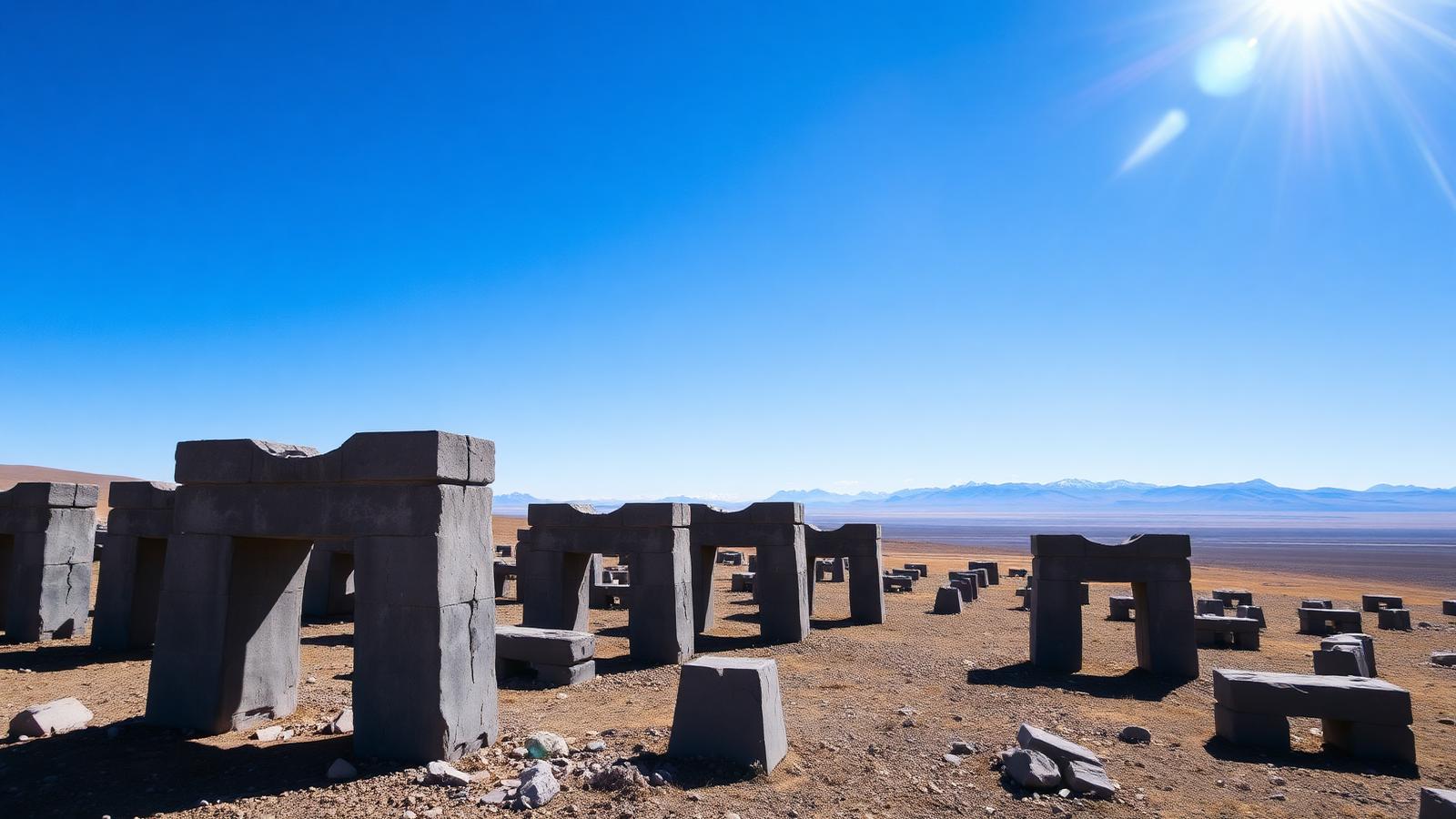
Precisely cut grey andesite H-blocks scattered across the Bolivian altiplano under a blue sky
Evidence File 12Archaeological Evidence

Puma Punku

Tiwanaku, Bolivia · c. 536 – 600 CE

How were interlocking andesite blocks cut to such tolerance without iron tools?

Chicago style · PDF or .txt

Puma Punku's H-blocks are cited endlessly as machining beyond ancient capability. The stonework is genuinely extraordinary. The inference drawn from it is not supported by the site itself, which preserves the unfinished blocks, the tool marks, and the quarries.

Puma Punku's modular blocks. The precision is real; the explanation is stone tools and a template.

Historical record

Pre-Columbian, no local writing; later Spanish accounts describe it already ruined.

Current scientific consensus

Tiwanaku stoneworking using hammerstones, abrasives, templates and skilled labor organization.

What is genuinely remarkable

The blocks are modular. Multiple andesite units share the same interior angles and dimensions to a tolerance that implies templates and standardisation rather than freehand carving. Some large slabs are red sandstone quarried roughly ten kilometres away and moved to a site nearly four kilometres above sea level. Metal cramps were poured in place to tie masonry together — an unusual and sophisticated technique.
How it was done

Andesite can be worked with harder hammerstones, abrasive sand, and time. Experimental work and the site's own unfinished pieces show the sequence: rough pecking, then grinding, then polishing. Tool marks survive. Reject blocks survive. Quarries with extraction faces survive. The chain of production is present, which is precisely what a machining hypothesis does not require and cannot explain away.

Dating places the complex in the Tiwanaku period, roughly the sixth to eleventh centuries CE. Claims of extreme antiquity rest on nineteenth-century astronomical arguments that have not survived scrutiny.

The open question

Not how, but why it stopped. The complex appears unfinished, and its destruction pattern — blocks scattered, cramps prised out — suggests deliberate dismantling as well as seismic damage and later stone-robbing. Whether the collapse of Tiwanaku was environmental, political, or both remains the substantive unresolved question here.

Competing interpretations

Standardized modular templates enabling repeatable forms.

Active Academic Debate
48% support

Specialists disagree. Competing interpretations are presented side by side.

Lost machining technology or outside intervention.

Speculative Theory
10% support

Proposed but unsupported by accepted evidence. Reported, never endorsed.

Support scores reflect the strength of the evidence class behind a claim, not how often you have heard it. Speculative entries appear because readers encounter them — never because we endorse them.

The dossier
Chicago style · PDF or .txt
The evidence base

Precisely cut andesite and sandstone blocks at a high-altitude Tiwanaku site, the surrounding platform architecture, and the quarries the stone came from.

How it is dated

Each row states the method, what was measured, and — the part usually skipped — what the result does not settle.

MethodSampleResultWhat it constrains
Radiocarbon on organic materialDeposits within and beneath the platform fillConstruction within the Tiwanaku sequence in the first millennium CEDates the fill and associated occupation, which brackets construction.
Petrographic sourcingAndesite and sandstone blocks matched to regional quarriesStone transported tens of kilometres from identified sourcesEstablishes supply routes and transport distance.
Tool-mark and metallurgy analysisCut surfaces, drill holes and recovered copper-alloy crampsMarks consistent with stone hammers, abrasives and cast metal cramps poured in placeDocuments a technique capable of the result. Production time and workforce remain estimates.
Competing readings, scored

The percentage is our editorial reading of how much of the surviving record each claim accounts for. It is a judgement, stated openly, not a consensus figure.

  • Tiwanaku construction using stone tools, abrasives, templates and metal cramps.

    Archaeological
    Explains the record86%
    Rests on
    • Quarries, unfinished blocks and cramp moulds are present in the region.
    • Repeated block geometry is consistent with template-based production.
    Runs into
    • No written record of the process survives from the builders.
  • The blocks were cast from a geopolymer rather than carved.

    Speculative
    Explains the record8%
    Rests on
    • The repetition of forms invites a mould explanation.
    Runs into
    • Petrography shows natural andesite structure, not a cast aggregate.
    • Quarry evidence with partly worked blocks exists.
  • Machining beyond the capability of the culture that lived there.

    Speculative
    Explains the record4%
    Rests on
    • Rests on the visual precision of the surfaces.
    Runs into
    • Experimental work reproduces the finish with abrasive techniques.
    • The claim requires discounting the site's own dated construction record.
Where to check us
  • Tiwanaku and Pumapunku excavation reports

    Latin American Antiquity / University of California

  • Andean stoneworking and metallurgy studies

    Journal of Archaeological Science

What would change this
  • Petrographic evidence that the blocks are artificial aggregate rather than quarried stone.

What the record supports

  • Tool marks under microscopy
  • Quarry sources within transport range
  • Experimental replication of H-blocks

What remains open

  • How were multi-ton blocks moved uphill?
  • What destroyed the complex?
How this file was built

Precision claims are assessed against published measurements rather than photographs. Construction claims are weighted toward evidence present on site: unfinished blocks, tool marks, quarry faces.

What would settle it
  • Published metrological survey of the H-block population
  • Securely dated evidence for the dismantling episode
  • Regional palaeoclimate work bracketing the Tiwanaku decline