Civilization Is Older, Stranger and More Complicated Than the Timeline We Learned
Monumental construction predates agriculture at some sites. That single fact broke a very tidy story about how civilization began.
By Erik Chambers
Founder, Creator & Editorial Architect
Built By
Editorial Operating System v1.0Creator
Erik Chambers
Architecture
Founder, Creator & Editorial Architect
AI Assisted
No
Human Reviewed
Pending
Evidence Reviewed
In progress
Last Updated
August 26, 2026
Confidence
Evergreen high/10
Research Status
Living investigation
We do not claim perfection. We promise transparency. Every investigation shows its work — the question, the evidence, the tools, the humans, and the updates.
DISCOVERY • ANCIENT CIVILIZATIONS & ORIGINS • EVIDENCE LAYER 5 OF 7
By Erik Chambers
Second City Standard
Ancient Civilizations & Origins • Discovery • 9 minute read
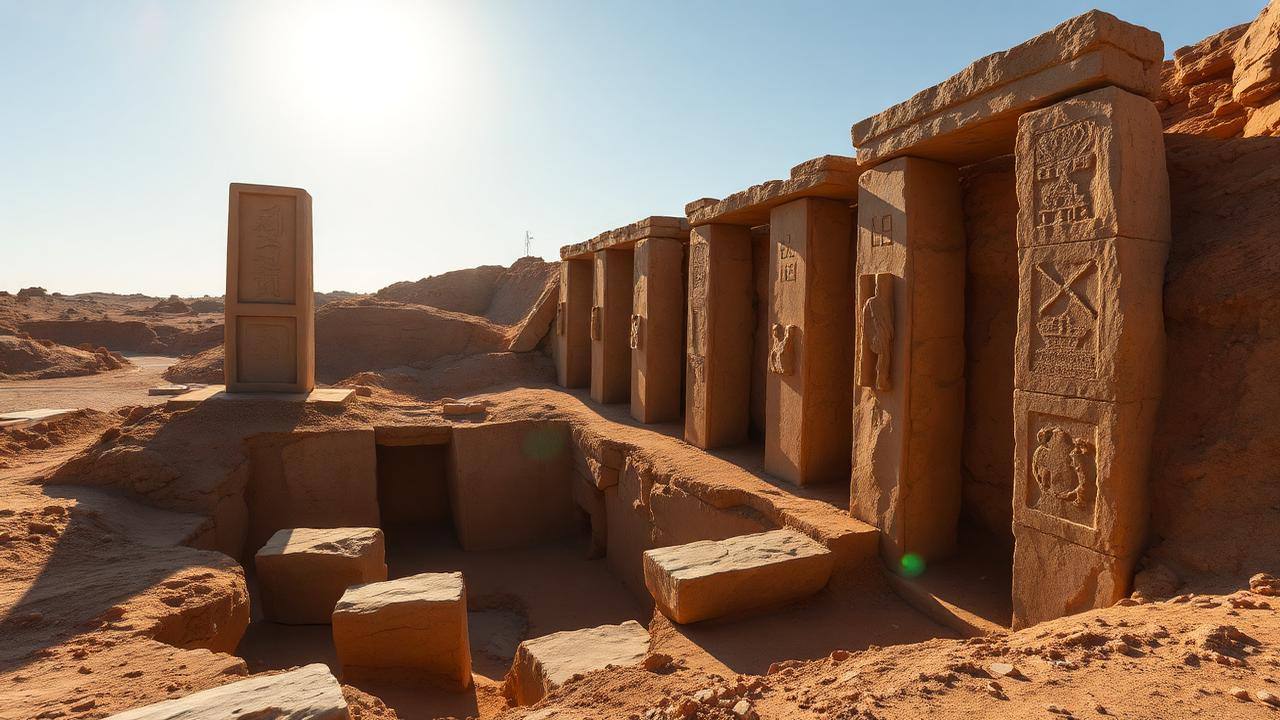
The textbook version was clean: people farm, farming produces surplus, surplus produces towns, towns produce temples, temples produce priests, priests produce writing. Cause, effect, tidy arrows. Then excavation at a hill in southeastern Turkey turned up carved limestone pillars up to five meters tall, arranged in enclosures, radiocarbon dated to roughly 11,600 years ago — built by people with no evidence of domesticated crops, no pottery, and no permanent city to speak of.
Göbekli Tepe did not prove a lost advanced civilization. It proved something more interesting and much harder to accommodate: hunter-gatherers organized large-scale monumental construction before agriculture, which means the arrows in the textbook diagram may point the other way at least some of the time.
The Question
This category asks how humans went from mobile foraging groups to settled communities, cities, states and record-keeping — and what combination of climate, ecology, technology and social decision made it happen where and when it did.
What the Data Says
Radiocarbon age of the oldest enclosures at Göbekli Tepe.
- Evidence
- Radiocarbon dating of construction fill and wall plaster.
- Confidence
- High
- Source
- German Archaeological Institute excavation reports.
Earliest securely dated crop domestication in the Fertile Crescent.
- Evidence
- Morphological change in cereal grains across dated occupation layers.
- Confidence
- High
- Source
- Peer-reviewed archaeobotany.
Age of the earliest known administrative writing (proto-cuneiform, Uruk).
- Evidence
- Clay tablets recording commodity quantities and personnel.
- Confidence
- High
- Source
- Museum and university cuneiform research collections.
A widely documented abrupt aridification event coinciding with several regional collapses.
- Evidence
- Speleothem, lake sediment and marine dust records across multiple continents.
- Confidence
- Moderate — event documented, causal link to collapse contested
- Source
- Peer-reviewed paleoclimatology.
What We Know
Agriculture was invented independently at least several times — in Southwest Asia, China, Mesoamerica, the Andes, New Guinea and parts of Africa — with different crops and different chronologies. Writing likewise emerged independently in Mesopotamia, China and Mesoamerica, and in the Mesopotamian case it began as accounting rather than literature, which is either deeply funny or deeply on brand for humanity.
Genetics has added a hard layer to what used to be pure inference. Ancient DNA from human remains now tracks population movement directly, documenting large-scale migrations into Europe from the Anatolian farming expansion and later from the Pontic steppe. Those are measured allele frequencies, not pottery-style guesses.
What We Think We Know
Why people settled remains contested. Climate stabilization at the end of the Pleistocene clearly opened the door; it does not explain why some groups walked through it and others, in equally favorable environments, did not for thousands of years. The "surplus first, ritual second" model is weaker than it used to be. Sites like Göbekli Tepe suggest large gatherings and shared construction may have driven food intensification rather than the reverse — a serious hypothesis with real support, not a settled fact.
What We Don't Know
Was monumental construction a cause of sedentism and agriculture, or a consequence?
- Evidence status
- Contested — chronology at key sites is good; causal direction is inferred.
- Source
- Peer-reviewed Neolithic archaeology.
Also open: how much coastal evidence was drowned by roughly 120 meters of post-glacial sea-level rise, which is a legitimate gap rather than a hidden conspiracy; and how many undeciphered scripts, such as the Indus Valley script, will ever be read.
Second City Standard maintains a hard line here. Our Book of Enoch project is an investigation of an ancient text: what it says, when it was written, which communities preserved it, and how it shaped later thought. That is historical and cultural evidence, and it is genuinely valuable.
It is not physical evidence that the events it describes occurred. "The text says X" and "material evidence demonstrates X" are separate claims requiring separate proof, and collapsing them is how credible ancient history turns into content. We keep those categories in separate rooms on purpose: Discovery for physical and scientific evidence, History & Ancient Texts for documents and cultural records, Investigations for the place where competing interpretations get compared.
The Second City Standard
This is where the evidence currently points: civilization was not a single invention with a single trigger, the chronology is older and lumpier than the school version, and the biggest revisions in the last thirty years came from better survey methods rather than from lost knowledge. The story got messier because the data got better. That is a good trade.
Connected Investigations
- Archaeology — How these dates are producedThe reasoning chain from object to claim.
- Geology — The clock under the sitesRadiometric dating and stratigraphy.
- Astronomy — What ancient people saw overheadSky observation as the first systematic dataset.
- History & Ancient Texts — The Book of Enoch projectTextual evidence, kept deliberately separate from physical evidence.
- Open the Ancient Civilizations hubEvery Second City Standard investigation in this category.
Editorial Transparency
This article contains a combination of reporting, publicly available research, and editorial analysis.
Analysis and interpretation. Facts are sourced; conclusions are the author's. Evidence before opinion — facts require sources, analysis requires transparency, opinions require labels.
Meet the creator
Erik Chambers
Founder, Creator & Editorial Architect
Erik originated the central idea, directed the investigation, reviewed the evidence, and approved the final published work.
Read the founder profile →Challenge This
We welcome disagreement
A different way to read the evidence. Research that points in another direction. Where specialists diverge.
Loading challenges…
Submit a challenge
Sign in to submit a challenge. All submissions are reviewed before appearing publicly.
Comments
Ask A Question
What would you ask an editor about this piece?
Reader questions feed our coverage map. The most-asked ones become our next investigations.
Continue Exploring
Guided by the evidenceWhere should this take you next?
Civilization Is Older, Stranger and More Complicated Than the Timeline We Learned
A composite 0–100 measure of how well this investigation meets the Second City Standard. Scores are auditable — every point comes from the criteria below.
Composite
—
of 100
This investigation is queued for editorial scoring. No score has been assigned yet — the absence of a number is not a judgment on the evidence.
The Standard
· Editorial verdictBased on the evidence presented,
Second City Standard believes Monumental construction predates agriculture at some sites. That single fact broke a very tidy story about how civilization began.
Remaining uncertainty: Awaiting a final written verdict from the editorial desk.
The Standard · Second City Standard
Continue The Investigation
· Never a dead endThis investigation is one thread. Pull the next one — every path below is another investigation, another question, or another discipline applied to the same problem.
Signal over noise.
One weekly dispatch. The best of 2ND CITY STANDARD, straight to your inbox.
No spam. Unsubscribe anytime.