Every Civilization Leaves Evidence. The Problem Is Reading It.
An artifact is data. Its meaning is an argument — and archaeology is mostly the discipline of keeping those two things apart.
By Erik Chambers
Founder, Creator & Editorial Architect
The Standard take
An artifact is data. Its meaning is an argument — and archaeology is mostly the discipline of keeping those two things apart.
Evidence rating: Emerging.
Key Findings
Evidence: Emerging- Archaeology is trying to reconstruct past human behavior from material remains.
- Practical upper limit of radiocarbon dating.
- Method has improved enormously, and most of the improvement is unglamorous.
DISCOVERY • ARCHAEOLOGY • EVIDENCE LAYER 4 OF 7
By Erik Chambers
Second City Standard
Archaeology • Discovery • 8 minute read
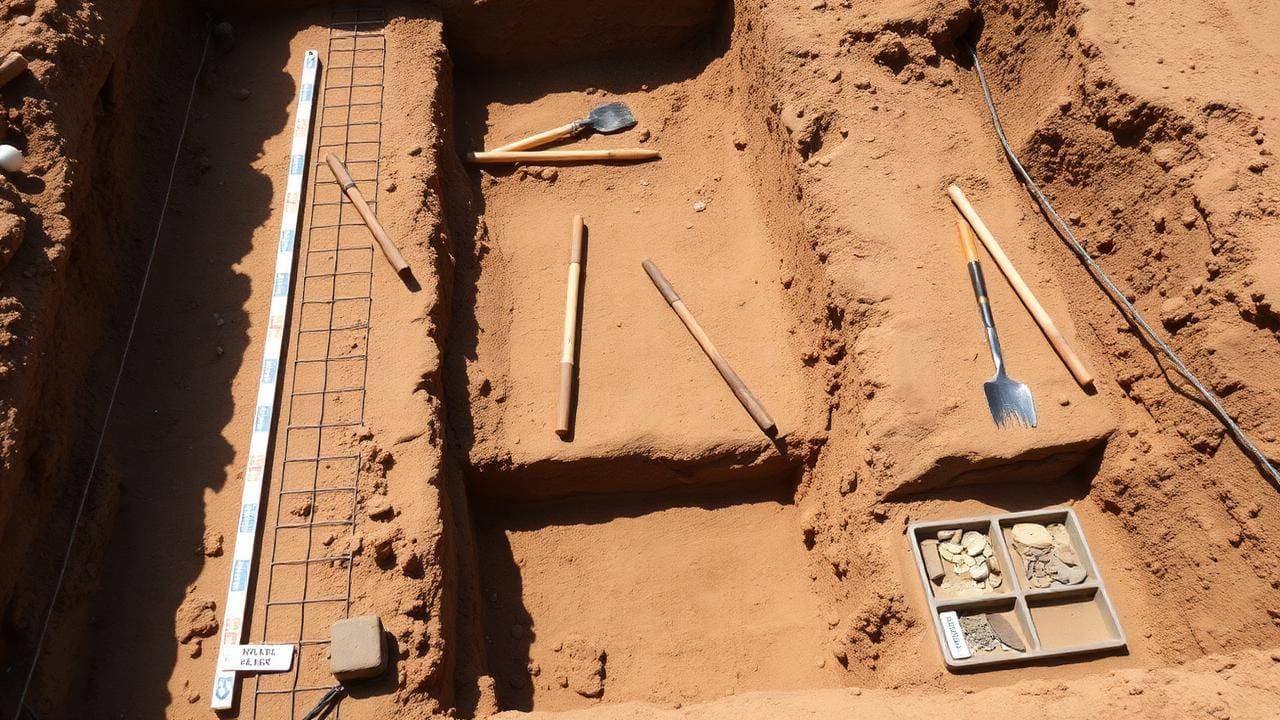
A ceramic bowl found in a burial can mean a funeral offering, a family heirloom, a trade good, a container someone dropped, or evidence that a later farmer plowed a field and moved things around. The bowl itself is not ambiguous. It is a fired clay object with measurable dimensions, a chemical fingerprint pointing to a clay source, and a position in the soil. Everything after that is inference.
Archaeology has one particularly annoying habit: every few decades somebody digs up something that forces everyone to rewrite a paragraph they were previously very confident about. That is not a failure of the discipline. It is the discipline working, in public, slowly, with dirt under its fingernails.
The Question
Archaeology is trying to reconstruct past human behavior from material remains. Not from what later chroniclers claimed. From objects, structures, residues, bones and the sediment they sit in — plus written records where they exist, treated as one more artifact rather than as an answer key.
What the Data Says
Practical upper limit of radiocarbon dating.
- Evidence
- Carbon-14 half-life of 5,730 years; usable signal across roughly 8–10 half-lives.
- Confidence
- Very High
- Source
- Peer-reviewed radiocarbon literature.
Maya structures mapped in a single Guatemalan LiDAR survey area.
- Evidence
- Airborne laser scanning penetrating dense forest canopy.
- Confidence
- High
- Source
- Science (2018) / PACUNAM LiDAR Initiative.
Age of hominin remains recovered from Sima de los Huesos, Spain.
- Evidence
- Uranium-series and paleomagnetic dating; nuclear DNA later recovered.
- Confidence
- High
- Source
- Peer-reviewed reports in Nature.
Layer position, not object style, is the primary dating control on a dig.
- Evidence
- Recorded section drawings, context sheets and find coordinates.
- Confidence
- Very High
- Source
- Standard excavation practice; Smithsonian and university field manuals.
What We Know
Method has improved enormously, and most of the improvement is unglamorous. Context recording means every find is logged with a three-dimensional position and a layer identity, because an artifact without context is a souvenir. Radiocarbon calibration curves, built from tree rings and other annually resolved records, correct raw dates into calendar years. Ancient DNA now recovers population relationships from bone and even from cave sediment. Remote sensing — LiDAR, ground-penetrating radar, satellite multispectral imagery — finds sites without a shovel, and has revealed settlement densities in Amazonia and Mesoamerica far higher than mid-century estimates allowed.
Those density findings are a good example of legitimate model revision: not "everything we knew was wrong," but "the survey method was blind to this, and now it isn't."
What We Think We Know
Function is where confidence drops. Archaeologists can say with high confidence that a structure was built around 3,000 BCE from timber cut locally. Whether it was a temple, a granary, a meeting hall or a very ambitious barn is interpretation, usually argued from analogy with other sites or with living cultures — a method that carries its own assumptions.
Absence is the other trap. Wood, textile, cordage and food rot. Stone and ceramic survive. The record is therefore biased toward durable materials and dry or frozen climates, which means "no evidence of X" often means "no evidence of X that could have survived here." Those are extremely different statements, and the second one rarely makes a headline.
What We Don't Know
What did most prehistoric symbolic objects and cave art actually mean to the people who made them?
- Evidence status
- Unresolved — the objects are documented; the belief systems behind them are not recoverable from material alone.
- Source
- Peer-reviewed archaeology and museum research departments.
Also unresolved: the timing and number of human migrations into the Americas, where dated sites keep pushing earlier and each new claim triggers a legitimate fight about contamination and site formation; and how much of any ancient population is represented by the tiny fraction of individuals whose remains we have.
The Second City Standard
Archaeology is the layer where physical evidence starts describing people, and it is where Second City Standard applies the sharpest distinction in this entire series: what the material demonstrates versus what a text or a tradition claims. Both are evidence. They are evidence of different things. A tablet proves someone wrote something; it does not prove the event described occurred.
This is where the evidence currently points: archaeological reasoning is strongest on chronology and construction, weaker on meaning, and most vulnerable when a spectacular interpretation outruns the context sheet. The best defense is boring — dates, layers, and a stated confidence level.
Connected Investigations
- Ancient Civilizations — The timeline keeps movingWhat happens when new sites break an established model.
- Geology — The dating frameworkStratigraphy and radiometric clocks under every site.
- Evolution — Before the objectsWhere biological evidence hands off to cultural evidence.
- Open the Archaeology hubEvery Second City Standard investigation in this category.
Built By
Editorial Operating System v1.0Creator
Erik Chambers
Architecture
Founder, Creator & Editorial Architect
AI Assisted
No
Human Reviewed
Pending
Evidence Reviewed
In progress
Last Updated
September 27, 2026
Confidence
Evergreen high/10
Research Status
Living investigation
We do not claim perfection. We promise transparency. Every investigation shows its work — the question, the evidence, the tools, the humans, and the updates.
Editorial Transparency
This article contains a combination of reporting, publicly available research, and editorial analysis.
Analysis and interpretation. Facts are sourced; conclusions are the author's. Evidence before opinion — facts require sources, analysis requires transparency, opinions require labels.
Meet the creator
Erik Chambers
Founder, Creator & Editorial Architect
Erik originated the central idea, directed the investigation, reviewed the evidence, and approved the final published work.
Read the founder profile →Challenge This
We welcome disagreement
A different way to read the evidence. Research that points in another direction. Where specialists diverge.
Loading challenges…
Submit a challenge
Sign in to submit a challenge. All submissions are reviewed before appearing publicly.
Comments
Ask A Question
What would you ask an editor about this piece?
Reader questions feed our coverage map. The most-asked ones become our next investigations.
Continue Exploring
Guided by the evidenceWhere should this take you next?
Part of a cluster
Origins Evidence
What does the material record actually support about the deep past?
See the whole clusterEvery Civilization Leaves Evidence. The Problem Is Reading It.
A composite 0–100 measure of how well this investigation meets the Second City Standard. Scores are auditable — every point comes from the criteria below.
Composite
—
of 100
This investigation is queued for editorial scoring. No score has been assigned yet — the absence of a number is not a judgment on the evidence.
The Standard
· Editorial verdictBased on the evidence presented,
Second City Standard believes An artifact is data. Its meaning is an argument — and archaeology is mostly the discipline of keeping those two things apart.
Remaining uncertainty: Awaiting a final written verdict from the editorial desk.
The Standard · Second City Standard
Continue The Investigation
· Never a dead endThis investigation is one thread. Pull the next one — every path below is another investigation, another question, or another discipline applied to the same problem.
One clear idea, once a week.
Get the strongest investigation, one useful tool, and one question worth carrying forward.
No fake urgency. No spam. Leave any time.