Evolution Isn't a Ladder — and Humans Were Never on Top
The evidence describes a branching, messy bush of relatives, most of which are dead. We are a surviving twig, not a summit.
By Erik Chambers
Founder, Creator & Editorial Architect
The Standard take
The evidence describes a branching, messy bush of relatives, most of which are dead. We are a surviving twig, not a summit.
Evidence rating: Emerging.
Key Findings
Evidence: Emerging- Evolutionary biology is trying to determine how populations of organisms change over time, what mechanisms drive that change, and how living and extinct species are related.
- Age of the earliest widely accepted microbial fossil evidence.
- Common descent is not in scientific dispute, and the reason is that four independent lines of evidence keep producing the same tree.
DISCOVERY • EVOLUTION • EVIDENCE LAYER 3 OF 7
By Erik Chambers
Second City Standard
Evolution • Discovery • 8 minute read
In 2010, a draft genome sequenced from a finger bone found in a Siberian cave produced a result nobody had ordered. The bone belonged to a population of humans that had never been named, never been described from anatomy, and existed in the scientific record only as a genome. The Denisovans were discovered by sequencing, not by digging — and their DNA is still carried today by people living in Oceania and parts of Asia.
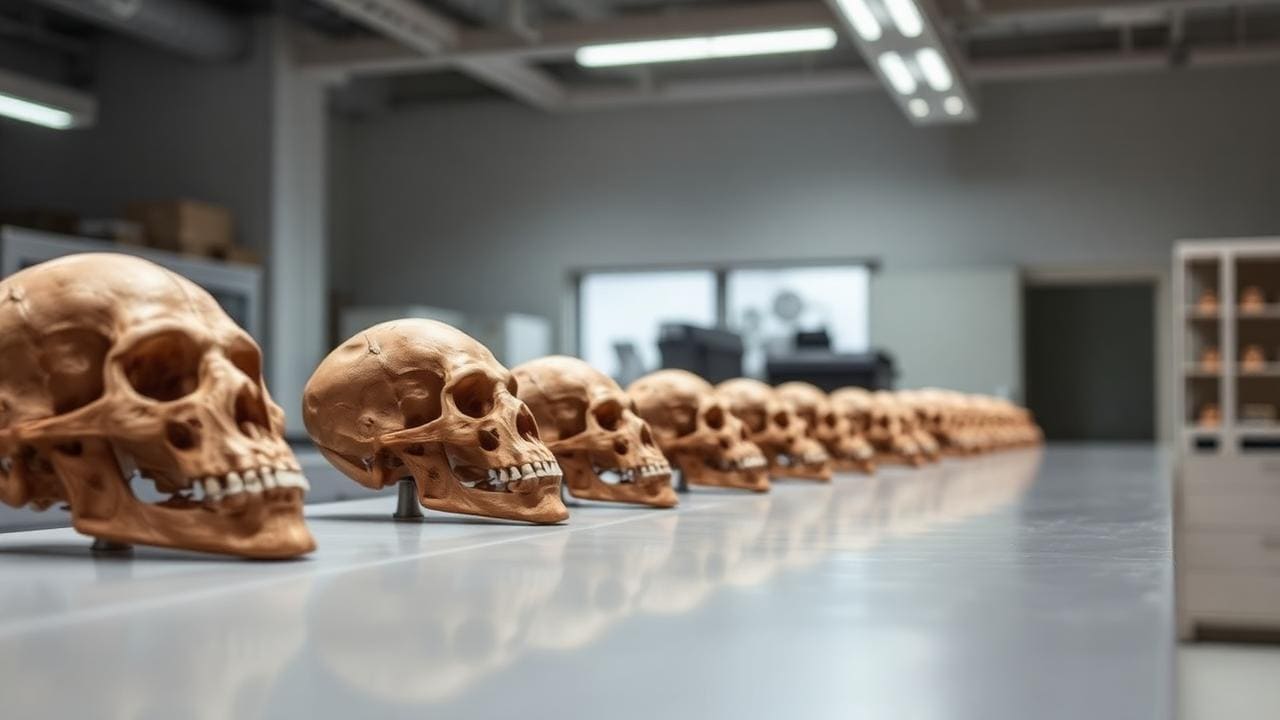
That single find should permanently retire the illustration everyone remembers from school: the tidy left-to-right parade from knuckle-walking ape to briefcase-carrying commuter. The evidence does not describe a parade. It describes a bush with a lot of dead branches, several of which were interbreeding with each other while doing it.
The Question
Evolutionary biology is trying to determine how populations of organisms change over time, what mechanisms drive that change, and how living and extinct species are related. That is the whole field. Not "where do we rank," which is a question about ego, not biology.
What the Data Says
Age of the earliest widely accepted microbial fossil evidence.
- Evidence
- Stromatolites and microfossils in Australian and Greenland formations.
- Confidence
- Moderate — interpretation debated
- Source
- Peer-reviewed paleobiology (Nature, PNAS).
Neanderthal-derived DNA in most non-African human genomes.
- Evidence
- Ancient genome sequencing and comparative population genetics.
- Confidence
- High
- Source
- Max Planck Institute for Evolutionary Anthropology / Science.
Named hominin species currently recognized in the fossil record.
- Evidence
- Comparative anatomy of dated fossil specimens.
- Confidence
- Moderate — species counts are contested
- Source
- Smithsonian Human Origins Program.
Estimated share of all species that ever existed which are now extinct.
- Evidence
- Fossil diversity modeling across the Phanerozoic.
- Confidence
- Moderate — modeled estimate
- Source
- Peer-reviewed paleontology.
What We Know
Common descent is not in scientific dispute, and the reason is that four independent lines of evidence keep producing the same tree. Comparative anatomy groups organisms one way. The fossil record, dated by the geology described in this series, orders them the same way. Molecular genetics — comparing DNA sequences between living species — reproduces that order again. So does biogeography, the distribution of species across continents that were themselves moving.
Natural selection is directly observable and measured routinely: antibiotic resistance in bacteria, pesticide resistance in insects, beak morphology in Galápagos finches tracked across drought years. These are not thought experiments. They are field measurements with error bars.
What We Think We Know
Specific relationships, however, move. Which australopithecine species leads to the genus Homo is an active argument. Whether a given fossil represents a new species or a variant of a known one is frequently a judgment call made from a partial jaw and three teeth. Ancient DNA has repeatedly overturned family trees built on anatomy alone — and ancient DNA itself degrades badly in warm climates, which biases the sample toward cold places.
Here is the honest framing: the framework is stable, the branch positions are provisional. Those are two different claims, and treating a revision of the second as a collapse of the first is the single most common misreading in popular science coverage.
What We Don't Know
Exactly how and where did life first emerge?
- Evidence status
- Unresolved — competing hydrothermal-vent and surface-pond models; no confirmed transitional chemistry.
- Source
- Peer-reviewed origin-of-life research (PNAS, Nature).
Why did Homo sapiens persist while every other hominin lineage did not?
- Evidence status
- Contested — climate, demography, social networks and chance are all proposed; none is demonstrated.
- Source
- Smithsonian and peer-reviewed paleoanthropology.
The Second City Standard
Evolution is the third evidence layer in this investigation for a reason. Geology supplies the clock. Earth Science supplies the changing conditions. Evolution describes what living systems did in response — and eventually produces the species that starts burying pottery for archaeologists to argue about.
This is where the evidence currently points: descent with modification is as well supported as anything in biology, the human branch is genuinely tangled, and the gaps are concentrated in origins and specific relationships rather than in the mechanism. The ladder was always a marketing decision. The bush is more interesting anyway.
Connected Investigations
- Geology — Rocks Are Earth's ReceiptsThe dating framework every fossil claim depends on.
- Earth Science — The system life adapts toExtinction and adaptation driven by planetary change.
- Archaeology — When a species starts leaving objectsWhere biological evidence hands off to cultural evidence.
- Open the Evolution hubEvery Second City Standard investigation in this category.
Built By
Editorial Operating System v1.0Creator
Erik Chambers
Architecture
Founder, Creator & Editorial Architect
AI Assisted
No
Human Reviewed
Pending
Evidence Reviewed
In progress
Last Updated
September 27, 2026
Confidence
Evergreen high/10
Research Status
Living investigation
We do not claim perfection. We promise transparency. Every investigation shows its work — the question, the evidence, the tools, the humans, and the updates.
Editorial Transparency
This article contains a combination of reporting, publicly available research, and editorial analysis.
Analysis and interpretation. Facts are sourced; conclusions are the author's. Evidence before opinion — facts require sources, analysis requires transparency, opinions require labels.
Meet the creator
Erik Chambers
Founder, Creator & Editorial Architect
Erik originated the central idea, directed the investigation, reviewed the evidence, and approved the final published work.
Read the founder profile →Challenge This
We welcome disagreement
A different way to read the evidence. Research that points in another direction. Where specialists diverge.
Loading challenges…
Submit a challenge
Sign in to submit a challenge. All submissions are reviewed before appearing publicly.
Comments
Ask A Question
What would you ask an editor about this piece?
Reader questions feed our coverage map. The most-asked ones become our next investigations.
Continue Exploring
Guided by the evidenceWhere should this take you next?
Part of a cluster
Origins Evidence
What does the material record actually support about the deep past?
See the whole clusterEvolution Isn't a Ladder — and Humans Were Never on Top
A composite 0–100 measure of how well this investigation meets the Second City Standard. Scores are auditable — every point comes from the criteria below.
Composite
—
of 100
This investigation is queued for editorial scoring. No score has been assigned yet — the absence of a number is not a judgment on the evidence.
The Standard
· Editorial verdictBased on the evidence presented,
Second City Standard believes The evidence describes a branching, messy bush of relatives, most of which are dead. We are a surviving twig, not a summit.
Remaining uncertainty: Awaiting a final written verdict from the editorial desk.
The Standard · Second City Standard
Continue The Investigation
· Never a dead endThis investigation is one thread. Pull the next one — every path below is another investigation, another question, or another discipline applied to the same problem.
One clear idea, once a week.
Get the strongest investigation, one useful tool, and one question worth carrying forward.
No fake urgency. No spam. Leave any time.