When the Model Misses the Player
A game played by people not spreadsheets
By Erik Chambers
Founder, Creator & Editorial Architect
The Standard take
A game played by people not spreadsheets
Evidence rating: Emerging.
Key Findings
Evidence: Emerging- By Erik Chambers Second City Standard Sports Intelligence • MLB Analysis
- Some athletes leave town without ever really leaving your head.
- Methodology: The Second City Intelligence Score is an internal editorial framework used to communicate the strength, relevance and historical importance of the article’s central question.
What this does not prove: limitations
SPORTS INTELLIGENCE • MLB ANALYSIS • CHICAGO BASEBALL
When the Model Misses the Player
By Erik Chambers
Second City Standard
Sports Intelligence • MLB Analysis
THE SECOND CITY QUESTION
Some athletes leave town without ever really leaving your head. You stop checking their box score every night, new prospects arrive, the front office gives another press conference about flexibility and roster construction, and eventually you convince yourself everybody moved on. Then one night the old guy shows up on national television and does something so ridiculously familiar that the entire emotional file gets reopened.
That was Kyle Schwarber at the 2025 Major League Baseball All-Star Game.
With the game tied after nine innings, Major League Baseball decided a normal baseball game apparently was not enough and unveiled the first swing-off in All-Star Game history. [MLB] Naturally, this bizarre new format found the one former Cub who has spent his entire career behaving as though baseballs personally insulted his family.
Schwarber homered on all three of his swings, won the tiebreaker for the National League and walked away with the Ted Williams All-Star Game Most Valuable Player Award. [MLB]
For Chicago fans, the whole thing felt new and completely familiar at the same time. We had never seen an All-Star Game end like that, but we absolutely knew the guy standing there swinging. This was the same Schwarber who made a habit of wandering into absurdly dramatic situations and looking more comfortable there than most people look ordering lunch.
It brought back the rookie who launched postseason baseballs onto parts of Wrigley Field nobody had previously considered seating areas. It brought back the hitter who tore both the ACL and LCL in his left knee during the opening week of 2016, missed the remainder of the regular season, then somehow returned for the World Series as if medical rehabilitation were merely an inconvenient scheduling conflict. [MLB]
And it brought back something else: that uncomfortable Chicago question we have been avoiding since the Cubs let him walk.
How did one of baseball’s smartest organizations look at Kyle Schwarber and decide the problem was Kyle Schwarber?
Some players fit the model. Others make the model explain what it missed.
SECOND CITY INTELLIGENCE SCORE
The Case at a Glance
| Category | Second City Score |
|---|---|
| Statistical Evidence | 9.5 / 10 |
| Historical Significance | 9.0 / 10 |
| Analytics Debate | 9.5 / 10 |
| Chicago Impact | 10 / 10 |
Methodology: The Second City Intelligence Score is an internal editorial framework used to communicate the strength, relevance and historical importance of the article’s central question. It is not an official MLB statistic, so nobody needs to call Elias Sports Bureau in a panic.
Schwarber’s 2016 regular season basically lasted long enough for Cubs fans to get excited and then immediately remember that being a Chicago sports fan is supposed to hurt.
During opening week, an outfield collision with Dexter Fowler tore both the ACL and LCL in Schwarber’s left knee. [MLB] The Cubs were beginning what would become the most important season in franchise history, and one of their most dangerous young hitters was suddenly gone.
That should have been the end of his year. It certainly looked like the end of his year. Instead, Schwarber spent months rehabbing, made a brief stop in the Arizona Fall League and was cleared in time for the World Series. [MLB]
Think about that for a second. His first real major-league at-bats in more than six months came in the World Series. Most people need three days to remember their password after vacation. Schwarber was being asked to recognize breaking balls from elite major-league pitching with a championship on the line.
He went 7-for-17, hit .412, reached base at a .500 clip and finished the World Series with a .971 OPS as the Cubs finally won the championship. [MLB]
.412
World Series batting average. [MLB]
.500
World Series on-base percentage. [MLB]
.971
World Series OPS. [MLB]
7-for-17
World Series hits and at-bats. [MLB]
The box score tells you what he did. It does not come close to explaining what it felt like watching it.
Every plate appearance started with the same thought: there is no possible way this guy can be ready. Then he would take a pitch just off the plate, work himself into a hitter’s count and line another ball somewhere inconvenient for Cleveland.
Eventually the disbelief turned into expectation, which may be the most Schwarber thing of all. He did something physically ridiculous so many times that Chicago eventually treated it like normal.
Schwarber’s Cubs career did not end with a dramatic trade, a goodbye tour or one of those press conferences where everyone pretends business decisions do not involve human beings. It ended with a transaction notice.
Following the pandemic-shortened 2020 season, Chicago non-tendered Schwarber and sent him into free agency at age 27. [MLB]
There was logic behind it. Schwarber had just hit .188 with a .308 on-base percentage, .393 slugging percentage and .701 OPS in 59 games. [MLB] His defensive fit was awkward, his arbitration salary was climbing and the Cubs were beginning to dismantle the championship core.
MLB reported that Schwarber earned $7.01 million in 2020 and was projected to make roughly $9 million to $10 million through arbitration in 2021. [MLB]
So yes, there was a spreadsheet case. Front offices love spreadsheet cases. Spreadsheets are wonderfully calm documents. They never remind you about that home run in October, they never yell from the bleachers and they definitely never ask why you just cut loose a 27-year-old left-handed power hitter.
The problem is that Chicago was evaluating Schwarber after one of the strangest seasons Major League Baseball had ever staged. The coronavirus pandemic shut down Spring Training, delayed Opening Day until late July and forced MLB into a 60-game regular-season schedule rather than the normal 162-game marathon. [MLB]
Schwarber appeared in 59 games during that 60-game season, while fans were prohibited from regular-season ballparks and clubs operated under extensive testing, travel and health restrictions. [MLB] [MLB] Calling that a normal evaluation environment would be like judging somebody’s driving ability during a tornado and then acting surprised when the insurance report looks weird.
Chicago nevertheless had to decide whether those 59 games represented a meaningful change in Schwarber’s long-term trajectory. That decision is the heart of this article: not whether the 2020 numbers existed—they obviously did—but how much confidence an organization should place in an unusual sample played under unprecedented conditions.
Fans, meanwhile, remembered something slightly different.
They remembered the 2015 postseason blast against St. Louis that landed atop Wrigley Field’s right-field video board. [MLB] They remembered the shredded knee and the impossible World Series comeback. They remembered a hitter whose presence changed the emotional temperature of the ballpark before he even swung.
Nostalgia is not a roster-construction strategy. I get it. You cannot build a championship team by asking everybody which former player gives them warm feelings.
But this was not a 36-year-old veteran whose bat speed had disappeared. This was a 27-year-old power hitter with an established track record, unusual plate discipline and obvious physical tools coming off the strangest season baseball had played in generations.
The Cubs correctly identified his weaknesses. The mistake was acting as though identifying a weakness automatically means you understand the player.
SECOND CITY DATA LAB
What Happened After Chicago
Then came the part that makes this uncomfortable.
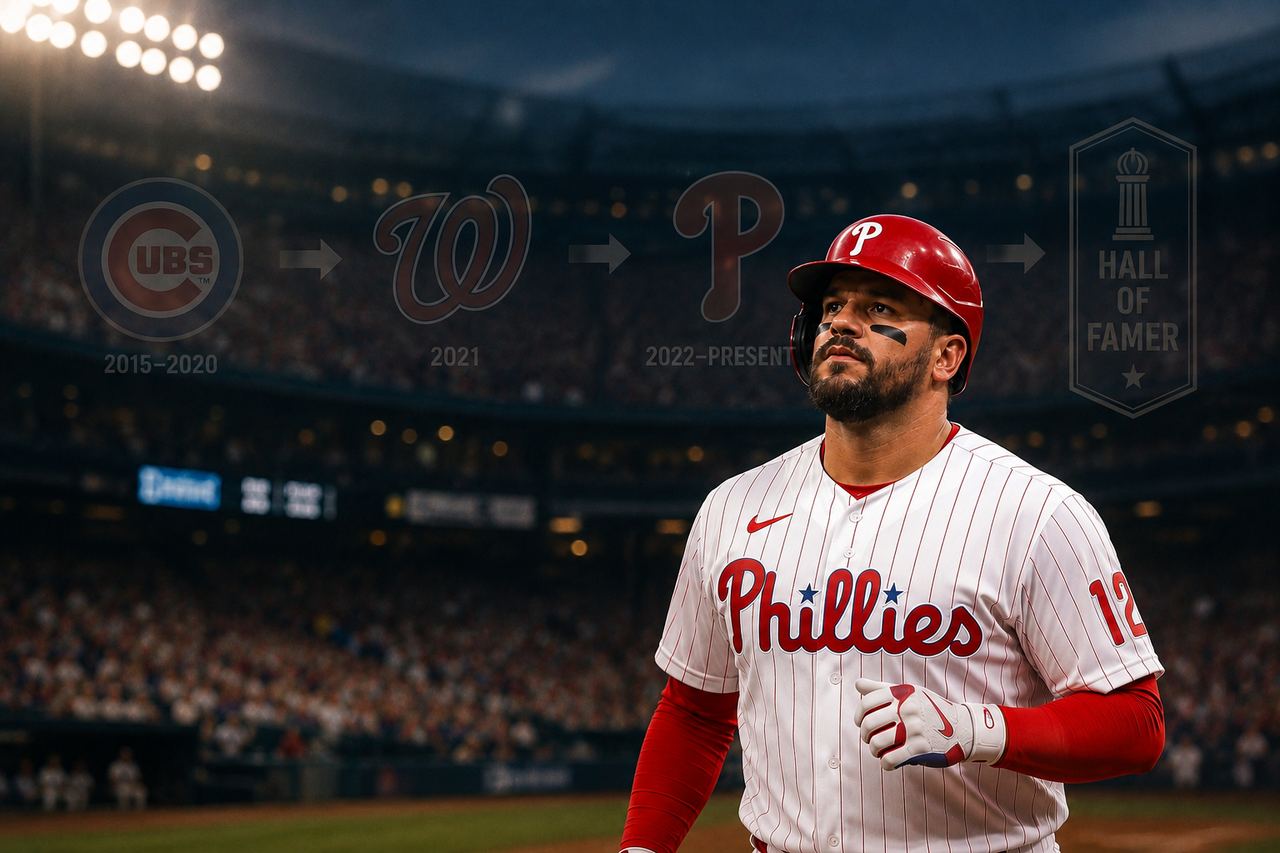
Washington signed Schwarber before the 2021 season. He earned his first All-Star selection that summer, was traded to Boston before the deadline as the Red Sox strengthened their playoff roster, and later signed a four-year, $79 million contract with Philadelphia. [MLB] [MLB]
The defensive limitations did not vanish. Nobody sprinkled magic defensive dust on him. His next organizations simply stopped demanding that the weakness define the entire player.
They leaned into what he did exceptionally well: draw walks, control the strike zone and hit baseballs hard enough to make outfielders reconsider their career choices.
| Season | Team | HR | OBP | SLG | OPS |
|---|---|---|---|---|---|
| 2020 | Cubs | 11 | .308 | .393 | .701 |
| 2021 | Nationals / Red Sox | 32 | .374 | .554 | .928 |
| 2022 | Phillies | 46 | .323 | .504 | .827 |
| 2023 | Phillies | 47 | .343 | .474 | .817 |
| 2024 | Phillies | 38 | .366 | .485 | .851 |
| 2025 | Phillies | 56 | .365 | .563 | .928 |
| Sources: MLB — Kyle Schwarber Official Player Record • Baseball Savant — Kyle Schwarber | |||||
The table is where Chicago’s decision begins to age like milk left on the back porch in August. Schwarber went from 11 home runs during the shortened 2020 season to 32 in 2021, then 46, 47, 38 and 56 over the following four seasons. [MLB]
From 2021 through 2025, Schwarber hit 219 regular-season home runs, an average of 43.8 per season based on those official yearly totals. [MLB]
In 2025, at age 32, he played all 162 games, led the National League with 56 home runs, led Major League Baseball with 132 RBIs, posted a .928 OPS and finished with a 150 OPS+. [MLB]
An OPS+ of 150 means his adjusted offensive production was 50 percent better than league average after accounting for context. [MLB GLOSSARY]
This was not merely a pleasant second chapter for a former Cub. It became one of the most productive power-hitting stretches in baseball, which is slightly more irritating when you remember Chicago received exactly zero home runs from him after deciding it no longer needed the headache.
There is a special type of Chicago sports experience where you genuinely enjoy watching a former player succeed while simultaneously wondering whether your own team misplaced the instruction manual. Schwarber has provided several years of that experience.
This is where the Schwarber story gets more interesting than the usual old-school-versus-analytics argument.
Analytics did not fail to recognize Kyle Schwarber’s power. Modern analytics actually explain Schwarber better than traditional statistics ever did.
In 2025, he hit .240 while posting a .365 on-base percentage, .563 slugging percentage, 56 home runs and a .928 OPS. [BASEBALL SAVANT]
If all you look at is batting average, .240 does not scream superstar. If you look at the rest of the offensive profile, the picture changes immediately.
That is exactly what advanced metrics are supposed to do. They pull us away from lazy shorthand and toward a more complete description of value.
The failure was not that the numbers were wrong.
The failure was in how the numbers were interpreted.
Chicago saw an awkward defender, a rough shortened season and an increasing salary obligation. Those were real things. But somebody still had to decide how much those things mattered compared with rare power, plate discipline, age and the possibility of a different role.
What Analytics Measured
Power. On-base ability. Strike-zone discipline. Expected production. Run creation. Batted-ball quality.
What Still Required Judgment
Whether 59 games represented a new baseline. Whether his defensive limitations could be managed. Whether his strengths were rare enough to justify designing the roster around them.
Algorithms did not non-tender Kyle Schwarber.
People did.
The computer handed them information. Human beings decided which information scared them the most.
That distinction matters, because blaming analytics for every bad transaction is about as useful as blaming a calculator because somebody typed in the wrong equation.
The Batting Average Trap
Schwarber has always annoyed people who prefer baseball statistics to fit neatly on the back of a card.
In 2023, Schwarber hit .197 while also producing 47 home runs, 126 walks, a .343 on-base percentage and 108 runs. [MLB]
That .197 average looks terrible. And if the entire objective of hitting were collecting singles frequently enough to impress somebody’s grandfather, we could probably end the discussion right there.
But batting average only measures hits divided by official at-bats. [MLB GLOSSARY] It does not count walks, and it treats a softly hit infield single exactly the same as a missile off the wall.
Schwarber is not proof that statistics lie.
He is proof that bad statistics used lazily can make smart people say dumb things.
SECOND CITY PRESSURE INDEX
The word clutch makes analytic people itchy, and there are legitimate reasons for that. Postseason sample sizes are small. Opportunities are unequal. Memory is biased toward drama.
Fine.
But at some point, when a guy keeps hitting enormous home runs in October, we should probably stop acting like everybody in Chicago hallucinated the same thing.
23
Career postseason home runs through 2025. [MLB]
Tied for Third
Position on MLB’s career postseason home-run list through 2025. [MLB]
119.7 MPH
Exit velocity of his 2022 NLCS home run. [MLB STATCAST]
488 FT
Statcast-projected distance of that home run. [MLB STATCAST]
His 2022 National League Championship Series homer against San Diego left the bat at 119.7 mph and traveled a Statcast-projected 488 feet. [MLB STATCAST]
That does not scientifically prove a supernatural clutch gene.
It does prove the baseball was extremely unhappy.
More importantly, it demonstrates that the folklore around Schwarber is not purely nostalgia. There is measurable evidence behind the moments people remember.
SECOND CITY FILM ROOM
The Cubs did not miss the flaws. They saw them perfectly well. Schwarber hit .188 in 59 games in 2020. [MLB] His defense was limited, his salary was increasing and Chicago was reassessing the roster.
Then came the decision: Chicago non-tendered him after the season. [MLB]
What changed afterward was not the existence of Schwarber’s limitations. Other teams simply used him differently. They emphasized the bat. They leaned into his on-base ability. They accepted that a player can be extraordinarily valuable without satisfying every traditional roster expectation.
From 2021 through 2025, Schwarber hit at least 30 home runs every season. [MLB]
That is the part worth studying.
Winning teams are not built from nine perfect baseball robots produced in the same laboratory. They are collections of imperfect players whose strengths fit together.
Schwarber is not a failed five-tool outfielder.
He is an extraordinarily successful version of Kyle Schwarber.
That sounds obvious now. Apparently it was less obvious when Chicago had him.
THE STANDARD
What Should Baseball Learn?
The easy version of this argument is that the Cubs got too analytical and ignored what everybody could see.
I do not think that is what happened.
The better lesson is that no measurement system eliminates judgment. Analytics can tell you what happened, estimate what may happen next and expose things the naked eye misses. They cannot decide how much risk an organization should tolerate or whether an unusual player deserves an unusual role.
Scouts can be biased. Executives can be biased. Models can contain assumptions built by people who are also biased. Welcome to humanity.
The answer is not to choose one side and declare victory.
The answer is to make them challenge each other.
When a scout says a player feels special, the data should test it. When the model says a player has a serious weakness, the baseball people should ask whether that weakness is actually fatal or merely inconvenient.
Baseball does not have too many numbers.
It has too many people pretending numbers remove the need to think.
Kyle Schwarber’s career is not an argument for throwing Statcast into Lake Michigan.
It is an argument for understanding what the numbers are actually telling you.
Modern metrics explain Schwarber beautifully. They show why batting average never captured his full value, why his power is elite, why walks matter and why an imperfect player can still be an extraordinary offensive weapon.
What they could not do was make the decision for Chicago.
Schwarber was the wide-eyed rookie who deposited a postseason home run on top of the Wrigley Field video board. [MLB] He was the injured slugger who returned from a torn ACL and LCL in time for the World Series and hit .412. [MLB]
Then he became the ex-Cub who developed into one of baseball’s most prolific postseason home-run hitters and eventually won the 2025 National League home-run crown. [MLB] [MLB]
And when Major League Baseball invented a strange All-Star Game tiebreaker and gave him three swings, Schwarber did exactly what anyone who watched him in Chicago should have expected.
He hit three home runs. [MLB]
No spreadsheet betrayed the Cubs.
No evil algorithm stole Kyle Schwarber from Chicago.
A baseball organization looked at an incomplete picture, decided it understood the entire player and moved on.
The player kept evolving.
The explanation arrived later.
Evidence should guide the evaluation. It should never become an excuse to stop looking.
SET THE STANDARD
Would you have kept Kyle Schwarber, traded him or made the same decision Chicago made?
Share the article and tell us whether the Cubs misread the player—or simply made a defensible decision that aged terribly.
JOIN THE SECOND CITY STANDARD
Get evidence-driven sports analysis, performance science, Chicago perspective and the stories hiding behind the statistics.
No manufactured outrage. No recycled debate-show nonsense. Better questions, better evidence and the human story behind the numbers.
More From Second City Standard
Is Pete Crow-Armstrong Building One of Baseball’s Greatest Center-Field Careers?
Defense, development and the evidence behind Chicago’s emerging center fielder.
WAR: What Is It Good For?
Does individual WAR predict team success—or measure something narrower than fans are usually told?
Explore Sports Science
How physics, biomechanics, psychology and data shape athletic performance.
Sources
- Major League Baseball reporting on Schwarber’s All-Star Game MVP performance.
- Major League Baseball reporting on the All-Star Game swing-off.
- Chicago Cubs announcement of Schwarber’s draft selection.
- Major League Baseball reporting on Schwarber’s knee injury.
- Major League Baseball reporting on Schwarber’s recovery and World Series return.
- Major League Baseball review of Schwarber’s World Series performance.
- Major League Baseball review of the 2020 non-tender decisions.
- Major League Baseball reporting on Chicago’s post-2020 roster and Schwarber arbitration context.
- Major League Baseball reporting on the pandemic-shortened 60-game 2020 season.
- Major League Baseball guide to the altered rules, health procedures and schedule used during the 2020 season.
- Major League Baseball retrospective noting that fans were not permitted in regular-season ballparks during 2020.
- Chicago Cubs / MLB review of Schwarber’s 2015 postseason scoreboard home run.
- Major League Baseball reporting on Schwarber’s trade from Washington to Boston.
- Major League Baseball reporting on Schwarber’s contract with Philadelphia.
- Kyle Schwarber’s official Major League Baseball player record.
- Baseball Savant statistical and Statcast record for Kyle Schwarber.
- Major League Baseball’s 2025 regular-season statistical leaders.
- Major League Baseball review of Schwarber’s 2025 season.
- Major League Baseball postseason home-run leaderboard.
- Major League Baseball Statcast reporting on Schwarber’s 2022 NLCS home run.
- Major League Baseball glossary explanation of OPS+.
- Major League Baseball glossary explanation of batting average.
OUR EDITORIAL STANDARD
Evidence Before Opinion
Second City Standard clearly separates documented facts, measured performance and editorial interpretation so readers can see how the argument was built.
We prioritize primary league records, official databases and clearly identified historical sources when verifying factual claims.
Analysis represents the author’s interpretation of that evidence and is not presented as an official league conclusion.
We do not chase the hot take. We examine the evidence, ask the better question and set the standard.
Erik Chambers
Erik Chambers is the founder and lead creator of Second City Standard. His work examines sports through competition, coaching, history, performance science, analytics and the occasionally painful experience of being a Chicago sports fan.
Second City Standard was created to ask better questions about the athletes, decisions and systems that shape how sports are understood.
Built By
Editorial Operating System v1.0Creator
Erik Chambers
Architecture
Founder, Creator & Editorial Architect
AI Assisted
No
Human Reviewed
Pending
Evidence Reviewed
In progress
Last Updated
September 27, 2026
Confidence
Evergreen medium/10
Research Status
Living investigation
We do not claim perfection. We promise transparency. Every investigation shows its work — the question, the evidence, the tools, the humans, and the updates.
Editorial Transparency
This article contains a combination of reporting, publicly available research, and editorial analysis.
Analysis and interpretation. Facts are sourced; conclusions are the author's. Evidence before opinion — facts require sources, analysis requires transparency, opinions require labels.
Meet the creator
Erik Chambers
Founder, Creator & Editorial Architect
Erik originated the central idea, directed the investigation, reviewed the evidence, and approved the final published work.
Read the founder profile →Challenge This
We welcome disagreement
A different way to read the evidence. Research that points in another direction. Where specialists diverge.
Loading challenges…
Submit a challenge
Sign in to submit a challenge. All submissions are reviewed before appearing publicly.
Comments
Ask A Question
What would you ask an editor about this piece?
Reader questions feed our coverage map. The most-asked ones become our next investigations.
Continue Exploring
Guided by the evidenceWhere should this take you next?
Part of a cluster
Baseball Value
What is a baseball player actually worth, and who decides?
See the whole clusterWhen the Model Misses the Player
A composite 0–100 measure of how well this investigation meets the Second City Standard. Scores are auditable — every point comes from the criteria below.
Composite
—
of 100
This investigation is queued for editorial scoring. No score has been assigned yet — the absence of a number is not a judgment on the evidence.
The Standard
· Editorial verdictBased on the evidence presented,
Second City Standard believes A game played by people not spreadsheets
Remaining uncertainty: Awaiting a final written verdict from the editorial desk.
The Standard · Second City Standard
Continue The Investigation
· Never a dead endThis investigation is one thread. Pull the next one — every path below is another investigation, another question, or another discipline applied to the same problem.
One clear idea, once a week.
Get the strongest investigation, one useful tool, and one question worth carrying forward.
No fake urgency. No spam. Leave any time.