Are Primates Entering the Stone Age?
Capuchins, chimpanzees and macaques are using tools, passing down traditions and leaving archaeological records behind. What does that tell us about the origins of human intelligence?
By The Standard
The Standard take
Capuchins, chimpanzees and macaques are using tools, passing down traditions and leaving archaeological records behind. What does that tell us about the origins of human intelligence?
Key Findings
- Any serious comparison has to begin with a fact that still somehow starts arguments: humans are primates.
- The bearded capuchins of Brazil are where the primate Stone Age idea becomes difficult to dismiss as a clever headline.
- Chimpanzees strengthen the argument because their technological behavior is broader and their archaeological record extends thousands of years into the past.
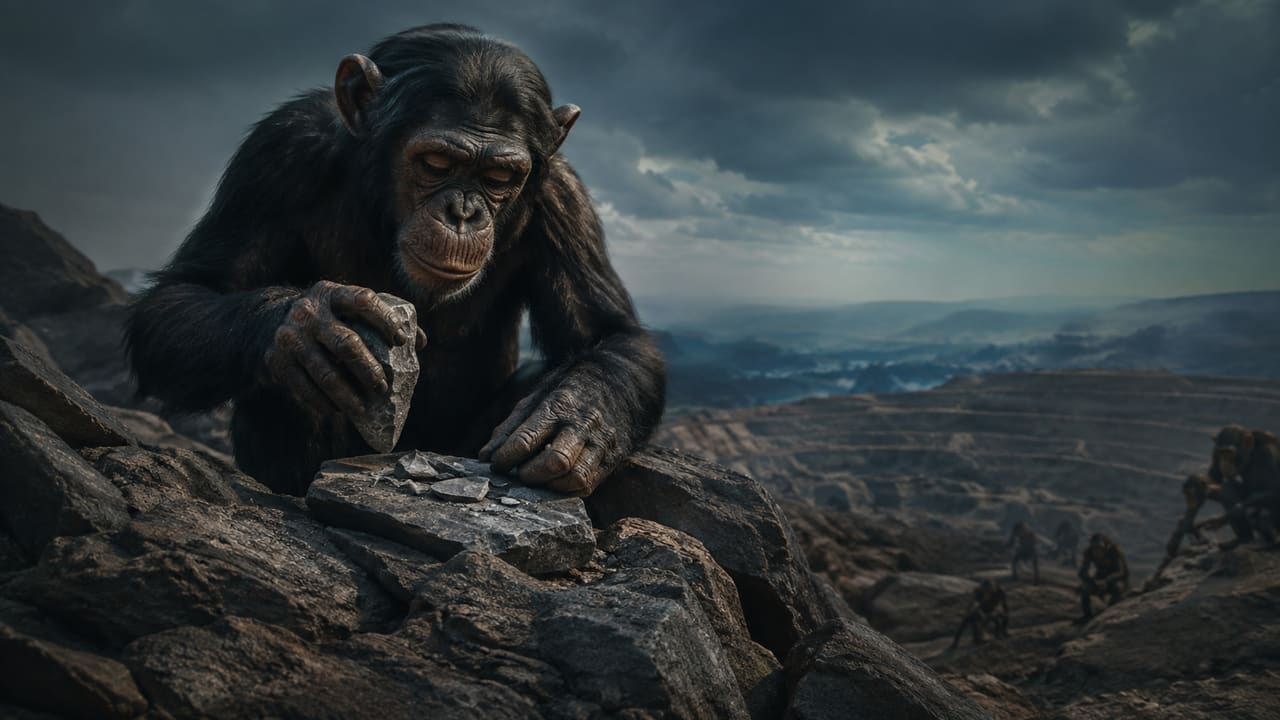
Somewhere in Brazil, a monkey picks up a rock, carries it to a hard surface, places food beneath it and begins pounding. At first glance there is nothing especially revolutionary about the scene. Animals solve problems all the time, and anybody who has ever watched a dog open a cabinet or a crow dismantle a feeder already knows humans do not own clever behavior.
What changes the story is what happens when scientists stop watching the animal and start looking at the ground.
They find older stones. Then older stones beneath those. Some carry the impact damage expected from repeated pounding. Others sit in layers deposited long before the animals alive today were born. Eventually the story stops being about one clever monkey doing one clever thing.
It becomes a story about continuity.
That is where the phrase Stone Age begins to become scientifically interesting.
Nobody serious is suggesting capuchins are about to build cities, chimpanzees are quietly waiting for metallurgy or macaques have a zoning board hidden somewhere in Thailand. Evolution does not work that way. But several non-human primates now satisfy important parts of a description once treated as almost uniquely human: they select tools, use them toward particular goals, learn behaviors socially and leave behind enough material evidence for archaeologists to reconstruct parts of their technological history.
The real question is not whether other primates are becoming human.
It is whether the ingredients that eventually made humans technological were ever uniquely ours.
Any serious comparison has to begin with a fact that still somehow starts arguments: humans are primates. Modern humans did not descend from the chimpanzees alive today, and chimpanzees did not descend from us. Instead, both lineages descend from older common ancestors and followed separate evolutionary paths. The Smithsonian Human Origins Program places humans within the great ape family and treats our evolutionary history as part of a much older primate story. Smithsonian Human Origins Program
Genetics reinforces that relationship. Humans typically carry 23 chromosome pairs while chimpanzees carry 24, and human chromosome 2 contains evidence consistent with the fusion of two ancestral ape chromosomes along the human lineage. National Human Genome Research Institute
Humans and chimpanzees are also commonly described as sharing roughly 98.8 percent of aligned DNA sequence, although that familiar number needs context. It does not mean the two species are functionally identical in 98.8 percent of every biological feature. Comparative genomics depends on what is being aligned and how different kinds of variation are counted. The larger conclusion, however, is clear: our genomes preserve a close evolutionary relationship. NHGRI Comparative Genomics
Once that relationship is established, the more interesting question comes into focus. How much of what we call human intelligence — planning, manipulation, social learning, material selection, long development and cultural transmission — existed in some form before our lineage became what it is today?
The bearded capuchins of Brazil are where the primate Stone Age idea becomes difficult to dismiss as a clever headline.
At Serra da Capivara National Park, archaeologists recovered monkey stone tools from layers dating between roughly 2,400 and 3,000 years ago. Measurements and damage patterns also differed across parts of the archaeological sequence, indicating that the technological behavior itself varied through time. Nature Ecology & Evolution
That is the detail that changes the tone of the entire discussion. A modern capuchin using a rock is interesting. A landscape preserving generations of similar behavior becomes history.
The monkeys are not simply grabbing any stone available. Research has shown that capuchins can adjust hammerstone selection according to properties of the food being processed. In other words, the animal is solving a material problem: some objects are better suited to particular jobs than others. Scientific Reports
Their repertoire also goes beyond the familiar image of a monkey cracking a nut. Field research has documented capuchins using stones and sticks while accessing underground food resources, expanding the known range of their tool behavior. Scientific Reports
Archaeological depth: the excavated capuchin stone-tool record reaches roughly 3,000 years into the past. Nature Ecology & Evolution
Observed toolkit: stone hammering, food processing, flexible hammerstone selection and documented stone-and-stick foraging behavior. Scientific Reports
Why it matters: the behavior persists long enough to leave a recoverable non-human archaeological record.
Chimpanzees strengthen the argument because their technological behavior is broader and their archaeological record extends thousands of years into the past. Excavations in Côte d'Ivoire identified chimpanzee-associated stone assemblages interpreted as ancient nut-cracking sites. PNAS
Modern chimpanzees use stones, probes and modified plant materials for different tasks. At Fongoli in Senegal, researchers documented chimpanzees modifying branches and using the resulting implements during hunting behavior directed toward small prey. Current Biology
The interesting part is not whether we insist on calling the implement a spear. The important part is the behavioral sequence. The animal must locate appropriate material, alter it, retain the object, carry it and later deploy it toward a specific goal.
That is a different cognitive problem than simply grabbing whatever happens to be nearby.
One controlled experiment pushed the cultural argument much further. Chimpanzees were given access to a sequential puzzle containing what they needed to solve the task, yet they failed to independently innovate the required sequence during prolonged exposure. After knowledgeable demonstrators were introduced, previously naive chimpanzees acquired the solution through social learning. Nature Human Behaviour
That distinction matters. Human culture became powerful not simply because we could learn, but because individuals could inherit solutions they might never have invented independently.
Once useful knowledge can move reliably from one brain to another, every individual no longer needs to start from zero.
That is one of the fundamental ingredients of cumulative culture.
A population-level analysis published in Science also found that connectivity among chimpanzee populations helps explain the distribution and complexity of cultural traits, with researchers identifying limited cases consistent with cumulative cultural processes. Science
Individual discovers behavior → another observes → behavior survives → later individuals begin from an existing solution instead of zero.
Long-tailed macaques offer another independent example of stone-tool behavior. Wild populations use stones while processing hard foods, and archaeologists have excavated macaque-created tool sites using archaeological methods. Journal of Human Evolution
The stranger discovery comes from what happens when those stones break.
Wild capuchins have been documented producing sharp-edged flakes and stone cores unintentionally as a byproduct of pounding. Some of those pieces share characteristics with very simple stone artifacts traditionally associated with deliberate hominin manufacture. Nature
Analysis of macaque stone-tool assemblages has created the same problem. Unintentional macaque flakes can overlap morphologically with some early hominin artifacts. Science Advances
That does not mean monkeys invented knives.
It means a sharp-edged stone alone may not tell archaeologists everything they once hoped it would.
The accidental-flake problem may be one of the most important parts of this entire investigation.
Repeated stone percussion can produce sharp edges even when the animal's original goal has nothing to do with making a cutting implement.
That means the earliest path toward sharp-stone technology may begin with an accident rather than an inventor deliberately trying to manufacture a blade.
The consequential threshold comes later: does the animal recognize the accidental object's new functional property, and can it reproduce that useful geometry intentionally?
The final two stages are questions, not claims that living capuchins or macaques routinely manufacture cutting flakes intentionally.
Living primates show us that several earlier stages can occur without a human brain.
The transition to reliable deliberate manufacture remains the line that matters.
It is tempting to look at several thousand years of capuchin stone use and ask why the animals have not developed anything more complicated.
The problem is scale.
Evidence from Lomekwi 3 in Kenya pushed known hominin stone-tool manufacture back to roughly 3.3 million years ago. Nature
From the perspective of a human lifetime, a few thousand years sounds ancient.
Placed beside a technological record measured in millions of years, the comparison looks very different.
The point is not that human technological history followed a smooth march toward modern civilization. It plainly did not. The comparison simply reminds us that technological change should not be judged on the scale of a single lifetime, a century or even a few thousand years.
That makes the question more interesting.
Instead of asking why capuchins have not become more like us, we can ask why durable stone technology emerged in another primate lineage at all.
This is usually the point where the conversation gets reduced to skull capacity. Humans have big brains. Other primates have smaller brains. Case closed.
Except comparative neuroscience does not work that cleanly.
The adult human brain weighs roughly 1.3 kilograms, and influential cellular-counting research has estimated approximately 16 billion neurons in the human cerebral cortex. Frontiers in Human Neuroscience
Chimpanzee brains are dramatically smaller in absolute volume, while capuchin brains are smaller still. Yet capuchins have attracted attention because they possess relatively large brains for their body size under some encephalization measures. That does not make a capuchin smarter than a chimpanzee. It demonstrates why no single measurement can rank cognition cleanly across species. Comparative neuroscience review
Brain mass and cortical neuron figures: Frontiers in Human Neuroscience. Comparative scaling context: comparative neuroscience review.
The meaningful comparison is not simply big brain versus small brain. Neuron number matters. Connectivity matters. Development matters. Memory matters. Motor control matters. Social learning matters.
Intelligence emerges from the system.
Humans do not merely invent.
We inherit inventions and begin where somebody else stopped.
One person discovers a useful technique. Another learns it. A third improves it. A later generation begins with the improved version instead of starting again.
Eventually knowledge becomes external.
Stories. Teaching. Symbols. Writing. Libraries. Computers.
The information does not disappear simply because the person who first figured it out dies.
That is the cultural ratchet.
This is an SCS explanatory framework rather than a claim that evolution follows a required sequence.
Other primates possess pieces of that system.
Humans turned it into something open-ended.
That remains an enormous difference, but it increasingly looks like a difference built from shared components rather than one magical ability that appeared from nowhere.
This is where the Stone Age language can become misleading.
Capuchins are not unfinished humans. Chimpanzees are not waiting to become us. Evolution has no obligation to move every lineage toward language, cities or industrial technology.
A technological tradition can remain useful without becoming dramatically more complicated.
That is not evolutionary failure.
It means the existing behavior works.
The human story was unusual because a particular combination of anatomy, ecology, social learning, communication, development and cultural accumulation eventually produced extraordinary technological complexity.
There is no guarantee the same combination will happen elsewhere.
There is also no biological rule saying complex technological intelligence was only allowed to emerge once.
The answer is still no.
Capuchin archaeology does not prove Bigfoot. Chimpanzee technology does not prove the Yeti. None of this establishes a hidden technologically sophisticated ape lineage wandering around North America while somehow avoiding bodies, fossils, clean DNA and every decent camera angle on Earth.
What the legitimate research establishes is narrower and far more interesting.
Humans are not the only primates capable of persistent technological traditions.
That makes folklore more fun to discuss.
It does not make folklore evidence.
The next truly important discovery would not be another video of a monkey hitting something with a rock.
Researchers would be looking for increasingly specialized tools, intentional production of desired stone forms, composite technology built from multiple materials, stronger evidence of deliberate teaching and — most important — measurable improvement that accumulates across generations.
If later generations consistently began building on technological innovations introduced by earlier ones, the conversation would change.
If primates began intentionally manufacturing useful cutting edges rather than creating similar flakes accidentally during percussion, the conversation would change.
If separate materials were deliberately assembled into composite tools, the conversation would change.
And if communication began carrying increasingly abstract technological information instead of requiring every learner to watch every step directly, the conversation would change again.
Those are the kinds of developments that would move the story from persistent technological tradition toward something recognizably more cumulative.
With a very large asterisk, yes.
If Stone Age means a durable technological tradition centered on stone use, supported by repeated behavior, transmitted socially and preserved archaeologically, then several non-human primate populations fit meaningful parts of that description.
Capuchins have left an archaeological stone-tool record extending roughly three millennia into the past. Nature Ecology & Evolution
Chimpanzees have ancient archaeological evidence of stone-based nut cracking. PNAS
Macaques and capuchins can unintentionally generate flakes similar enough to some early hominin material to complicate archaeological interpretation. Science Advances
Chimpanzees can also acquire difficult solutions socially after failing to independently innovate them. Nature Human Behaviour
If Stone Age means these species are moving through a predetermined evolutionary conveyor belt that inevitably ends in human-like civilization, then no.
The evidence does not say that.
The more interesting conclusion is that humans are not the only primates that select tools, transport them, modify materials, learn from one another, preserve local traditions and leave technological traces behind.
One branch of the primate family tree combined those capacities in an extraordinary way.
Stone was deliberately fractured. Tools became more specialized. Knowledge became more reliable. Communication became richer. Culture accumulated.
Eventually that branch built cities, laboratories, telescopes, satellites, computers and artificial intelligence.
And now one of those computers is helping the descendants of that branch investigate another primate smashing food open with a rock.
The question is not whether they are becoming us.
The question is what happens when culture starts to remember.
Method note: Citation links are placed directly beside material factual claims or inside the same visual block containing the claim. The phrase Stone Age is used as an editorial analogy rather than a formal evolutionary classification for living primates. Brain comparisons are presented as comparative biology rather than universal intelligence rankings.
Sources and further reading
Nature Ecology & Evolution — Three thousand years of wild capuchin stone tool use
Scientific Reports — Wild capuchin tool selection
Scientific Reports — Capuchin stone and stick use
PNAS — Ancient chimpanzee stone-tool archaeology
Current Biology — Savanna chimpanzees hunt with tools
Nature Human Behaviour — Chimpanzee social learning
Science — Chimpanzee cultural connectivity
Journal of Human Evolution — Macaque archaeology
Nature — Wild monkeys flake stone tools
Science Advances — Macaque flakes and early hominin comparisons
Nature — Lomekwi early stone tools
Smithsonian Human Origins Program
National Human Genome Research Institute — Chromosome 2
NHGRI Comparative Genomics
Frontiers in Human Neuroscience — The Human Brain in Numbers
Comparative neuroscience review
Built By
Editorial Operating System v1.0Creator
Erik Chambers
Architecture
Founder, Creator & Editorial Architect
AI Assisted
No
Human Reviewed
Pending
Evidence Reviewed
In progress
Last Updated
September 27, 2026
Confidence
Evergreen medium/10
Research Status
Living investigation
We do not claim perfection. We promise transparency. Every investigation shows its work — the question, the evidence, the tools, the humans, and the updates.
Editorial Transparency
This article contains a combination of reporting, publicly available research, and editorial analysis.
Analysis and interpretation. Facts are sourced; conclusions are the author's. Evidence before opinion — facts require sources, analysis requires transparency, opinions require labels.
Meet the creator
Erik Chambers
Founder, Creator & Editorial Architect
Erik originated the central idea, directed the investigation, reviewed the evidence, and approved the final published work.
Read the founder profile →Challenge This
We welcome disagreement
A different way to read the evidence. Research that points in another direction. Where specialists diverge.
Loading challenges…
Submit a challenge
Sign in to submit a challenge. All submissions are reviewed before appearing publicly.
Comments
Ask A Question
What would you ask an editor about this piece?
Reader questions feed our coverage map. The most-asked ones become our next investigations.
Continue Exploring
Guided by the evidenceWhere should this take you next?
Part of a cluster
Origins Evidence
What does the material record actually support about the deep past?
See the whole clusterAre Primates Entering the Stone Age?
A composite 0–100 measure of how well this investigation meets the Second City Standard. Scores are auditable — every point comes from the criteria below.
Composite
—
of 100
This investigation is queued for editorial scoring. No score has been assigned yet — the absence of a number is not a judgment on the evidence.
The Standard
· Editorial verdictBased on the evidence presented,
Second City Standard believes Capuchins, chimpanzees and macaques are using tools, passing down traditions and leaving archaeological records behind. What does that tell us about the origins of human intelligence?
Remaining uncertainty: Awaiting a final written verdict from the editorial desk.
The Standard · Second City Standard
Continue The Investigation
· Never a dead endThis investigation is one thread. Pull the next one — every path below is another investigation, another question, or another discipline applied to the same problem.
One clear idea, once a week.
Get the strongest investigation, one useful tool, and one question worth carrying forward.
No fake urgency. No spam. Leave any time.