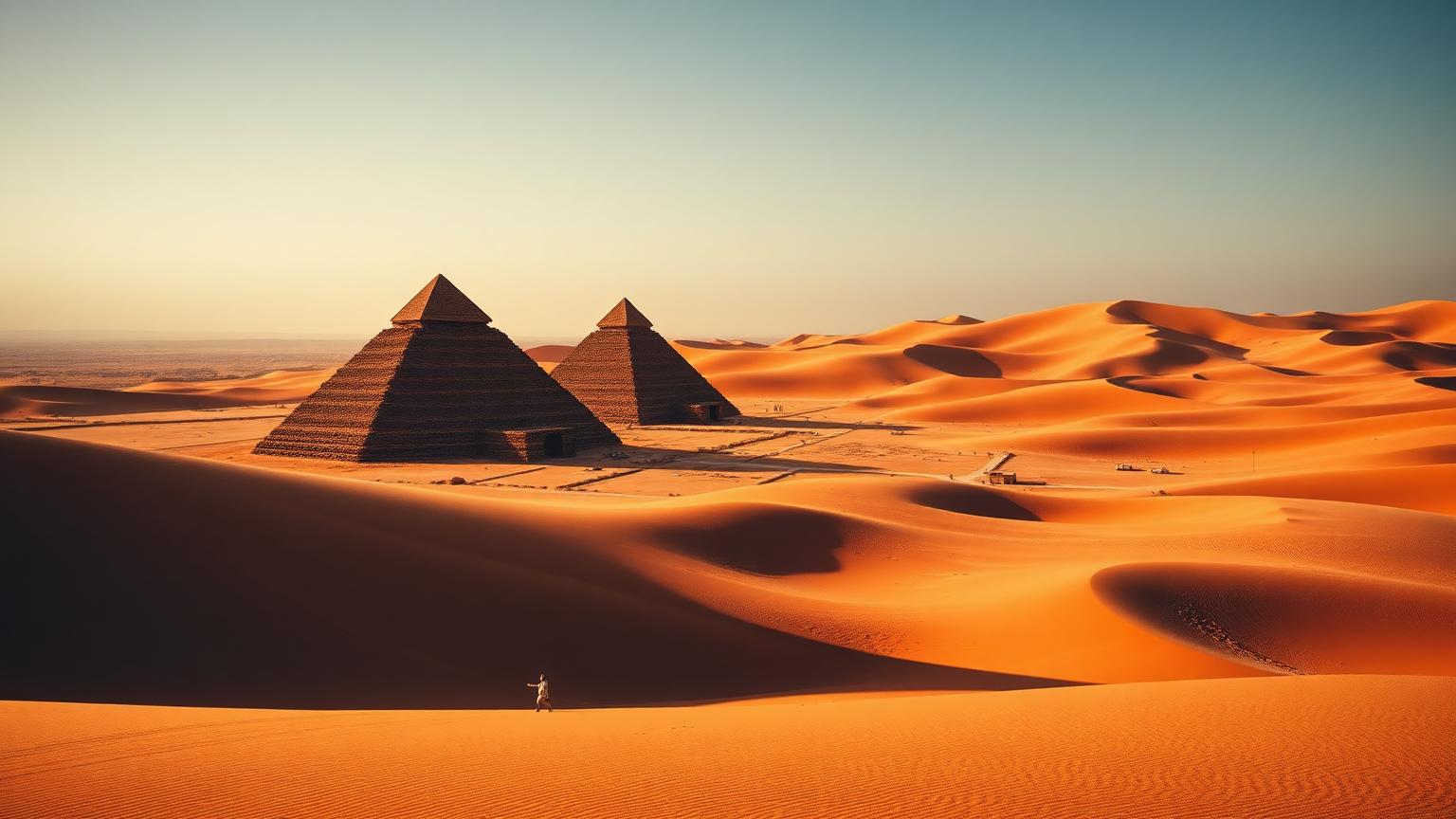
Nubia
Egypt's southern neighbor, rival, conqueror — and the builder of more pyramids.
- Span
- c. 3500 BCE – 350 CE
- Now
- Northern Sudan
- Coordinates
- 16.93° N, 33.75° E
- Palette
- Red sand · iron · gold
Geography first. Everything else is a response to it.
Kingdoms of Kerma, Napata and Meroe
Northern Sudan
Nile cataracts · Atbara
Kerma · Napata · Meroe
The cataracts made this stretch of river a control point for every trade route between inner Africa and the Mediterranean — gold, ivory, ebony and cattle all passed through.
Rainfall here is marginal and the desert is closer than in Egypt, so settlement clusters tightly at the river and at seasonal wadis.
Iron production at Meroe left slag heaps still visible from the air, which is why nineteenth-century travelers described it as the Birmingham of Africa — a bad analogy that stuck.
Kush and Meroe — an African power that ruled Egypt outright and left its own script behind.
The civilization at a glance
Ancient population and army figures are estimates. Anything marked est. is a reconstruction, not a count.
What they built, and how it worked
Meroitic script
Nubian pyramids
Iron production
How we know what we claim
Editorial confidence ratings, not measurements. They describe how much of the picture rests on each channel — and where a single new find could move the file.
This rating governs the whole hub. Any claim on this page that outruns it is labeled where it appears.
- Can Meroitic be fully read?
- How was Kushite kingship structured?
Where the evidence stops
- The 25th Dynasty of Egypt was Nubian; Kushite kings ruled the whole Nile valley for roughly a century.
- Meroe's pyramid fields outnumber Egypt's, though the structures are smaller and steeper.
- Meroe's decline involved a mix of Aksumite pressure, shifting trade routes and environmental strain.
- Meroitic can be pronounced but largely not translated — the vocabulary is missing.
- The internal political structure of Kerma.
Who else was alive
Middle Nile · 2,500 BCE – 350 CE. Bars below show civilizations alive at the same moment.
Where Nubia connects to the rest of the ancient record — the worlds it belongs to, the chapters it sits in, the documents that record it, and the questions still open.
Deep Time
All deep time →
One more civilization
Same moment in history, different world. Keep going.