The Half Second Before the Body Moves
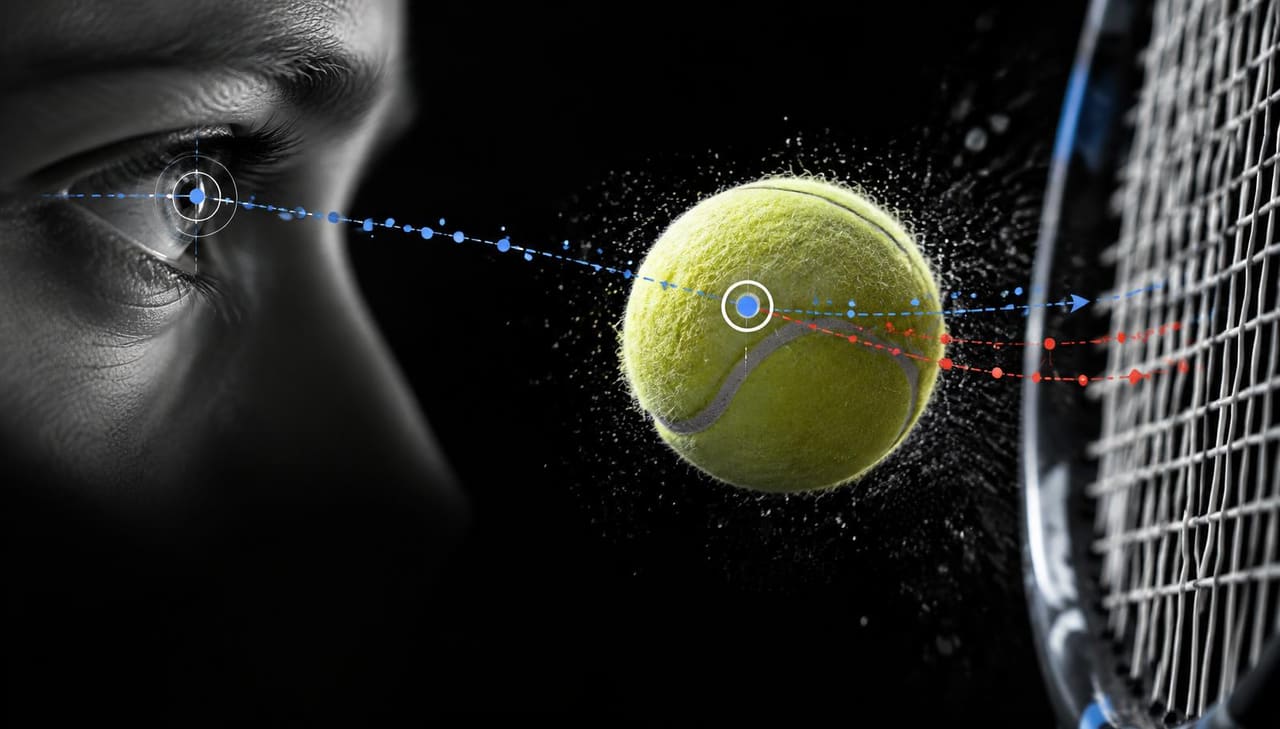
Elite athletes are not simply reacting faster. They extract useful cues earlier, narrow the likely outcomes and begin the right movement sooner.
By The Standard
In this articleThe Standard take
The Standard take
Elite performers gain more usable time by reading the event earlier than by possessing dramatically faster raw reflexes. Meta-analyses find large expert advantages in sport-specific anticipation and gaze control, while simple reaction-time differences are smaller and inconsistent. No credible study supports assigning a universal percentage to “decision speed” versus physical speed.
Evidence rating: High. This rating holds unless Large, preregistered in-game studies that decompose perceptual commitment, muscle activation and movement execution in the same athletes — or trials showing generic reaction-time training transfers as strongly as repres…
Key Findings
Evidence: High- Experts extract useful information from opponents' movements earlier than novices.
- Quiet-eye and anticipation differences are large in controlled studies.
- Sport-specific perceptual training transfers to competition, but less strongly than it improves laboratory tasks.
- Generic reaction speed is a smaller, inconsistent part of the difference.
What this does not prove: Most studies compare existing experts with novices, so training and self-selection are difficult to separate.
The Standard take
Elite performers gain more usable time by reading the event earlier than by possessing dramatically faster raw reflexes. Meta-analyses find large expert advantages in sport-specific anticipation and gaze control, while simple reaction-time differences are smaller and inconsistent. No credible study supports assigning a universal percentage to “decision speed” versus physical speed.
A fast pitch, serve or strike can arrive before a deliberate see-decide-move sequence could finish. The expert survives by reducing uncertainty early. Posture, joint position, gaze, formation and situational probability narrow the options before the decisive movement is complete.
That is anticipation, not clairvoyance. It is learned sensitivity to information in a specific environment. The same player can look uncannily fast inside the sport and entirely ordinary on a generic button-press test.
This work belongs to Sports Science. It also connects to how attention changes under pressure and how sleep loss affects performance.
What the studies show
Mann and colleagues combined 42 studies and 388 effect sizes in a foundational meta-analysis. Experts were more accurate and often faster on sport-specific perceptual tasks, used fewer and longer visual fixations and maintained a longer “quiet eye” before critical movement.
Lebeau and colleagues later found a large expert–novice difference in quiet-eye duration (d = 1.04) and a moderate difference between successful and unsuccessful attempts within the same performers (d = 0.58). Quiet-eye training improved gaze behavior and performance, although intervention studies cannot prove one visual mechanism explains every sport.
A 2024 systematic review of perceptual-cognitive training found a large improvement on laboratory tasks (ES = 1.51) but a smaller transfer to real competition (ES = 0.65). That gap matters. A drill can teach someone to beat the drill without fully teaching the game.
Simple reaction time asks for one response to one signal. Sport asks the athlete to select among many possible actions while the opponent is actively disguising intent. Some athlete groups do beat non-athletes on simple tests, but the differences are often measured in tens of milliseconds and vary by sport. They are not a universal elite-athlete superpower.
Temporal occlusion offers stronger evidence. Researchers hide progressively later frames of an opponent's action and ask participants to predict the outcome. Experts retain accuracy with less information because they use earlier kinematic cues.
A screen, joystick or verbal prediction is not a live opponent. Representative-design research warns that perception and action are coupled: changing the response can change the information an athlete uses. This means laboratory effect sizes should not be copied directly into claims about match performance.
The clean conclusion is directional. Anticipation and sport-specific decision processes explain a substantial expert advantage. The evidence does not tell us that exactly 60, 70 or 80 percent of elite performance occurs before movement.
Key findings
- Experts extract useful information from opponents' movements earlier than novices.
- Quiet-eye and anticipation differences are large in controlled studies.
- Sport-specific perceptual training transfers to competition, but less strongly than it improves laboratory tasks.
- Generic reaction speed is a smaller, inconsistent part of the difference.
Most studies compare existing experts with novices, so training and self-selection are difficult to separate. Samples of genuine experts are often small. Sports and tasks differ enough that one pooled effect should not be treated as a law.
The strongest counterargument is conceptual: decision and movement may not be separable stages at all. Ecological accounts treat skilled action as continuous perception-guided control. That critique weakens neat percentage claims, but it strengthens the practical point that isolated reflex tests miss the skill being measured.
What would change our mind
Large, preregistered in-game studies that decompose perceptual commitment, muscle activation and movement execution in the same athletes — or trials showing generic reaction-time training transfers as strongly as representative sport-specific training — would weaken the conclusion that anticipation is the dominant source of the expert timing advantage.
Sources
- Mann et al., “Perceptual-Cognitive Expertise in Sport: A Meta-Analysis,” Journal of Sport & Exercise Psychology (2007): https://doi.org/10.1123/jsep.29.4.457
- Lebeau et al., “Quiet Eye and Performance in Sport: A Meta-Analysis,” Journal of Sport & Exercise Psychology (2016): https://doi.org/10.1123/jsep.2015-0123
- Zhu et al., “Effects of Perceptual-Cognitive Training on Anticipation and Decision-Making Skills in Team Sports,” Behavioral Sciences (2024): https://pmc.ncbi.nlm.nih.gov/articles/PMC11505547/
- Zhang et al., “A Comparison of Perceptual Anticipation in Combat Sports,” Frontiers in Psychology (2022): https://pmc.ncbi.nlm.nih.gov/articles/PMC9650920/
- Pinder et al., “Representative Learning Design and Functionality of Research and Practice in Sport,” JSEP (2011): https://doi.org/10.1123/jsep.33.1.146
Built By
Editorial Operating System v1.0Creator
Erik Chambers
Architecture
Founder, Creator & Editorial Architect
AI Assisted
No
Human Reviewed
Yes
Evidence Reviewed
In progress
Last Updated
September 26, 2026
Confidence
Evergreen high/10
Research Status
Living investigation
We do not claim perfection. We promise transparency. Every investigation shows its work — the question, the evidence, the tools, the humans, and the updates.
Editorial Transparency
This article contains a combination of reporting, publicly available research, and editorial analysis.
Analysis and interpretation. Facts are sourced; conclusions are the author's. Evidence before opinion — facts require sources, analysis requires transparency, opinions require labels.
Meet the creator
Erik Chambers
Founder, Creator & Editorial Architect
Erik originated the central idea, directed the investigation, reviewed the evidence, and approved the final published work.
Read the founder profile →Challenge This
We welcome disagreement
A different way to read the evidence. Research that points in another direction. Where specialists diverge.
Loading challenges…
Submit a challenge
Sign in to submit a challenge. All submissions are reviewed before appearing publicly.
Comments
Ask A Question
What would you ask an editor about this piece?
Reader questions feed our coverage map. The most-asked ones become our next investigations.
Continue Exploring
Guided by the evidenceWhere should this take you next?
The Half Second Before the Body Moves
A composite 0–100 measure of how well this investigation meets the Second City Standard. Scores are auditable — every point comes from the criteria below.
Composite
—
of 100
This investigation is queued for editorial scoring. No score has been assigned yet — the absence of a number is not a judgment on the evidence.
The Standard
· Editorial verdictBased on the evidence presented,
Second City Standard believes Elite athletes are not simply reacting faster. They extract useful cues earlier, narrow the likely outcomes and begin the right movement sooner.
Remaining uncertainty: Awaiting a final written verdict from the editorial desk.
The Standard · Second City Standard
Continue The Investigation
· Never a dead endThis investigation is one thread. Pull the next one — every path below is another investigation, another question, or another discipline applied to the same problem.
One weekly email: an evidence-rated training idea, a sourced frontier question, and a Chicago note.
Free. Sign-ups are saved now — we'll email you when the first issue goes out.
No spam. Leave any time. Read our privacy policy.