Money Can't Buy October. Chicago Baseball Fans Could've Told You That.
The Brewers swept the Dodgers. The Rays eliminated the Yankees. And anyone who's survived decades of Chicago baseball knows that spending money and knowing how to build a winning team are two entirely different accomplishments.
By The Standard
In this articleOctober Doesn't Read Payroll Reports
There's something wonderfully inconvenient happening in Major League Baseball.
For years, the sport has debated competitive balance as though winning were primarily an accounting problem. The wealthy organizations possess the financial resources to acquire established stars, absorb expensive mistakes, and stockpile talent. The smaller organizations are left searching for efficiencies, developing young players, and hoping their best performers don't eventually become somebody else's free-agent acquisition.
Then October arrives, and the spreadsheet starts looking a little nervous.
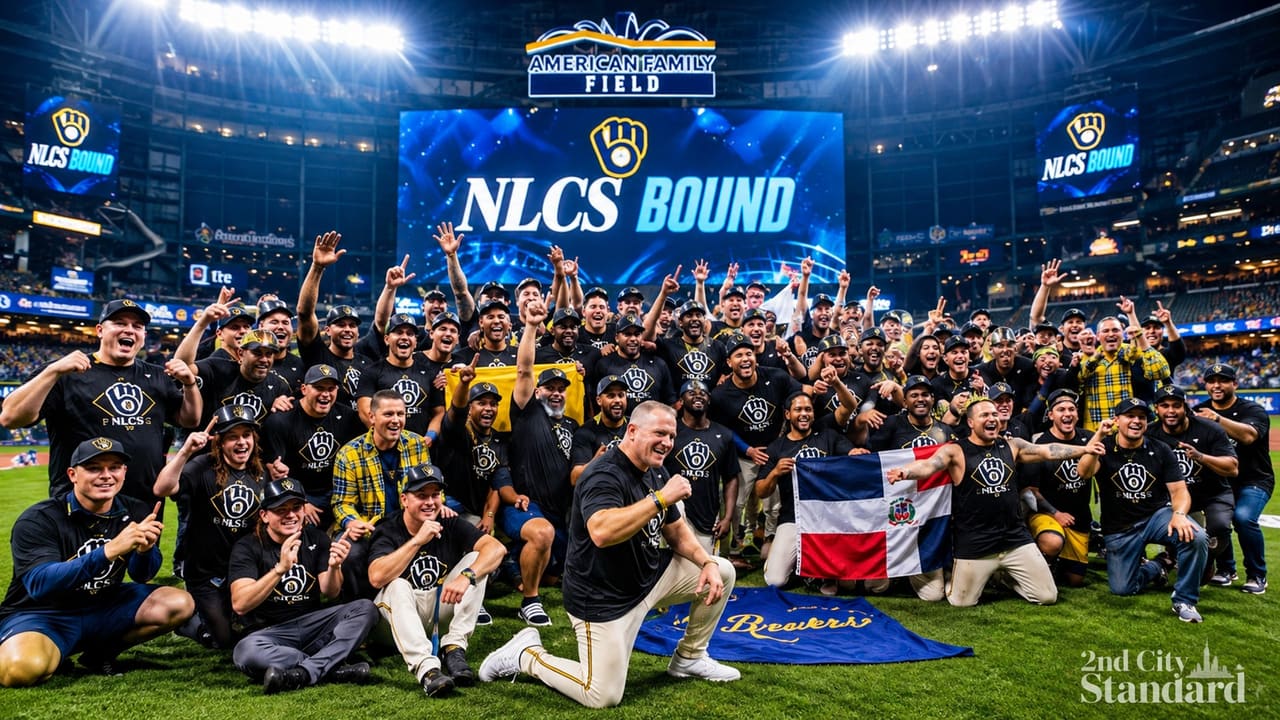
The Milwaukee Brewers, operating with a fraction of the Los Angeles Dodgers' payroll, have swept them out of the National League Championship Series. Tampa Bay eliminated the Yankees. Cleveland and Tampa Bay, two of baseball's lowest-spending organizations, are competing for the American League pennant.
Milwaukee didn't merely get hot at the right moment. The Brewers finished the regular season with 103 wins, the best record in Major League Baseball, before reaching the World Series.
Those developments are documented in Associated Press reporting on Milwaukee's NLCS sweep and Reuters coverage of Cleveland's ALCS lead.
It's tempting to announce that baseball has finally proven money doesn't matter.
Unfortunately, that would be a spectacularly convenient interpretation of the evidence.
Because money does matter. A great deal.
The more interesting question is whether we've misunderstood precisely how it matters, what it purchases, and whether the expectations surrounding enormous financial investments sometimes introduce problems no spreadsheet can solve.
October Doesn't Read Payroll Reports
Consider the Dodgers and Brewers.
Los Angeles entered the postseason with its familiar advantages: extraordinary financial resources, established stars, and an organization capable of assembling talent that much of baseball cannot afford to match.
Milwaukee had something else: the best regular-season record in baseball and a roster capable of defeating the Dodgers four consecutive times.
The Brewers didn't receive bonus runs for spending less. They didn't receive an extra out for developing players. Their pitchers still had to execute, their hitters still had to produce, and their defense still had to make plays.
They won because they played winning baseball.
Which creates a problem for anyone who equates the cost of assembling a team with the quality of its actual performance.
The same postseason has seen Tampa Bay eliminate the Yankees, while Cleveland and Tampa Bay have reached the American League Championship Series despite operating near the bottom of the payroll rankings.
That isn't evidence that resources are irrelevant. It's evidence that financial advantages do not eliminate the need for execution.
103
Regular-season victories by Milwaukee in 2026, the highest total in MLB.
Source: Associated Press, October 2026.
The Payroll Gap Is Real. So Is the Result.
A reported 2026 payroll comparison placed the Dodgers around $339 million, Milwaukee around $146 million, Tampa Bay around $95 million, and Cleveland around $74 million. The comparison ranked Los Angeles second, Milwaukee nineteenth, Tampa Bay twenty-eighth, and Cleveland thirtieth.
These are approximate figures from one reported payroll snapshot, not universal definitions of payroll. Opening Day payroll, current payroll and competitive-balance-tax accounting can produce materially different figures. See the October 2026 payroll comparison underlying these rankings.
| Team | Approx. payroll | Relative spending |
|---|---|---|
| Dodgers | $339M | |
| Brewers | $146M | |
| Rays | $95M | |
| Guardians | $74M |
Rounded payroll estimates; selected 2026 postseason teams. These figures are not a calculation of individual player value, organizational operating expenses, or total baseball investment. Bars are scaled to the Dodgers.
The Dodgers' reported payroll exceeded Milwaukee's by approximately $193 million.
And Milwaukee swept them.
There's a certain beauty to that. Particularly if you believe the purpose of playing baseball is to determine which team is better at baseball rather than which owner has the more impressive collection of accountants.
But one postseason upset cannot establish that the cheaper roster was more likely to succeed before the games were played.
That distinction matters.
An expensive team can have a superior probability of winning and still lose. That's how probability works. Sometimes the favorite loses without the underlying model being wrong.
The correct question isn't simply whether Milwaukee defeated Los Angeles.
It's how frequently teams outperform their payroll expectations, and which organizational characteristics explain those differences.
Here's the Part the Small-Market Fairy Tale Leaves Out
Before we throw every large-market owner into a swimming pool filled with regrettable contracts, there's historical evidence that deserves attention.
MLB's analysis of payroll and regular-season results from 1998 through 2025 found that teams ranked among the five highest payrolls averaged 89 wins per season.
Teams ranked among the five lowest payrolls averaged 74.
That's a fifteen-win difference. Not a rounding error. Not a statistical curiosity best ignored because a small-budget team made an exciting playoff run.
MLB presents the comparison in its competitive-balance analysis.
| Payroll ranking | Average wins |
|---|---|
| 1–5 | 89 |
| 6–10 | 86 |
| 11–15 | 82 |
| 16–20 | 78 |
| 21–25 | 77 |
| 26–30 | 74 |
Source: MLB competitive-balance analysis. Group averages are descriptive and do not alone establish causal effects.
It's a remarkably orderly relationship. More spending is associated with more wins across the payroll groups.
Now, correlation is not causation. Well-run teams may both generate the resources to spend and know how to spend them. Large markets may create revenue advantages that interact with scouting, retention and player development.
Nevertheless, anyone claiming baseball payroll doesn't matter needs to explain this historical pattern.
And explaining it away because the Brewers just swept the Dodgers isn't going to get the job done.
Money buys useful things: established talent, pitching depth, replacement options when injuries happen, and the ability to keep successful players rather than repeatedly rebuilding around their departures.
Across a 162-game season, those advantages accumulate.
October asks a different question.
Six Months of Advantage. One Week of Chaos.
The regular season is a long examination of organizational strength.
The postseason is a collection of much smaller examinations conducted under very different conditions.
A club's depth matters enormously when injuries, fatigue, travel, and roster changes accumulate over months. It doesn't necessarily provide the same advantage during a seven-game series in which a handful of pitchers, plate appearances and defensive plays can decide everything.
A team can be genuinely better over 162 games without being assured victory over seven.
Consider a simplified illustration. Suppose one baseball team has a 60 percent chance of winning any given game against its opponent, with the same probability in every game and independent outcomes.
That team would have approximately a 71 percent chance of winning a best-of-seven series.
Which sounds reassuring until you remember that its opponent still has approximately a 29 percent chance of winning.
That's nearly three chances in ten for the supposedly inferior team.
And actual baseball games are more complicated: pitching matchups change, injuries matter, home-field conditions vary, and games aren't independent laboratory trials.
The illustration doesn't establish either club's true probabilities. It demonstrates why even meaningful talent advantages cannot guarantee postseason results.
A wealthy roster may purchase a better chance of success without purchasing certainty.
There is another complication. Playoff teams are already a selected group of successful organizations. When we compare only those teams, we're no longer studying the full financial advantage of reaching October in the first place.
That is why competitive balance must be examined in two stages: the probability of qualifying for the postseason, and the probability of advancing after qualification.
Combining those two questions can hide more than it explains.
What If the Most Expensive Thing in Baseball Is Expectation?
Here's where my suspicion moves beyond the numbers.
Baseball is an extraordinary combination of athletic ability, repetition, timing, perception and motor precision. Players perform movements that look effortless only because they're exceptionally difficult.
Yet the sport surrounds those movements with a remarkable amount of noise.
Contracts. Headlines. Expectations. Endless analysis. Fan reaction. Talk radio. Social media.
A hitter who signs a massive contract doesn't suddenly acquire a new nervous system that can ignore everything surrounding his performance.
The public discussion changes. Every slump becomes more expensive. Every strikeout gets attached to a salary figure. Every disappointing October invites another examination of whether the organization received an acceptable return on investment.
Imagine being required to execute a difficult motor task with almost no margin for error while thousands of people loudly explain why your compensation makes failure unacceptable.
Sounds relaxing.
But here's the important scientific distinction: that description is plausible as a pressure mechanism. It is not proof that larger contracts reduce performance.
There is research concerning the relationship between audience size, pressure and batting performance. It offers a reason to investigate how the performance environment affects athletes, but audience exposure cannot simply be treated as the equivalent of salary expectations.
Choking under pressure is also not inevitable. Some athletes respond positively to higher stakes, and experienced professionals can develop effective routines for managing demanding environments.
Without player-level measurements and appropriate controls, claiming that highly paid players are more likely to choke would turn an interesting psychological hypothesis into an unsupported accusation.
What I want to know is whether performance expectations change an athlete's preparation, attentional control, decision-making, or ability to maintain routines.
Does an individual player experience higher compensation as security or as an additional obligation?
Do organizational culture and coaching determine the answer?
Could a stable environment offset pressure even when the payroll is enormous?
And might some lower-payroll organizations succeed because they provide excellent preparation and clarity of roles, not simply because nobody expects them to win?
These are research questions. They're worth studying precisely because the answers aren't obvious.
What Smart Organizations Build That Money Alone Cannot Buy
If payroll is one input into organizational performance, what are the others?
Player development is the obvious starting point.
Scouting, instruction, mechanical development, individualized training, health management, defensive positioning, opponent preparation and intelligent roster construction can turn inexpensive players into valuable contributors.
Organizations with smaller payrolls may have especially strong incentives to develop these capabilities because they cannot as easily purchase replacements when their own systems fail.
But we should resist romanticizing poverty as an organizational virtue.
Having fewer resources doesn't automatically create better coaching, superior chemistry or a healthier clubhouse. A poorly managed team with a small payroll is still poorly managed.
Likewise, a wealthy organization can invest in outstanding coaches, research departments, sports science, player development and mental-performance support.
The interesting possibility is that the effectiveness of those organizational systems changes the return a team receives from its payroll.
Two clubs could spend identical amounts and produce dramatically different results.
Not because dollars lose their value once deposited into a player's bank account, but because the process of converting talent into coordinated baseball performance is itself a competitive skill.
For me, this should be central to how we evaluate baseball organizations.
Are they developing talent? Retaining it? Defining roles? Building depth? Giving athletes useful information without overwhelming them? Creating predictable preparation routines while remaining tactically adaptable?
Or are they collecting impressive résumés and hoping the collection turns itself into a championship?
That's a much more revealing distinction than simply comparing payroll totals.
The central hypothesis: Organizational quality may influence how efficiently teams convert financial resources and individual talent into wins. Psychological stability could be one component, but its independent effect remains unmeasured in this investigation.
Does Baseball Need a Salary Cap, or Better Questions?
Baseball's competitive-balance debate often becomes a fight between two convenient positions.
One side argues that wealthy teams can purchase nearly unlimited advantages, turning competitive success into a function of market size and revenue.
The other points to successful lower-payroll organizations and argues that intelligent management can overcome financial disadvantages.
Both observations can be true.
The existence of the 2026 Brewers does not mean Milwaukee faces the same structural financial opportunities as Los Angeles.
And the Dodgers' ability to spend extraordinary amounts does not relieve their players of the responsibility to actually win games.
MLB's published analysis shows that the payroll gap correlates with long-term winning. That supports concern about unequal opportunity. But one season's postseason outcomes are not enough to determine the effects of a proposed salary cap, payroll floor, different revenue-sharing system or competitive-balance tax.
Those policies have different implications for player compensation, owner spending, organizational incentives and team competitiveness.
We should evaluate those effects separately rather than treating any single mechanism as a guaranteed solution.
The question should not be whether spending matters or whether smart management matters.
The answer to both is yes.
The better question is how much each matters, when each matters, and why some organizations consistently generate more winning baseball from their available resources than others.
Which brings us back to Milwaukee.
The Brewers didn't prove money was useless. They demonstrated that a large financial advantage can still be defeated by a team capable of executing at a higher level over the games that decide a championship series.
That's not the death of the competitive-balance debate.
It's the reason we should finally make that debate more intelligent.
Money Buys Advantages. Baseball Still Demands Answers.
I don't believe baseball should be judged by which organization can write the largest checks.
And I don't believe the solution is to pretend that money has no effect on the standings.
Both arguments are too simple for a sport this complicated.
Teams need resources. They need great athletes. They need talented coaches, strong developmental systems, intelligent preparation, and organizations that understand how human beings perform under pressure.
They also need to recognize the difference between acquiring talent and creating an environment where that talent consistently succeeds.
My suspicion is that we don't adequately measure the second part.
What we know is that high-payroll teams win more regular-season games on average. What we know from 2026 is that teams with much smaller payrolls have produced extraordinary postseason results.
What we don't know is whether the expectations attached to expensive rosters systematically help, hurt, or simply interact with the way individual athletes and organizations respond to pressure.
That's worth investigating before we decide baseball's future is primarily a payroll problem.
And if spending another couple hundred million dollars guaranteed October success, the Dodgers would have had a considerably less interesting week.
Baseball, fortunately, still insists on playing the games.
What We Measured—and What We Didn't
Research question: How strongly is MLB payroll associated with regular-season success, and what can the 2026 postseason tell us about the limitations of that relationship?
Historical dataset: MLB's published 1998–2025 payroll-ranking and average-wins analysis, covering the league's thirty teams during that period.
2026 postseason: Results available through October 15, 2026. The World Series has not yet been played.
Payroll comparison: Selected, rounded 2026 team payroll estimates reported in October 2026. These values should not be mixed with opening-day, tax-accounting or other payroll definitions without adjustment.
Method: Descriptive comparison of payroll rankings, regular-season performance and postseason outcomes, plus conceptual analysis of organizational and psychological hypotheses.
Confidence: High in the reported game outcomes and the cited MLB historical averages; limited confidence in claims about the causal effect of salary-induced pressure.
Limitations: This report does not conduct an original team-season regression, estimate the independent causal effect of payroll, measure player anxiety, or compare psychological characteristics of high- and low-payroll rosters. An unsuccessful playoff series is not sufficient to diagnose choking.
Further research: A more rigorous study should use all thirty teams across multiple seasons, consistent inflation-adjusted payroll definitions, preseason expectations, regular-season win probability, postseason qualification, roster quality, injuries, player development, coaching continuity and measurable psychological variables.
Interpretation rule: Association is not causation; pressure as a plausible mechanism is not evidence that pressure caused a specific loss.
Selected Sources
MLB — Baseball's Competitive Balance Issue Explained
Associated Press — Milwaukee Brewers Sweep Los Angeles Dodgers in the NLCS
Reuters — Cleveland Guardians Take 2–1 ALCS Lead
Federal Baseball — 2026 Championship Series Payroll Comparison
Editorial standards: Second City Standard. Questioned, measured and argued.
Built By
Editorial Operating System v1.0Creator
Erik Chambers
Architecture
Founder, Creator & Editorial Architect
AI Assisted
No
Human Reviewed
Pending
Evidence Reviewed
Yes
Last Updated
October 16, 2026
Confidence
Evergreen medium/10
Research Status
Living investigation
We do not claim perfection. We promise transparency. Every investigation shows its work — the question, the evidence, the tools, the humans, and the updates.
Editorial Transparency
This article contains a combination of reporting, publicly available research, and editorial analysis.
Analysis and interpretation. Facts are sourced; conclusions are the author's. Evidence before opinion — facts require sources, analysis requires transparency, opinions require labels.
Meet the creator
Erik Chambers
Founder, Creator & Editorial Architect
Erik originated the central idea, directed the investigation, reviewed the evidence, and approved the final published work.
Read the founder profile →Challenge This
We welcome disagreement
A different way to read the evidence. Research that points in another direction. Where specialists diverge.
Loading challenges…
Submit a challenge
Sign in to submit a challenge. All submissions are reviewed before appearing publicly.
Comments
Ask A Question
What would you ask an editor about this piece?
Reader questions feed our coverage map. The most-asked ones become our next investigations.
Continue Exploring
Guided by the evidenceWhere should this take you next?
Part of a cluster
Baseball Value
What is a baseball player actually worth, and who decides?
See the whole clusterContinue The Investigation
· Never a dead endThis investigation is one thread. Pull the next one — every path below is another investigation, another question, or another discipline applied to the same problem.
One weekly email: an evidence-rated training idea, a sourced frontier question, and a Chicago note.
Free. Sign-ups are saved now — we'll email you when the first issue goes out.
No spam. Leave any time. Read our privacy policy.