Second City Standard · The Book of Enoch · Chapter 7
The Giants
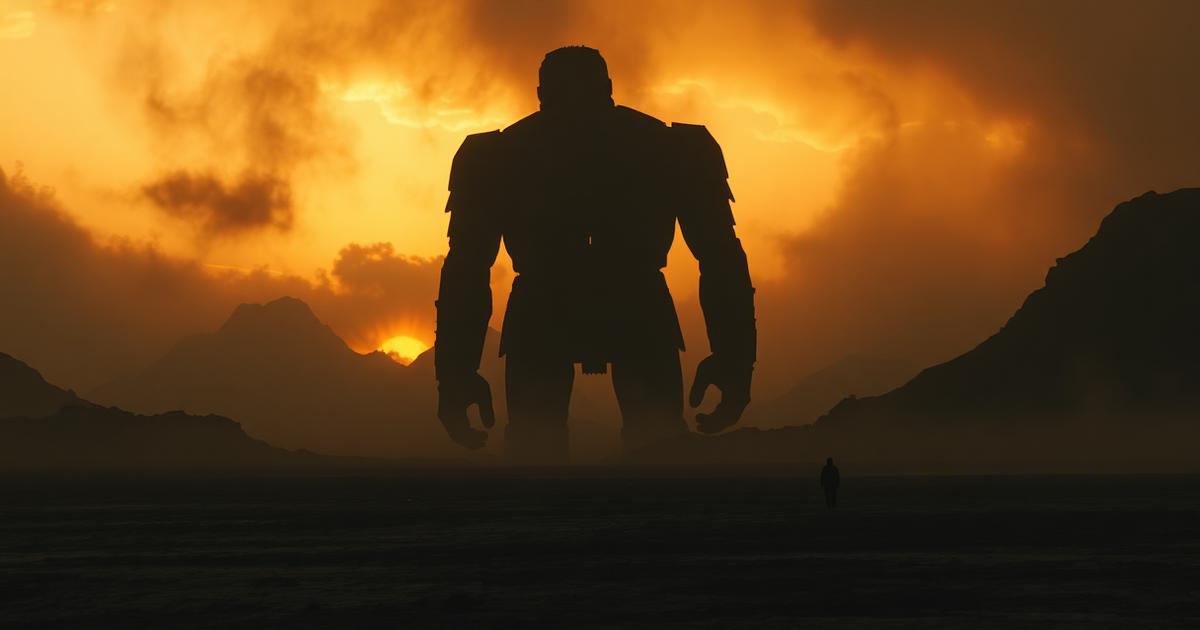
Book of Enoch Chapter 7 describes the birth of the giants from the Watchers and human women. Their uncontrolled appetite consumes humanity's resources and eventually fills the earth with violence and bloodshed.
Read-aloud is unavailable in this browser. The full chapter text is on the page above.
Book of Enoch Chapter 7: Modern Reading
The Watchers took wives for themselves, and each chose for himself one. They began to go in to them and to defile themselves with them, and they taught them charms and enchantments, the cutting of roots, and made them acquainted with plants.
The women became pregnant and bore great giants, whose stature was three thousand cubits. From their first breath they were unlike anything the earth had seen — creatures born of two worlds and belonging fully to neither, hungry in a way that ordinary hunger could not explain.
These consumed all the produce of humanity — the grain of the fields, the fruit of the trees and the yield of the herds — until humans could no longer sustain them. Storehouses that had been filled for winter were emptied before autumn. Harvests that had once fed villages for a year were consumed in weeks. What the giants could not eat, they spoiled.
When there was nothing left to give, the giants turned against the people themselves and devoured them. They began to sin against the birds and the beasts and the creeping things and the fish, and to devour one another's flesh, and to drink the blood. There was no creature small enough to be overlooked and no boundary strong enough to hold them back.
Fields that had been tilled for generations grew back into thorns. Roads that had connected towns were emptied by fear. Mothers hid their children in the caves along the hillsides and did not come out for their own harvests. Whole peoples reduced their lives to what could be carried and what could be hidden.
Then the earth laid an accusation against the lawless ones. The blood that had been shed cried out from the ground, and the wailing of humanity rose up so that it could no longer be ignored. The land itself, which had been meant to hold seed and yield bread, refused to keep the record silent any longer.
It is worth noticing what the chapter does not say. It does not describe the giants as heroes, and it does not describe them as monsters in the ordinary sense. It describes them as consumers — beings whose defining act is that nothing was ever enough. The horror is not their size. The horror is that no amount of the world could satisfy what they had been born to want.
By the end of the chapter, the moral geography of the earlier chapters has been inverted. The sky still turns in its order. The seasons still arrive on schedule. But the ground beneath that sky has become a place where the strongest devour the weakest and then devour one another, and where creation itself begins looking upward for an answer.
What Happens in Book of Enoch Chapter 7?
Book of Enoch Chapter 7 describes the birth of the giants from the Watchers and human women. Their uncontrolled appetite consumes humanity's resources and eventually fills the earth with violence and bloodshed.
What Does Chapter 7 Mean?
The giants are not merely large. They are an image of consumption without limit — the natural end of a rebellion that recognized no boundary.
Their turn against humanity begins the moment the earth can no longer supply their appetite. The chapter is describing an economy of destruction: first the crops, then the animals, then people themselves.
The closing image — the earth itself bringing an accusation — is one of the oldest surviving expressions of the idea that the natural world can bear witness against human violence.
Historical and Biblical Context
Many readers connect Enoch's giants with the Nephilim mentioned in Genesis 6:4. The texts do not provide identical levels of detail — 1 Enoch greatly expands the brief Genesis account.
The stature '3,000 cubits' is symbolic — an image of scale beyond containment rather than a literal measurement. Different manuscript traditions give different numbers.
The 'accusation' of the earth in the closing line sets up Chapter 8 and the cry that reaches the archangels in Chapter 9.
Key Ideas
Appetite without limit.
The giants exhaust the crops, then the herds, then humanity itself.
The earth speaks.
Creation itself brings an accusation, echoing the moral universe of Chapter 1.
Boundaries were the safeguard.
The giants exist because a boundary was crossed. Their violence is the boundary's absence made visible.
Questions Raised by the Chapter
Are the giants and the Nephilim the same?
Many readers connect them. The Book of Enoch expands the four-word Genesis reference into a full narrative.
How literal is the 3,000-cubit height?
Almost certainly symbolic. Ancient apocalyptic writing used extreme measurements to communicate scale, not to give an engineering figure.