Second City Standard · The Book of Enoch · Chapter 4
The Heat of Summer
Book of Enoch Chapter 4 turns from winter to summer. The intense heat, warmed earth and need for shade demonstrate that creation changes dramatically while continuing within an established seasonal order.
Read-aloud is unavailable in this browser. The full chapter text is on the page above.
Book of Enoch Chapter 4: Modern Reading
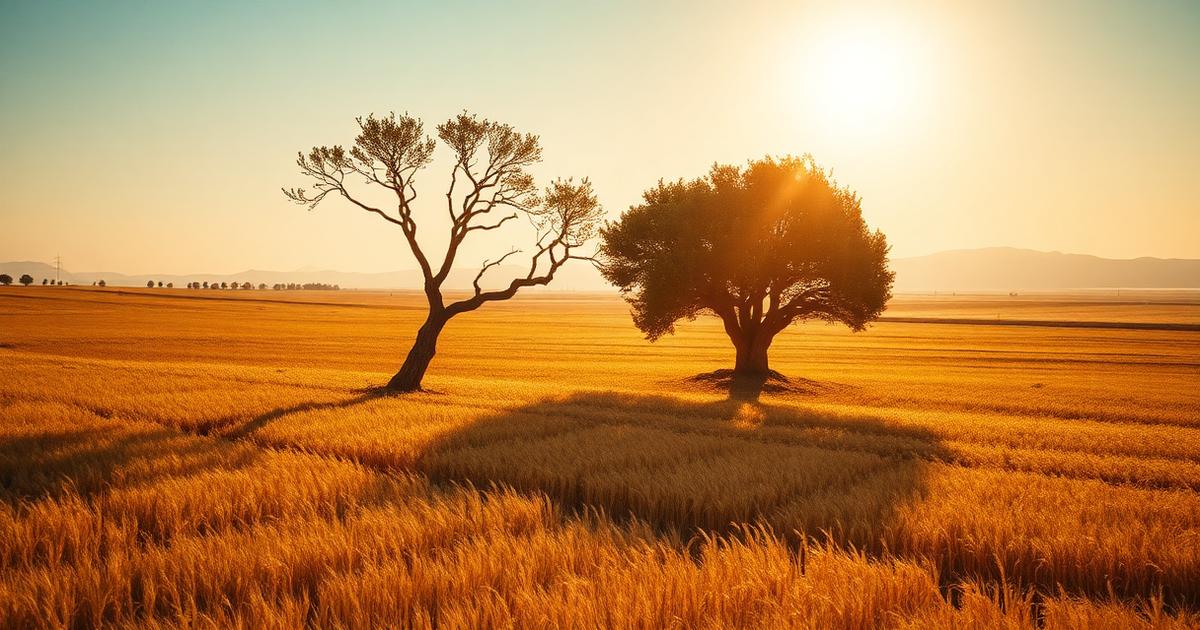
And now observe the days of summer — how the sun stands above the earth, directly opposite it, and you seek out shade and shelter because of the heat of the sun. The earth itself grows warm under his heat. The ground burns beneath your feet, and you cannot walk upon the earth or upon a rock because of the fire in it.
The air itself takes on weight. Distant hills waver behind rising heat. Streams that ran full in the spring narrow, then disappear beneath their own beds, waiting underground for a season that has not yet come. Animals learn where the shadow of a single tree will fall at noon, and they arrive there before it does.
See how the same sun that gave the winter's cold now gives the summer's fire. The heavens have not changed. The path has not changed. Only the season has turned, and with it the whole of the earth's experience.
Consider that shade itself belongs to the same order — the trees that stood bare in winter now spread their leaves so that the traveler may pass beneath them. The response to the heat has been prepared by the same design that produced it.
The lesson is uncomfortable in its simplicity. What burns you was not sent to harm you; what shelters you was not an accident. Both belong to a single arrangement older than the field you happen to be crossing.
The farmer counts the days. The shepherd moves the flock uphill toward the cooler air. The child learns, without ever being told, that the noon hour belongs to the shade and not to the field. Wisdom in the ancient world was often nothing more than the willingness to live inside a pattern that had already been given.
And still, the sun sets on schedule. The heat that felt endless at midday breaks by evening. The same order that pressed the earth by afternoon lifts its hand by nightfall, and the ground begins to cool for a harvest that will arrive exactly when the calendar said it would.
What Happens in Book of Enoch Chapter 4?
Book of Enoch Chapter 4 turns from winter to summer. The intense heat, warmed earth and need for shade demonstrate that creation changes dramatically while continuing within an established seasonal order.
What Does Chapter 4 Mean?
Chapter 4 is the counterweight to Chapter 3. Winter shows patience; summer shows transformation. The same order governs both.
The lesson is not that nothing changes. The lesson is that change is not chaos. The severity of summer and the emptiness of winter are two faces of one dependable pattern.
The mention of shade is quietly important. The relief is not incidental. It is part of the same design.
Historical and Biblical Context
In an agricultural society, seasonal reliability was survival itself. Enoch's argument would have carried weight because his audience depended on it every year.
This is the last of the observational chapters. Chapter 5 will draw the conclusion.
Key Ideas
Change is not chaos.
The seasons transform the world without violating its order.
Shade is a gift of the same order.
The response to summer is provided by the same design that produced the heat.
One sun, two experiences.
The path of the heavens is unchanged; only the earth's position beneath it differs.
Questions Raised by the Chapter
Does the sequence of Chapters 2–4 matter?
Yes. Sky first, then trees, then heat — the argument moves from the distant heavens to the ground beneath the reader's feet.
Why insist on such ordinary examples?
Because Chapter 5 will accuse humanity of rebelling against something as obvious as this. The ordinariness of the argument is the strength of the accusation.