Second City Standard · The Book of Enoch · Chapter 3
The Trees of Winter
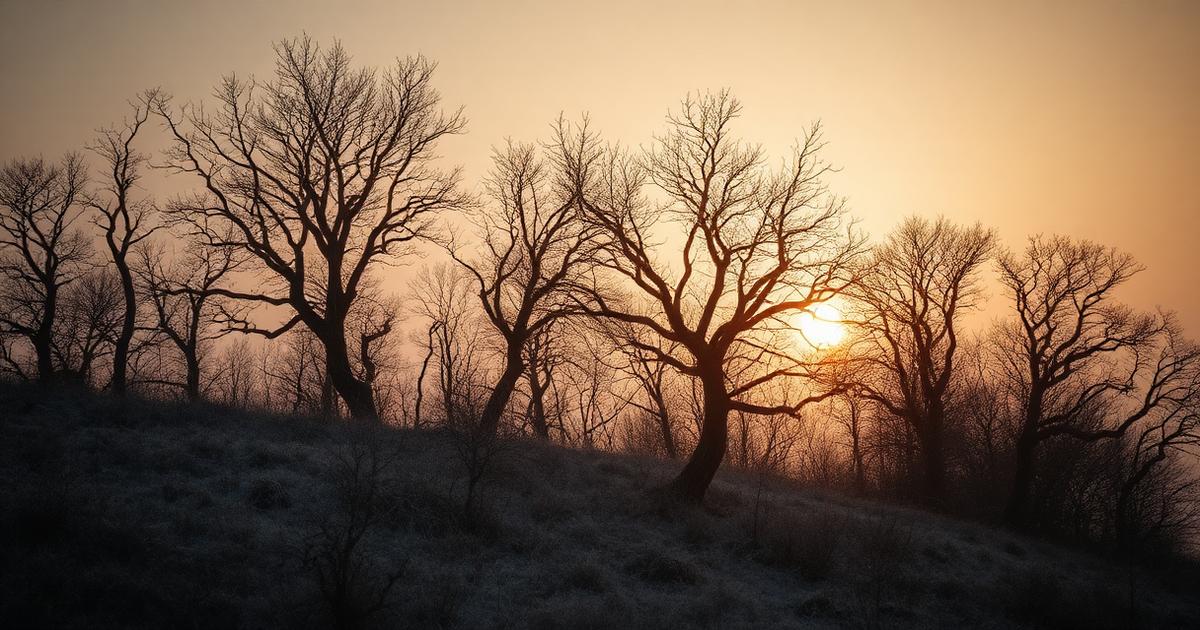
Book of Enoch Chapter 3 uses trees in winter to show that apparent emptiness exists within a larger cycle. The trees remain rooted and wait for renewal rather than abandoning their appointed place.
Read-aloud is unavailable in this browser. The full chapter text is on the page above.
Book of Enoch Chapter 3: Modern Reading
Consider the trees. In winter their leaves fall from all of them, except from fourteen trees whose foliage does not fall, but which keep the old leaves for two or three years until the new appear.
See how the rest stand bare and dry, giving no sign of the life still hidden within them. And yet they do not leave the ground. They do not tear themselves out of place because the season has turned against them. They wait. They remain rooted while the earth around them appears empty.
Walk beneath them in the coldest weeks and you will see nothing that looks like promise — grey branches, cracked bark, silence where songbirds used to be. If you did not already know the pattern, you would swear the tree had ended. But the tree has not ended. It has only stopped performing.
Consider again the days of winter, when the sun stands far from the earth, and understand that in the appointed time the sun will return, and the trees that seemed dead will bud, and the fields that seemed barren will yield their crops again.
This is the argument of the chapter, quietly delivered: the appearance of ending is not the same thing as ending. The tree is doing something in winter that the eye cannot see. The field is doing something under the frost that the calendar has not yet announced.
What Happens in Book of Enoch Chapter 3?
Book of Enoch Chapter 3 uses trees in winter to show that apparent emptiness exists within a larger cycle. The trees remain rooted and wait for renewal rather than abandoning their appointed place.
What Does Chapter 3 Mean?
Emptiness is not the same thing as ruin. Chapter 3 is a short parable about patience within an order larger than the moment.
The image is deliberately domestic. Anyone who has walked past a bare tree in winter has seen the argument in progress.
It also carries a moral weight the reader will encounter again: the difference between what looks like the end and what is actually a pause inside a longer cycle.
Historical and Biblical Context
The image belongs to the same argument as Chapter 2 — the reliability of the natural world contrasted with human choice.
The 'fourteen trees' detail links Chapter 3 directly to the observation catalog begun in Chapter 2, suggesting the two were composed as a single unit.
Key Ideas
Rootedness matters.
The trees do not walk away when winter comes. Their steadiness is part of the lesson.
Absence is not abandonment.
What looks empty is waiting, not lost.
Exceptions still have a pattern.
The evergreens are not disorder; they are a second, quieter kind of order.
Questions Raised by the Chapter
Why so short a chapter?
It is a single image inside a five-chapter argument. Its brevity is part of the point — the reader is meant to sit with the picture rather than move through more text.