What the UAP Record Actually Supports
The official record supports a narrower conclusion than either believers or debunkers usually offer: real reports, many ordinary resolutions, and unresolved cases limited by poor data.
By The Standard
In this articleThe Standard take
The Standard take
The declassified record establishes that the U.S. government receives genuine UAP reports, has released authentic military imagery and cannot resolve every case. It also shows that many well-documented cases have ordinary explanations. No published ODNI, AARO or NASA report verifies extraterrestrial technology, recovered non-human craft or physics-defying performance.
Evidence rating: High. This rating holds unless Raw multi-sensor data with chain of custody, calibrated range and independent analysis showing performance beyond known systems would raise the evidentiary rating.
Frontier
What is documented
- ODNI's June 2021 preliminary assessment reviewed 144 reports from U.S. government sources spanning November 2004 through March 2021. [Source](https://archive.dni.gov/files/ODNI/documents/assessments/Prelimary-Assessment-UAP-20210625.pdf) - ODNI's June 2021 preliminary assessment resolved one report with high confidence as a large deflating balloon. [Source](https://archive.dni.gov/files/ODNI/documents/assessments/Prelimary-Assessment-UAP-20210625.pdf) - ODNI's 2022 annual report brought the cumulative catalog to 510 reports. [Source](https://archive.dni.gov/files/ODNI/documents/assessments/Unclassified-2022-Annual-Report-UAP.pdf) - AARO's fiscal-year 2024 report added 757 reports, including 272 older submissions. [Source](https://media.defense.gov/2024/Nov/14/2003583603/-1/-1/0/FY24-CONSOLIDATED-ANNUAL-REPORT-ON-UAP-508.PDF) - AARO's 2024 historical review reported no verifiable evidence that a U.S. government investigation had confirmed extraterrestrial technology. [Source](https://www.aaro.mil/Portals/136/PDFs/AARO_Historical_Record_Report_Vol_1_2024.pdf) - NASA's 2023 independent study described current UAP data as fragmented, incidental and often poorly calibrated. [Source](https://science.nasa.gov/wp-content/uploads/2023/09/uap-independent-study-team-final-report.pdf)
Key Findings
Evidence: High- The declassified record establishes that the U.S.
- ODNI's June 2021 preliminary assessment reviewed 144 reports from U.S.
- An infrared targeting pod records a relationship among the object, the aircraft, the sensor and the atmosphere.
The Standard take
The declassified record establishes that the U.S. government receives genuine UAP reports, has released authentic military imagery and cannot resolve every case. It also shows that many well-documented cases have ordinary explanations. No published ODNI, AARO or NASA report verifies extraterrestrial technology, recovered non-human craft or physics-defying performance.
What “unidentified” means
Unidentified is a status, not an origin. It can mean the available data do not distinguish a balloon from a drone, a distant aircraft from a sensor artifact, or apparent motion from platform motion. A case can remain unresolved because evidence is poor, not because the object is extraordinary.
The distinction is the center of the UAP Archive, where readers can inspect the government records. This investigation belongs to Discovery, where uncertainty is reported rather than filled with a preferred story.
The documented record
ODNI's June 2021 preliminary assessment reviewed 144 reports from U.S. government sources spanning November 2004 through March 2021. It resolved one with high confidence as a large deflating balloon. The report emphasized limited high-quality data, inconsistent reporting and sensors not designed to identify unfamiliar objects.
The 2022 annual report brought the cumulative catalog to 510 reports. Initial characterization placed many into balloon, drone or clutter categories while leaving others uncharacterized. “Uncharacterized” did not mean “confirmed anomalous”; it meant the office lacked enough information for attribution.
AARO's fiscal-year 2024 report added 757 reports, including 272 older submissions. It stated that AARO possessed no data indicating the capture or exploitation of UAP and had confirmed no health effects from encounters. Its 2024 historical review reported no verifiable evidence that a U.S. government investigation had confirmed extraterrestrial technology and no empirical evidence of a hidden reverse-engineering program.
NASA's 2023 independent study reached a compatible methodological conclusion: UAP can be studied scientifically, but the current data are fragmented, incidental and often poorly calibrated. NASA did not review each historic case and did not find evidence for an extraterrestrial explanation.
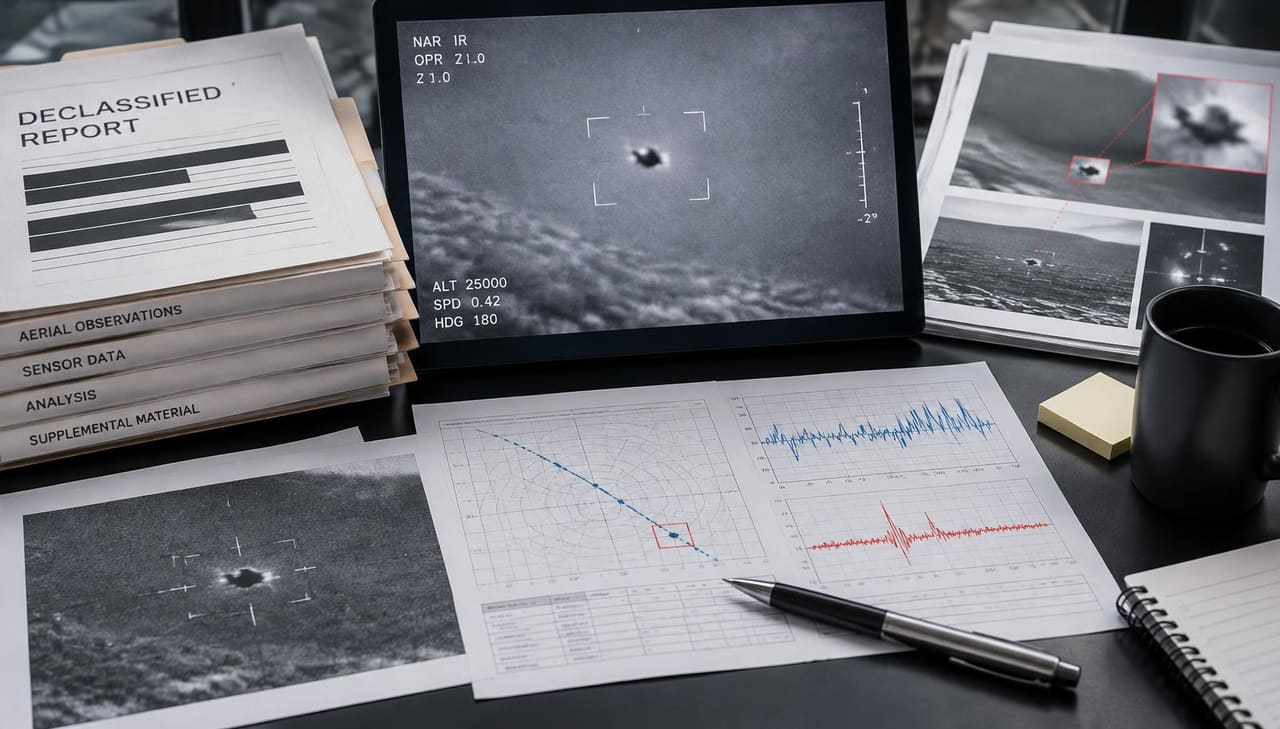
An infrared targeting pod records a relationship among the object, the aircraft, the sensor and the atmosphere. Apparent speed can be distorted by parallax. Apparent rotation can involve the sensor's optics. Without reliable range, an angular motion on a screen cannot yield a trustworthy linear speed.
Radar can add independent information, but only if calibration, track history and raw data are available. Eyewitness testimony can identify a serious event worth investigating, yet estimates of distance, size and speed are tightly coupled: an error in one changes the others.
What is established
- The military videos released in 2020 are authentic government imagery.
- UAP reporting represents a real aviation and intelligence dataset.
- Many cases with adequate information resolve as balloons, drones, aircraft, birds, satellites or sensor effects.
- Some cases remain unresolved because the available evidence is insufficient.
- No public official report establishes a non-human origin.
What remains open
The public cannot independently test most cases because raw sensor data and calibration details are unavailable or classified. A small subset has been described as showing unusual characteristics, but those descriptions are not equivalent to independently verified performance measurements. Classified evidence could alter the public conclusion; it cannot support a public claim until it can be examined.
AARO sits inside the Department of Defense, so concerns about institutional bias are reasonable. That is an argument for independent data access and replication, not evidence that AARO's opposite conclusion must be true. Witness testimony about alleged programs is evidence that claims were made; without documents, materials or auditable records, it does not verify the claims themselves.
Skeptics can also overstate the record. “No verified extraterrestrial evidence” is not “every case has been explained.” The unresolved set is real. Its proper label is unresolved.
What would change our mind
Raw multi-sensor data with chain of custody, calibrated range and independent analysis showing performance beyond known systems would raise the evidentiary rating. So would physical material tied to a documented incident and openly replicated laboratory results inconsistent with known terrestrial manufacture. Better sensors steadily resolving the residue as ordinary objects would move the conclusion the other way.
Sources
- ODNI, Preliminary Assessment: Unidentified Aerial Phenomena (2021): https://archive.dni.gov/files/ODNI/documents/assessments/Prelimary-Assessment-UAP-20210625.pdf
- ODNI, 2022 Annual Report on Unidentified Aerial Phenomena (2023): https://archive.dni.gov/files/ODNI/documents/assessments/Unclassified-2022-Annual-Report-UAP.pdf
- AARO, Fiscal Year 2024 Consolidated Annual Report on UAP (2024): https://media.defense.gov/2024/Nov/14/2003583603/-1/-1/0/FY24-CONSOLIDATED-ANNUAL-REPORT-ON-UAP-508.PDF
- AARO, Report on the Historical Record of U.S. Government Involvement with UAP, Volume I (2024): https://www.aaro.mil/Portals/136/PDFs/AARO_Historical_Record_Report_Vol_1_2024.pdf
- NASA, UAP Independent Study Team Final Report (2023): https://science.nasa.gov/wp-content/uploads/2023/09/uap-independent-study-team-final-report.pdf
Built By
Editorial Operating System v1.0Creator
Erik Chambers
Architecture
Founder, Creator & Editorial Architect
AI Assisted
No
Human Reviewed
Yes
Evidence Reviewed
In progress
Last Updated
September 26, 2026
Confidence
Evergreen high/10
Research Status
Living investigation
We do not claim perfection. We promise transparency. Every investigation shows its work — the question, the evidence, the tools, the humans, and the updates.
Editorial Transparency
This article contains a combination of reporting, publicly available research, and editorial analysis.
Analysis and interpretation. Facts are sourced; conclusions are the author's. Evidence before opinion — facts require sources, analysis requires transparency, opinions require labels.
Meet the creator
Erik Chambers
Founder, Creator & Editorial Architect
Erik originated the central idea, directed the investigation, reviewed the evidence, and approved the final published work.
Read the founder profile →Challenge This
We welcome disagreement
A different way to read the evidence. Research that points in another direction. Where specialists diverge.
Loading challenges…
Submit a challenge
Sign in to submit a challenge. All submissions are reviewed before appearing publicly.
Comments
Ask A Question
What would you ask an editor about this piece?
Reader questions feed our coverage map. The most-asked ones become our next investigations.
Continue Exploring
Guided by the evidenceWhere should this take you next?
Part of a cluster
UAP Evidence
What does the documentary record actually support?
See the whole clusterWhat remains open
The public cannot independently test most cases because raw sensor data and calibration details are unavailable or classified. A small subset has been described as showing unusual characteristics, but those descriptions are not equivalent to independently verified performance measurements. Classified evidence could alter the public conclusion; it cannot support a public claim until it can be examined.
What the UAP Record Actually Supports
A composite 0–100 measure of how well this investigation meets the Second City Standard. Scores are auditable — every point comes from the criteria below.
Composite
—
of 100
This investigation is queued for editorial scoring. No score has been assigned yet — the absence of a number is not a judgment on the evidence.
The Standard
· Editorial verdictBased on the evidence presented,
Second City Standard believes The official record supports a narrower conclusion than either believers or debunkers usually offer: real reports, many ordinary resolutions, and unresolved cases limited by poor data.
Remaining uncertainty: Awaiting a final written verdict from the editorial desk.
The Standard · Second City Standard
Continue The Investigation
· Never a dead endThis investigation is one thread. Pull the next one — every path below is another investigation, another question, or another discipline applied to the same problem.
One weekly email: an evidence-rated training idea, a sourced frontier question, and a Chicago note.
Free. Sign-ups are saved now — we'll email you when the first issue goes out.
No spam. Leave any time. Read our privacy policy.