Ancient Sharks Beneath Egypt’s Desert
A vanished Cretaceous sea explains the shark fossils. The harder question is what Egypt’s changing landscape can — and cannot — tell us about the missing chapters of human history.
By Erik Chambers
Founder & Editor · Second City Standard
The Standard take
The Standard take
Evidence rating: High. This rating holds unless What would change our mind
Key Findings
Evidence: High- Shark fossils occur in Egypt’s Western Desert because the area lay beneath the warm Tethys Sea during the Late Cretaceous, roughly 70 million years ago.
- A securely dated archaeological layer that directly connects an advanced human settlement to the fossil-bearing Cretaceous deposits would change the historical conclusion.
- The new specimens come from phosphate-bearing layers in the Maghrabi-Liffiya sector of the Abu-Tartur Plateau in southwestern Egypt.
The Standard take
Shark fossils occur in Egypt’s Western Desert because the area lay beneath the warm Tethys Sea during the Late Cretaceous, roughly 70 million years ago. The fossil teeth and marine sediments are direct evidence of that vanished sea; they do not, by themselves, establish a lost human civilization.
What would change our mind
A securely dated archaeological layer that directly connects an advanced human settlement to the fossil-bearing Cretaceous deposits would change the historical conclusion. New stratigraphic or taxonomic work could also revise the age or species interpretation of the shark assemblage.
Continue with the Ancient Civilizations & Origins collection and our investigation of what Göbekli Tepe actually proves.
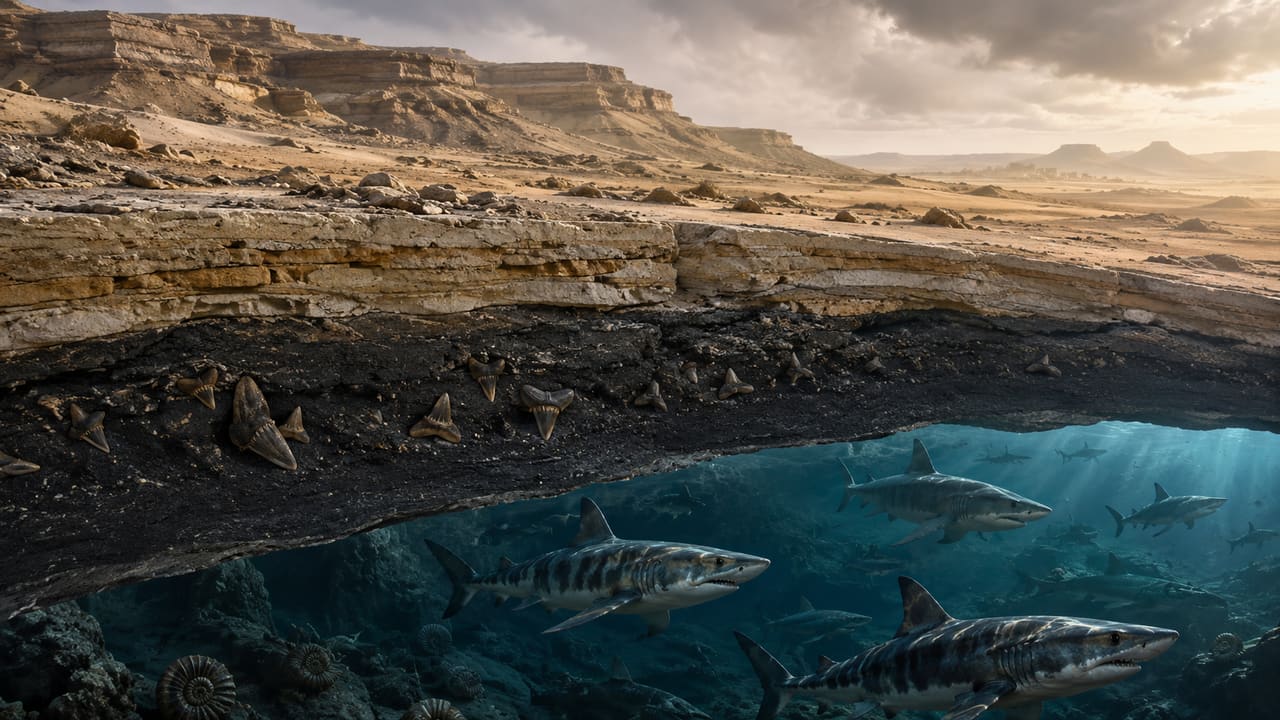
\n\nThere are shark teeth buried in the Egyptian desert.
That sounds like the beginning of a conspiracy theory. It is also completely real.
Researchers studying the Abu-Tartur Plateau in Egypt's Western Desert have identified fossil teeth from an assemblage of extinct lamniform sharks preserved inside phosphate beds of the Late Cretaceous Duwi Formation. The newest study examined 14 isolated teeth representing five shark taxa newly documented from the Abu-Tartur assemblage, while previous work from the locality brings the broader shark record there to at least seven forms. Cretaceous Research ↗ Gizmodo ↗
The fossils are extraordinary. The explanation is not supernatural. The land beneath today's Sahara has repeatedly occupied environments that would be nearly impossible to recognize from the landscape now sitting above them. During the Late Cretaceous, part of Egypt's Western Desert belonged to a tropical marine system connected with the southern margin of the Tethys Ocean. Primary study ↗
None of this moves the construction of Egypt's pyramids into deep prehistory. The shark deposits and the monuments belong to completely different geological and archaeological timescales.
But Egypt is also a useful place to examine why the larger question refuses to disappear. The country contains marine sediments in deserts, whale skeletons sitting in sand, records of periods when the Sahara was green, monumental architecture whose original scale can be difficult to comprehend, and geological erosion whose causes are sometimes more complicated than the simple phrase “wind and sand” suggests.
The interesting question, then, is not whether Egypt preserves evidence of forgotten worlds. It unquestionably does.
The question is what kind of worlds the evidence actually allows us to reconstruct.
The new specimens come from phosphate-bearing layers in the Maghrabi-Liffiya sector of the Abu-Tartur Plateau in southwestern Egypt. The peer-reviewed study describes 14 isolated shark teeth recovered from the Duwi Formation and assigns them to five extinct lamniform taxa: Cretalamna cf. maroccana, Scapanorhynchus cf. raphiodon, Serratolamna cf. serrata, Squalicorax bassanii and Squalicorax pristodontus. Primary research ↗ FOX Weather ↗
The researchers report that Serratolamna cf. serrata and Squalicorax bassanii represent first records from Egypt under their taxonomic interpretation, while the Scapanorhynchus material may represent a first African record and potentially an unusually young occurrence of that taxon. The language matters: “cf.” indicates comparison with a named species rather than absolute taxonomic certainty, and the authors specifically leave parts of the identification open to future revision. Cretaceous Research ↗
The broader Abu-Tartur locality had already yielded evidence for other sharks, meaning the new material expands an existing marine fossil record rather than creating one from nothing. Contemporary reporting has summarized the total shark diversity represented from the locality as at least seven extinct species or forms. Gizmodo ↗
The important word here is teeth. Shark skeletons are composed primarily of cartilage rather than heavily mineralized bone, so complete shark skeletons are comparatively rare in the fossil record. Teeth are considerably more resistant, and sharks continuously replace them throughout life. That combination makes isolated teeth one of the primary tools paleontologists use to reconstruct ancient shark diversity. Study summary ↗
The Duwi Formation records a marine environment from the Late Cretaceous, when northern Africa occupied a very different geographic and climatic world. The shark-bearing deposits are associated with tropical marine conditions along the southern Tethyan margin, and the fossil-bearing layers formed before retreating seas and later geological processes transformed the region into the landscape visible today. Cretaceous Research ↗ Gizmodo ↗
FOX Weather described Late Cretaceous global sea-level estimates as roughly 320 to 850 feet above modern levels, illustrating the scale of the marine conditions that characterized portions of the period. The exact sea-level curve varied through the Cretaceous, but the important point for Abu-Tartur is straightforward: the modern desert surface cannot be projected backward onto a geological landscape tens of millions of years older. FOX Weather ↗
The phosphate deposits are also part of the explanation. Phosphorite accumulations are associated with productive marine systems and can develop where nutrient cycling and oceanographic conditions concentrate phosphorus in sediment. The shark teeth therefore occur inside a geological package consistent with a biologically productive marine environment rather than inside an inexplicable patch of desert sand. Primary study ↗
Then the system changed. Seas retreated. Sediments hardened into rock. Tectonic movement altered elevations and drainage. Erosion stripped away overlying material. What had once been seafloor became dry land, and eventually that exposed land became part of the Western Desert.
Sharks did not invade the Sahara.
The Sahara arrived later.
How Big Were They?
The fossils do not justify imagining a buried megalodon graveyard beneath Egypt. The new specimens consist principally of isolated teeth, and the published material includes teeth measured in millimeters rather than enormous jaws emerging from the rock. In the Cretalamna cf. maroccana material, for example, reported tooth heights are on the order of roughly 14 to 19 millimeters. Primary measurements ↗
That does not mean the animals were tiny. Estimating a fossil shark's body size from teeth requires understanding where a tooth sat in the jaw, how tooth dimensions scale within that taxon and how closely the fossil form resembles relatives for which better anatomical information exists. An isolated tooth can be taxonomically informative without providing a perfectly precise body-length estimate.
The more interesting biological signal is diversity. The teeth differ substantially in shape. Some are comparatively narrow and suited to gripping prey, while broader or serrated forms are better adapted for cutting. The study and subsequent reporting interpret that variation as evidence that several shark types occupied different ecological roles inside the ancient marine system. Gizmodo ↗
The researchers also note ecological differences among the taxa. The occurrence of Squalicorax may indicate input from nearshore or inner-shelf settings, while Scapanorhynchus is associated with deeper-water conditions toward the outer shelf and slope. Reported interpretation ↗
Because geological landscapes do not stay put.
Sediment deposited underwater can be buried beneath younger layers and lithified into rock. Regional uplift can later raise those rocks. Wind, runoff, chemical weathering and differences in rock hardness remove overlying material at different rates until older formations are exposed again. A fossil collected from desert bedrock can therefore record an environment that disappeared tens of millions of years before the desert itself developed.
Egypt's fossil record contains far more than the Abu-Tartur sharks. The country's Western Desert famously includes Wadi Al-Hitan, the Valley of the Whales, where Eocene marine sediments preserve exceptionally important early whale fossils. The ages are different, but the principle is identical: today's arid surface contains geological archives of environments that were once marine.
That is worth keeping in mind whenever an ancient landscape looks impossible. The problem may not be the evidence. The problem may be our tendency to imagine the modern map as permanent.
The Abu-Tartur sharks belong to deep time and have nothing directly to do with human civilization. But Egypt and the broader Sahara also underwent dramatic environmental changes during periods in which humans were present.
A large body of paleoclimate evidence shows that northern Africa was substantially wetter during the African Humid Period, beginning near the end of the Younger Dryas approximately 11,500 years ago and declining toward roughly 5,000 years before present. Paleolake reconstructions, vegetation records, marine sediment cores, archaeological evidence and climate modeling all indicate a Sahara containing far more lakes, wetlands and vegetation than the region supports today. Geophysical Research Letters ↗ Nature Education ↗
Evidence from Egypt reaches much farther into the past. Uranium-series dating of speleothems from Wadi Sannur Cave identified growth periods around 335,000, 219,400 and 128,500 years ago. The researchers interpret those growth intervals and their oxygen-isotope signatures as evidence for periods of extensive rainfall and vegetation in the northeastern Sahara linked primarily to stronger West African monsoon penetration. Quaternary Science Reviews ↗
The same Wadi Sannur study connects those wet intervals with important episodes in early human dispersal, arguing that greener Sahara corridors would have made movement across North Africa substantially more viable than modern geography suggests. El-Shenawy et al. ↗
This is where the conversation moves from established paleoclimate into a genuine interpretive dispute.
Geomorphologist Colin Reader published an analysis of the Giza necropolis arguing that several weathering and erosion features within the Sphinx enclosure are consistent with flowing water and, more specifically, rainfall runoff. Reader concluded that the distribution of erosion could support development of parts of the site before Khufu and therefore before the standard Fourth Dynasty construction sequence usually associated with the major Giza monuments. Archaeometry ↗
Reader's argument is important because it is considerably more restrained than the popular claim that rainfall erosion proves the Sphinx was carved near the end of the Ice Age. His published conclusion suggests possible pre-Fourth Dynasty development at Giza; it does not establish an Ice Age construction date or an unknown global civilization. Reader 2001 ↗
The issue has also generated published criticism and alternative geological interpretation. The same Archaeometry volume included commentaries responding to Reader, while earlier geological work by K. Lal Gauri, John Sinai and Jayanta Bandyopadhyay argued that the Sphinx's weathering can be interpreted through limestone properties, preexisting geological features and deterioration mechanisms without requiring a radically older construction date. Archaeometry debate ↗
The most defensible reading is therefore more complicated than either extreme. Rainfall runoff, groundwater, salt crystallization, natural fractures, variations between limestone beds and prolonged arid weathering can all influence the appearance and deterioration of exposed limestone. Identifying one or more of those processes does not, by itself, establish when the Sphinx was carved. Reader ↗ Published responses ↗
Hawara provides a different kind of warning about how incomplete the visible remains of an ancient civilization can become.
The structure traditionally known as the Labyrinth of Egypt stood near the pyramid of Amenemhat III at Hawara in the Faiyum. Archaeological identification associates the complex primarily with Amenemhat III of the Twelfth Dynasty, while cartouches discovered by Karl Richard Lepsius also connect Amenemhat's daughter Sobekneferu with later work at the site. Site overview & references ↗
The surviving archaeological footprint is enormous. The complex's perimeter has been reconstructed at approximately 385 meters by 158 meters, while estimates place the labyrinth itself at about 28,000 square meters — roughly 300,000 square feet. Flinders Petrie's nineteenth-century excavation attempted to reconstruct portions of a layout that had already suffered massive destruction and stone removal. Dimensions & excavation references ↗
Classical authors made the place sound even more extraordinary. Herodotus wrote that the labyrinth surpassed the pyramids in its effect on him and described a huge arrangement of courts and chambers, including rooms said to exist below ground. Later writers including Strabo also described the complex. Classical accounts ↗
Contemporary research has used geophysical techniques to study the area, while a high local water table complicates preservation and investigation. Geophysical anomalies, however, are not the same thing as excavated architecture. They identify contrasts below the surface that still require archaeological interpretation. Research overview ↗
Could sophisticated human societies have existed earlier than the civilizations currently represented by Egypt, Mesopotamia and other familiar early urban cultures?
In principle, yes.
The archaeological record is not a perfect recording device. Human settlements can be buried beneath river sediment, destroyed by later construction, dismantled for building material or submerged by post-glacial sea-level rise. Organic objects decompose. Coastal settlements are particularly vulnerable because coastlines moved substantially after the Last Glacial Maximum.
Archaeology has also repeatedly demonstrated that complex behavior occurred earlier than simplistic older timelines once implied. Monumental ritual architecture at Göbekli Tepe, for example, belongs to communities living thousands of years before the Egyptian pyramids. Discoveries like that legitimately expand the range of possibilities archaeologists must consider.
But acknowledging gaps in the archaeological record is fundamentally different from asserting that a technologically advanced global civilization existed before the end of the last Ice Age. The first statement describes uncertainty in what has survived. The second proposes a specific historical society that should be testable against material evidence.
And specific hypotheses need specific evidence.
A civilization capable of extensive stone engineering, long-distance navigation, organized agriculture, advanced metallurgy or global cultural transmission should produce some combination of settlements, mines, quarries, workshops, tools, waste deposits, domesticated species, human remains, trade networks, chemical residues and repeated technological traditions.
Those traces do not have to survive everywhere.
But a civilization large enough to reorganize human development should leave a coherent signal somewhere.
The weak version starts with an anomaly and immediately fills the blank space with a civilization.
Sharks in Egypt? Lost civilization.
Water erosion? Lost civilization.
Buried architecture? Lost civilization.
That is not investigation. It is reverse engineering a conclusion.
The stronger version begins somewhere else: the Earth humans inherited after the Ice Age was physically different from the Earth visible today. The Sahara experienced repeated wet periods. Habitable corridors appeared and disappeared. Coastlines migrated. Low-lying coastal landscapes were submerged. Rivers shifted. Sediment buried human occupation surfaces. Entire buildings could later be dismantled until little remained above ground. African Humid Period evidence ↗ Egypt paleoclimate ↗
The scale of the conclusion has to match the scale of the evidence. Evidence for one previously undocumented site would establish that site and whatever its physical remains can demonstrate. It would not, by itself, demonstrate a technologically advanced global society. Larger historical claims require correspondingly broader and independently verifiable archaeological evidence.
That distinction allows us to remain open without pretending uncertainty is proof.
| Claim | Status | Evidence |
|---|---|---|
| Sharks lived where Egypt's Western Desert now exists. | Established | Fossil teeth occur in Late Cretaceous marine deposits of the Duwi Formation. Source ↗ |
| The new Abu-Tartur study examined 14 shark teeth representing five taxa. | Established | Peer-reviewed paleontological description. Source ↗ |
| Parts of Egypt were once beneath tropical marine waters. | Established | Marine sedimentology, fossils and regional Late Cretaceous geology. Source ↗ |
| The Sahara has repeatedly experienced far wetter climates. | Established | Paleolakes, vegetation records, sediments, cave deposits and climate reconstructions. Source ↗ |
| Wadi Sannur records major Egyptian wet periods hundreds of thousands of years ago. | Established | U-series-dated speleothems record wet phases around 335 ka, 219.4 ka and 128.5 ka. Source ↗ |
| Flowing water contributed to some Giza erosion features. | Supported but interpretation debated | Published geomorphological argument and subsequent scholarly discussion. Source ↗ |
| The Sphinx dates to the end of the Ice Age. | Not established | Existing erosion arguments do not independently establish an Ice Age construction chronology. Reader analysis ↗ |
| A massive labyrinth complex existed at Hawara. | Established | Archaeological remains, historical descriptions and subsequent investigation. Source overview ↗ |
| Hawara's labyrinth belonged to an Ice Age civilization. | Unsupported | Archaeological attribution places the known complex in Egypt's Middle Kingdom. Source overview ↗ |
| Our reconstruction of early human history is incomplete. | Strong inference | Preservation bias, changing landscapes and continuing archaeological discoveries mean portions of the human record have not survived or have not yet been found. |
| A technologically advanced global Ice Age civilization existed. | Unproven hypothesis | No coherent archaeological dataset currently establishes such a civilization. |
The Abu-Tartur fossils do not rewrite human history.
They rewrite the landscape on which we imagine history happened.
Roughly tens of millions of years before humans existed, sharks occupied a tropical marine ecosystem where Egypt's Western Desert now stretches across the horizon. The Duwi Formation preserves the physical remains of that vanished environment, and the newly described assemblage adds five shark taxa to the locality's known record. Primary study ↗
Much later, during human prehistory, the Sahara repeatedly changed again. Wet periods expanded vegetation and water across North Africa, including climatic episodes preserved in Egyptian cave deposits hundreds of thousands of years ago and the much more recent African Humid Period experienced by Holocene human populations. Wadi Sannur ↗ African Humid Period ↗
Hawara demonstrates something different: monumental architecture can be dismantled until the modern visitor sees only a fraction of what ancient observers described. At Giza, published geological debate demonstrates that even familiar monuments can contain erosion histories requiring multiple physical processes to evaluate. Hawara ↗ Giza geomorphology ↗
Together, those facts do not prove Graham Hancock's Ancient Apocalypse hypothesis or any comparable lost-civilization model.
They do support one of the assumptions that makes the question worth investigating: human history occurred on landscapes that changed dramatically, and the archaeological record preserved from those landscapes is incomplete.
There may be undiscovered prehistoric settlements beneath sediment.
There are almost certainly archaeological sites beneath modern seas.
There will be future discoveries that force timelines to move.
None of that requires us to invent the civilization before we find it.
Science works better the other way around.
Find the anomaly. Measure it. Date it. Compare explanations. Try to kill the exciting theory first. If it survives, then things get interesting.
The shark teeth survived.
Tens of millions of years of geological change could not erase them.
If an unknown civilization of comparable significance existed in human prehistory, the challenge is no longer to imagine what it might have looked like.
The challenge is to find something it left behind.
Research Brief
Sources & Further Reading
- Yassin, Tarek et al. “Egyptian shark graveyard: New Late Cretaceous Lamniform shark Assemblage from Duwi Formation of Abu-Tartur Area, Southwestern desert, Egypt.” Cretaceous Research, 2026. ScienceDirect
- Passant Rabie. “Evidence of Ancient Sharks Found Buried in the Egyptian Desert.” Gizmodo, August 25, 2026. Gizmodo
- FOX Weather. Reporting on the Abu-Tartur shark fossil discovery and Late Cretaceous marine environment. FOX Weather
- El-Shenawy, Mohammed I. et al. “Speleothem evidence for the greening of the Sahara and its implications for the early human dispersal out of sub-Saharan Africa.” Quaternary Science Reviews, 2018. ScienceDirect
- Chandan, Deepak & W. Richard Peltier. “African Humid Period Precipitation Sustained by Robust Vegetation, Soil, and Lake Feedbacks.” Geophysical Research Letters, 2020. Wiley / AGU
- Reader, C.D. “A Geomorphological Study of the Giza Necropolis, with Implications for the Development of the Site.” Archaeometry, Vol. 43, Issue 1, 2001. Wiley
- Archaeometry, Volume 43 Issue 1. Scholarly comments and responses concerning Reader's Giza geomorphology interpretation. Issue archive
- Labyrinth of Egypt — Hawara reference overview. Sources concerning Amenemhat III, Lepsius, Petrie, classical descriptions, site dimensions and modern investigation. Reference overview
Built By
Editorial Operating System v1.0Creator
Erik Chambers
Architecture
Founder & Editor · Second City Standard
AI Assisted
No
Human Reviewed
Pending
Evidence Reviewed
In progress
Last Updated
September 27, 2026
Confidence
Evergreen medium/10
Research Status
Living investigation
We do not claim perfection. We promise transparency. Every investigation shows its work — the question, the evidence, the tools, the humans, and the updates.
Editorial Transparency
This article contains a combination of reporting, publicly available research, and editorial analysis.
Analysis and interpretation. Facts are sourced; conclusions are the author's. Evidence before opinion — facts require sources, analysis requires transparency, opinions require labels.
Meet the creator
Erik Chambers
Founder, Creator & Editorial Architect
Erik originated the central idea, directed the investigation, reviewed the evidence, and approved the final published work.
Read the founder profile →Challenge This
We welcome disagreement
A different way to read the evidence. Research that points in another direction. Where specialists diverge.
Loading challenges…
Submit a challenge
Sign in to submit a challenge. All submissions are reviewed before appearing publicly.
Comments
Ask A Question
What would you ask an editor about this piece?
Reader questions feed our coverage map. The most-asked ones become our next investigations.
Continue Exploring
Guided by the evidenceWhere should this take you next?
Part of a cluster
Origins Evidence
What does the material record actually support about the deep past?
See the whole clusterAncient Sharks Beneath Egypt’s Desert
A composite 0–100 measure of how well this investigation meets the Second City Standard. Scores are auditable — every point comes from the criteria below.
Composite
—
of 100
This investigation is queued for editorial scoring. No score has been assigned yet — the absence of a number is not a judgment on the evidence.
The Standard
· Editorial verdictBased on the evidence presented,
Second City Standard believes A vanished Cretaceous sea explains the shark fossils. The harder question is what Egypt’s changing landscape can — and cannot — tell us about the missing chapters of human history.
Remaining uncertainty: Awaiting a final written verdict from the editorial desk.
The Standard · Second City Standard
Continue The Investigation
· Never a dead endThis investigation is one thread. Pull the next one — every path below is another investigation, another question, or another discipline applied to the same problem.
One clear idea, once a week.
Get the strongest investigation, one useful tool, and one question worth carrying forward.
No fake urgency. No spam. Leave any time.