Second City Standard · The Book of Enoch · Chapter 11
The Storehouses of Blessing Opened
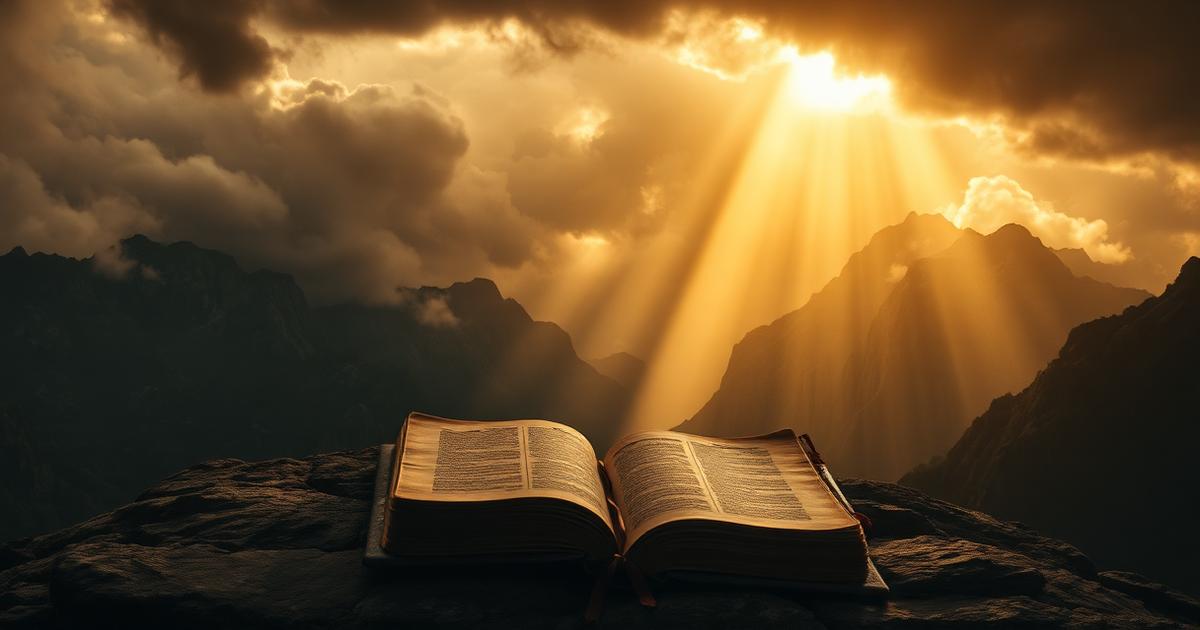
Chapter 11 closes the Watchers' judgment sequence with a promise: after the earth is cleansed, God will open the storehouses of blessing so that heaven's provision falls on a restored humanity.
Read-aloud is unavailable in this browser. The full chapter text is on the page above.
Book of Enoch Chapter 11: Modern Reading
'And in those days,' the voice continues, 'I will open the store chambers of blessing which are in the heaven, so as to send them down upon the earth, over the work and the labour of the children of men.'
The wording matters. The blessing is not sent down onto an empty landscape or a paradise handed over ready-made. It is sent down over work and over labour — over ploughed ground, over hands that are already busy. What heaven restores is the ordinary productivity that the giants had consumed and the Watchers' teaching had corrupted.
'And truth and peace shall be associated together throughout all the days of the world, and throughout all the generations of men.'
Two words are set side by side and left there: truth and peace. In the chapters that came before, they had been separated. There had been a kind of peace in the days of the Watchers — the quiet of people who did not yet know what had been done to them — and there had been truth, but only as an accusation. Chapter 11 imagines the two finally holding the same ground at the same time.
It is the shortest chapter in the Book of the Watchers, and it is placed where a reader most needs it: immediately after four chapters of binding, burial, fire and flood. The judgment sequence does not end on the image of Azazel in the darkness under the rocks. It ends on rain falling on a field.
Notice also what the chapter does not promise. It does not promise that the Watchers are restored, or that the giants are undone, or that what was taught can be untaught. It promises that the storehouses will be opened — that what heaven has been holding back will be released — and that the release will last for all the days of the world.
What Happens in Book of Enoch Chapter 11?
Chapter 11 closes the Watchers' judgment sequence with a promise: after the earth is cleansed, God will open the storehouses of blessing so that heaven's provision falls on a restored humanity.
What Does Chapter 11 Mean?
Chapter 11 is short but pivotal: it insists that judgment is not the last word. The removal of corruption is a doorway to blessing, not simply an end in itself. The Watchers cycle is structured as a repair, and this is the moment the repair completes.
The 'storehouses' language treats God's provision as an already-existing supply held back only by human and angelic corruption — an image that will return throughout Enoch's later journeys, where he is shown the physical treasuries of rain, wind, thunder and light.
The pairing of truth with peace is the chapter's quiet argument. A world that is calm but dishonest has not been healed, and a world that knows the truth but cannot live safely has not been healed either. Enoch's restored earth requires both, and requires them permanently.
Historical and Biblical Context
The pairing of 'peace and truth' becomes a recurring formula in Second Temple literature; it echoes Psalm 85:10 ('mercy and truth are met together; righteousness and peace have kissed each other') and prefigures later apocalyptic promises of a healed world.
The 'store chambers' or treasuries of heaven appear across ancient Jewish cosmology — Deuteronomy 28:12 speaks of the Lord opening 'his good treasure, the heaven, to give the rain unto thy land.' 1 Enoch takes the metaphor literally and will later give Enoch a tour of the rooms themselves.
This closing image completes the flood-and-restoration arc that began with the descent in Chapter 6 and sets the stage for Enoch's personal commission to the Watchers in Chapter 12. In the Aramaic Qumran fragments, chapters 10 and 11 run together as a single unit of judgment-then-blessing.
Key Ideas
Judgment ends in blessing.
The Watchers' story does not conclude with punishment; it concludes with a restored earth receiving what had been withheld.
Peace and truth belong together.
Enoch treats the two as inseparable — a restored world is one where honesty and safety appear at the same time.
Heaven has held back what earth is refusing.
The storehouses image implies that corruption itself is what closes the sky, and that the sky opens once the corruption is removed.
Blessing lands on labour.
The provision falls over 'the work and the labour of the children of men' — restoration is ordinary productivity resumed, not paradise substituted for it.
Questions Raised by the Chapter
Is Chapter 11 describing the flood or something later?
It reads primarily as the aftermath of the flood judgment in Chapter 10, but its language — 'throughout all the days of the world' — stretches toward a final, permanent restoration rather than a single historical recovery.
Why is such a short chapter given its own place?
It functions as the resolution of the Watchers cycle before Enoch himself steps forward as a messenger in Chapter 12. Structurally it is the exhale after four chapters of verdict.
What exactly is in the 'store chambers'?
The chapter does not say, but Enoch's later journeys itemize them: treasuries of the winds, the stars, the thunder, the dew and the rain. Chapter 11 assumes a stocked heaven and reports only that it is opened.