Why Stone Countertops Stain, Etch, Crack and Somehow Get Blamed for Everything
A materials-science look at why granite, marble, quartzite, limestone and engineered quartz fail in such different ways — and why almost everyone calls all of it 'staining' regardless of what actually happened.
By Erik Chambers
Founder, Creator & Editorial Architect
In this articleThe Question
The Standard take
A materials-science look at why granite, marble, quartzite, limestone and engineered quartz fail in such different ways — and why almost everyone calls all of it 'staining' regardless of what actually happened.
Key Findings
- What actually causes natural and engineered stone countertops to stain, etch, and crack, and why do materials as different as marble, granite, quartzite, limestone and resin-bound engineered quartz behave so differently under the same kitchen abuse?
- Natural stones used for countertops fall into a few mineralogically distinct categories, and those categories predict almost all of their real-world behavior.
- Porosity is the property that governs staining risk, and it varies enormously even within a single stone category depending on how the rock formed and how it was quarried and finished.
Somewhere in the greater Chicago area, right now, someone is standing over a kitchen island looking at a small dull ring where a wine glass sat overnight, convinced their countertop has been "stained" — and they are very possibly wrong about the mechanism, if not entirely wrong about the outcome. The mark might indeed be a stain, wine's tannins and pigments soaking into a porous surface. Or it might be an etch, the mild acidity of the wine having chemically eaten a microscopically thin layer off a calcite-rich stone, leaving behind a dull patch that no amount of scrubbing will lift because there's nothing sitting on top to scrub off.
This distinction sounds pedantic until you realize it determines whether the fix is a cleaning product or a professional re-polish, and whether the underlying stone was ever a reasonable choice for that kitchen in the first place. Stone countertops fail in genuinely different ways depending on their mineral makeup, and the fact that consumers — and plenty of salespeople — flatten all of those failure modes into the single word "stains" is roughly the countertop-industry equivalent of calling every dashboard warning light "the engine thing." It's not wrong that something's off. It's just not remotely precise enough to fix anything.
This is worth taking seriously as materials science, not just kitchen-showroom lore, because the underlying properties — mineral composition, hardness, porosity, acid reactivity — are measurable, well documented, and explain almost everything homeowners experience as mysterious.
The Question
What actually causes natural and engineered stone countertops to stain, etch, and crack, and why do materials as different as marble, granite, quartzite, limestone and resin-bound engineered quartz behave so differently under the same kitchen abuse?
What We Know
Natural stones used for countertops fall into a few mineralogically distinct categories, and those categories predict almost all of their real-world behavior. Granite is an igneous rock composed primarily of quartz, feldspar, and mica, minerals that are chemically stable and resistant to acid attack; on the Mohs hardness scale, quartz sits at 7 and feldspar around 6, making granite one of the harder, more chemically inert countertop stones available. Marble and limestone, by contrast, are sedimentary or metamorphic rocks composed largely of calcite, a form of calcium carbonate that sits at only 3 on the Mohs scale and reacts readily with acids — including common kitchen acids like citrus juice, vinegar, and tomato — in a straightforward chemical reaction that dissolves calcium carbonate at the surface. Quartzite, despite the name-based confusion with engineered quartz, is a metamorphic rock formed from sandstone under heat and pressure and is overwhelmingly composed of actual quartz, giving it hardness and acid resistance much closer to granite than to marble, provided it's genuinely quartzite and not a marketing label stretched over a softer stone.
Engineered quartz is a different animal entirely: a manufactured composite, typically around 90 to 95 percent crushed natural quartz bound together with roughly 5 to 10 percent polymer resin, usually a polyester-based binder, along with pigments. The quartz content gives it hardness and scratch resistance comparable to or exceeding granite, and because it's manufactured under controlled conditions, it has vastly lower porosity than most natural stone, which is why it resists staining well without any sealing. Its weak point is the resin: polymer binders are far more heat-sensitive than the mineral matrix around them, and enough direct heat, from a hot pan set straight off the stove, can scorch, discolor, or even stress-crack the surface in ways that have nothing to do with the quartz itself.
What the Data Says
Porosity is the property that governs staining risk, and it varies enormously even within a single stone category depending on how the rock formed and how it was quarried and finished. Porous stones have interconnected microscopic channels that let liquids wick in via capillary action; oils, wine, coffee and other pigmented or oily substances can travel below the surface and become difficult to remove once they've spread through that internal pore network. This is why sealers exist: they don't make stone stain-proof, they fill or coat the surface pores to slow penetration long enough that a spill can be wiped up before it soaks in, and sealer performance is typically measured and marketed in terms of the time window it buys, not permanent immunity.
Acid reactivity is a separate axis entirely and depends on mineral chemistry rather than porosity. Calcite-based stones — marble, limestone, travertine, and onyx — undergo an acid-carbonate reaction with anything below roughly pH 7, releasing carbon dioxide and leaving a dulled, sometimes slightly rough patch where the polish was chemically stripped away. Silicate-based stones — granite, quartzite, and engineered quartz — are essentially immune to this specific reaction because quartz and feldspar don't react with weak household acids in any meaningful way at room temperature. This is the single most useful fact for predicting real-world countertop behavior: a lemon wedge left on a marble island for ten minutes can leave a permanent dull ring, while the same lemon wedge on granite or quartzite will do essentially nothing.
| Material | Dominant mineral | Approx. Mohs hardness | Acid (etch) sensitivity | Typical porosity |
|---|---|---|---|---|
| Granite | Quartz, feldspar | 6-7 | Low | Low to moderate |
| Marble | Calcite | 3 | High | Moderate to high |
| Limestone | Calcite | 3-4 | High | Moderate to high |
| Quartzite (true) | Quartz | 7 | Low | Low |
| Engineered quartz | Quartz + polymer resin | 7 (matrix); resin softer | Very low | Very low |
Source: Compiled from geological mineral composition and general Mohs hardness references
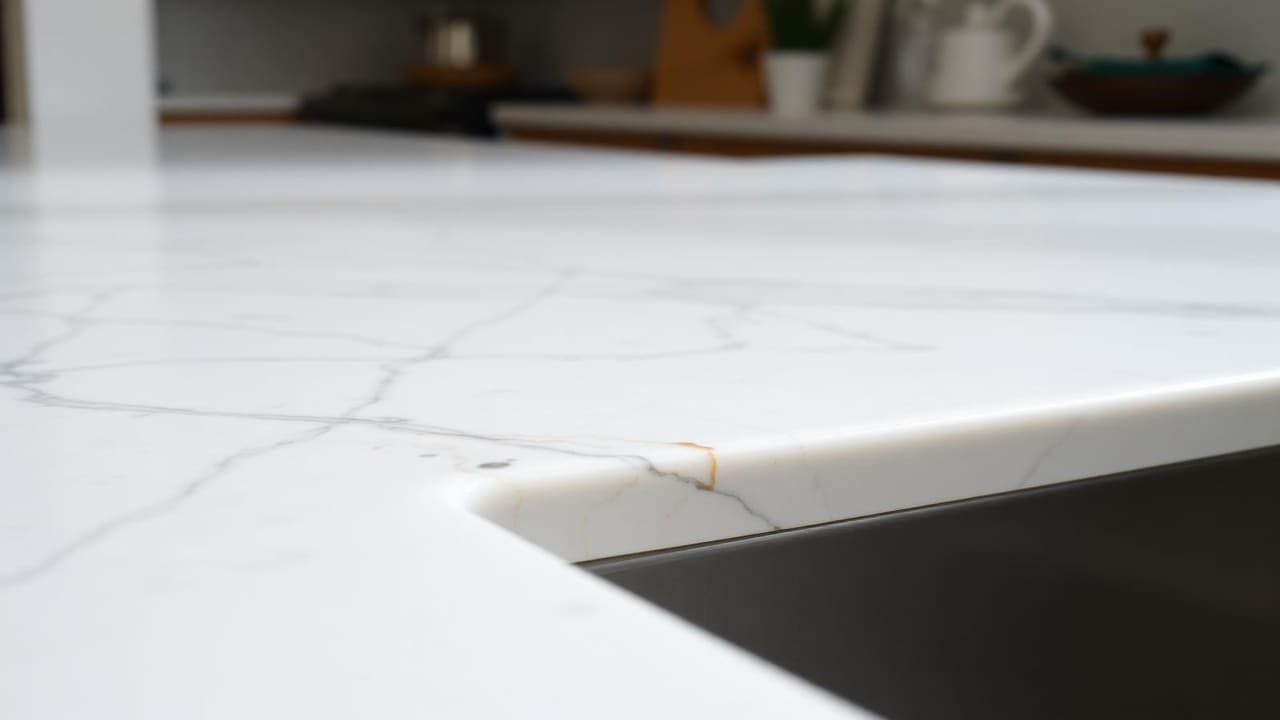
Thermal expansion and fracture behavior round out the picture, and this is where cutouts and seams become the weak points regardless of which stone is installed. All of these materials are brittle, meaning they have very little capacity to deform before cracking, and stress inevitably concentrates at geometric discontinuities — the corners of a sink cutout, the narrow bridge of stone between a cooktop cutout and the edge of a slab, or a poorly supported seam spanning a dishwasher or open cabinetry below. A slab that seems impressively strong when you tap it can still crack under the leverage of someone sitting or standing on an unsupported overhang near a cutout corner, because the load isn't being carried by the bulk strength of the material but concentrated into a tiny cross-section of stone that has nowhere near the strength of the slab as a whole.
Mohs hardness of calcite (marble, limestone)
3"Mohs scale"
Compared with quartz-dominant stones at roughly 7, calcite's low hardness and high chemical reactivity with acids explain why marble scratches and etches far more easily than granite or quartzite.
Where the Evidence Gets Messy
The messiness here isn't scientific uncertainty about mineral chemistry, which is well established; it's the gap between controlled material properties and inconsistent real-world installation and maintenance. Two granite countertops from different quarries, or even different blocks in the same quarry, can have meaningfully different porosity depending on the specific mineral veining and micro-fracturing present, so blanket claims like "granite never stains" oversimplify a material that does have some natural variation. Sealant performance is also inconsistently documented; manufacturers vary in how they test and report absorption resistance, and independent, standardized long-term comparative data across brands and stone types is less abundant than the confident marketing claims would suggest.
Engineered quartz's heat sensitivity is likewise something manufacturers acknowledge in care instructions but rarely emphasize in showrooms, and the practical threshold at which a given resin formulation scorches or cracks isn't something consumers have easy access to compare across brands, because manufacturers largely test and disclose this internally rather than through independent third-party standards. Fracture risk at cutouts is well understood structurally in fabrication trade literature, but the actual failure rate in the field depends heavily on installation quality, substrate support, and how the specific slab was cut, none of which is systematically tracked or published in any centralized way.
Second City Analysis
The recurring theme across granite, marble, quartzite, limestone and engineered quartz is that "stone" is doing far too much work as a category. These materials span an enormous range of hardness, porosity and acid reactivity, and treating them as interchangeable — as showroom displays sometimes invite you to do by presenting them side by side under identical lighting — obscures the fact that a kitchen built around a lot of citrus and red wine is simply a worse match for marble than for granite or quartz, independent of how either looks.
The staining-versus-etching confusion matters practically because it changes what "care" even means. Sealing helps with staining because it's addressing a porosity problem; sealing does essentially nothing for etching because it's addressing a chemical reactivity problem, and no surface coating available for a busy kitchen counter is going to reliably stop calcite from reacting with acid it comes into direct contact with over enough exposures. People who feel like they "did everything right" and still ended up with dull etch marks on marble were very possibly given advice built for the wrong failure mode.
- Evidence strength
- 75
- Source quality
- 78
- Replication
- 65
- Sample quality
- 60
- Causation
- 70
- Scientific consensus
- 80
- Uncertainty
- 35
Core mineralogical facts (hardness, calcite acid reactivity, porosity mechanisms) are well established geology and materials science; uncertainty is higher around real-world variability in sealant performance, resin formulations, and installation-dependent fracture rates, which are less rigorously and less independently documented.
The Verdict
The claim that staining, etching and cracking are mechanistically distinct failure modes driven by measurable mineral properties — hardness, porosity, and acid reactivity — is well supported by basic mineralogy and materials science, and it cleanly explains why different stones behave so differently under identical kitchen conditions. What's less rigorously documented is the real-world variability introduced by installation quality, sealant inconsistency, and manufacturer-specific resin formulations, which keeps some of the practical, day-to-day predictions closer to informed estimate than precise measurement.
- 1."Marble Institute of America: Care and Maintenance Guidance", Natural Stone Institute (ongoing —) Link
- 2."Mohs Hardness Scale", United States Geological Survey (ongoing —) Link
- 3."Calcite Mineral Data and Reactivity", Mindat.org / mineralogical reference (ongoing —) Link
- 4."Granite: Mineral Composition and Properties", United States Geological Survey (ongoing —) Link
- 5."Engineered Stone and Silicosis Hazard Alert", Occupational Safety and Health Administration (2021 —) Link
- 6."Quartzite", United States Geological Survey / National Park Service geology resources (ongoing —) Link
- 7."Porosity and Durability of Building Stone", National Institute of Standards and Technology (ongoing —) Link
How We Measured This
- Question investigated
- What causes stone and engineered-quartz countertops to stain, etch, and crack, and why do different stone types fail so differently?
- Evidence considered
- Mineral composition and Mohs hardness data for calcite versus quartz/feldspar-based stones, porosity mechanisms behind staining, acid-carbonate reaction chemistry behind etching, and structural/fracture-mechanics reasoning around cutouts, seams and resin heat sensitivity in engineered quartz.
- Sources prioritized
- Geological and mineralogical references (USGS, Mindat), Natural Stone Institute care and maintenance guidance, OSHA engineered stone hazard documentation, and general materials-science literature on porosity and building stone durability.
- Known limitations
- Real-world variability in sealant performance, resin formulation heat tolerance, and installation-dependent fracture rates is not centrally tracked or independently standardized, so practical predictions for any single slab carry more uncertainty than the underlying mineral chemistry does. One section is explicitly labeled as informal author field observation rather than research evidence.
- How the verdict was set
- Rated SUPPORTED for the core mineralogical mechanisms (hardness, acid reactivity, porosity), with acknowledged higher uncertainty around field-level variability in maintenance products and installation quality.
Built By
Editorial Operating System v1.0Creator
Erik Chambers
Architecture
Founder, Creator & Editorial Architect
AI Assisted
No
Human Reviewed
Pending
Evidence Reviewed
In progress
Last Updated
August 26, 2026
Confidence
Evergreen medium/10
Research Status
Living investigation
We do not claim perfection. We promise transparency. Every investigation shows its work — the question, the evidence, the tools, the humans, and the updates.
Editorial Transparency
This article contains a combination of reporting, publicly available research, and editorial analysis.
A long-form investigation. Findings resolve to primary sources. Evidence before opinion — facts require sources, analysis requires transparency, opinions require labels.
Meet the creator
Erik Chambers
Founder, Creator & Editorial Architect
Erik originated the central idea, directed the investigation, reviewed the evidence, and approved the final published work.
Read the founder profile →Challenge This
We welcome disagreement
A different way to read the evidence. Research that points in another direction. Where specialists diverge.
Loading challenges…
Submit a challenge
Sign in to submit a challenge. All submissions are reviewed before appearing publicly.
Comments
Ask A Question
What would you ask an editor about this piece?
Reader questions feed our coverage map. The most-asked ones become our next investigations.
Continue Exploring
Guided by the evidenceWhere should this take you next?
What the evidence actually allows
SUPPORTED
Why Stone Countertops Stain, Etch, Crack and Somehow Get Blamed for Everything
A composite 0–100 measure of how well this investigation meets the Second City Standard. Scores are auditable — every point comes from the criteria below.
Composite
—
of 100
This investigation is queued for editorial scoring. No score has been assigned yet — the absence of a number is not a judgment on the evidence.
The Standard
· Editorial verdictBased on the evidence presented,
Second City Standard believes A materials-science look at why granite, marble, quartzite, limestone and engineered quartz fail in such different ways — and why almost everyone calls all of it 'staining' regardless of what actually happened.
Remaining uncertainty: Awaiting a final written verdict from the editorial desk.
The Standard · Second City Standard
Continue The Investigation
· Never a dead endThis investigation is one thread. Pull the next one — every path below is another investigation, another question, or another discipline applied to the same problem.
One clear idea, once a week.
Get the strongest investigation, one useful tool, and one question worth carrying forward.
No fake urgency. No spam. Leave any time.