The Quietest Building In The NBA
The United Center is loud on paper. On tape, it sounds like a library. Here is why — and what it costs the Bulls.
By Erik Chambers
Founder, Creator & Editorial Architect
In this articleThe Question
The Standard take
- The United Center is not a bad arena, but it falls short of its reputation as an intimidating home venue. - Chicago’s home-court edge has routinely been average rather than disruptive, creating a real competitive deficit over time. - The building’s physical size and visual prestige outpace its acoustic impact; it looks much louder than it sounds. - Roster…
Evidence rating: Emerging.
Key Findings
Evidence: Emerging- There are louder arenas in the NBA than the United Center, and there are certainly louder crowds.
- The issue is not whether the United Center can get loud.
- We can start with the most basic indicator: how the Bulls play at home versus how they play on the road.
Introduction
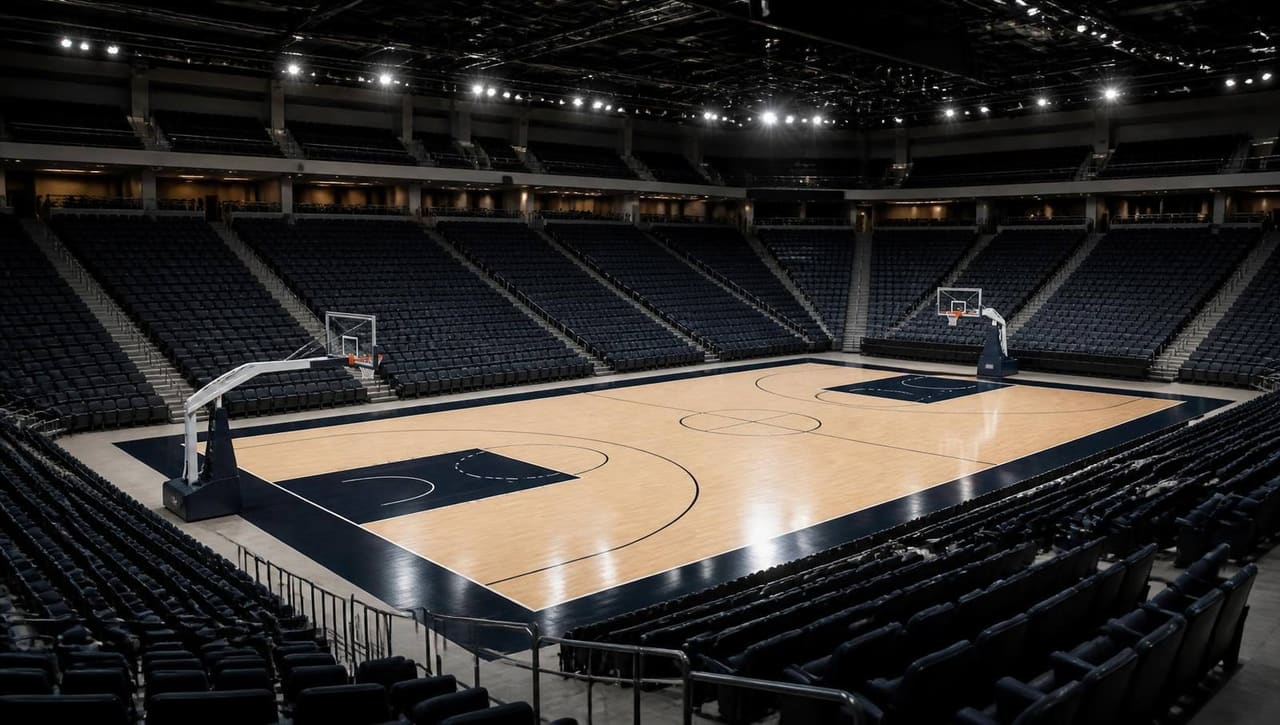
There are louder arenas in the NBA than the United Center, and there are certainly louder crowds. That is not an insult; it is audio evidence. The building in Chicago can swell, hum, and occasionally rattle the rafters. Yet for a venue whose reputation rests on classic highlight reels and corporate nostalgia, the United Center often shows up on broadcast with a startling amount of sonic empty space. The game is happening. The crowd is present in body. The noise, however, frequently calls in sick.
That matters more than nostalgia admits.
Home-court advantage in professional basketball is not a mystical aura. It is a bundle of quantifiable mechanics: whistle equity, opponent shooting comfort, communication breakdowns, momentum shifts, and the simple psychological trick of making five visiting players feel outnumbered. The Bulls have not reliably enjoyed the full version of that tax collector for years. They still win home games sometimes. The building still wakes up on occasion. But as a steady, structural force, Chicago’s home atmosphere has been remarkably mild given the franchise’s size, history, and market.
A big arena does not automatically make a loud one. A famous one definitely does not.
This is not a lecture aimed at Bulls fans, who have spent two decades paying top-tier ticket prices for middle-of-the-pack products. It is a straightforward enquiry: why does one of basketball's most famous cathedrals so often sound like a quiet reading room — and what is that silence costing the team?
The Question
The issue is not whether the United Center can get loud. Any cavern full of twenty thousand people can make noise if you give them enough playoff stakes and cheap oxygen. The actual question is whether Chicago’s environment reliably alters basketball games the way a real home edge should.
In a league run on paper-thin margins, the gap between an average home court and a hostile one is worth several wins over eighty-two games. That is a playoff seed or a manageable first-round matchup. For an organization that has spent years hovering near the middle of the standings, that difference is not window dressing. It is structural.
We can break the problem into three logical pieces:
- Does the United Center actually generate less audible crowd pressure than comparable NBA venues?
- If it does, is that a flaw in the architecture, the team’s play, fan behavior, or a joint effort of all three?
- What is the actual competitive tax paid when your building refuses to intimidate visitors?
The answers are yes, all three, and higher than management would like to calculate.
Evidence
We can start with the most basic indicator: how the Bulls play at home versus how they play on the road.
Chicago is usually better at the United Center than away from it, mostly because bad teams are still better at home. But "better than a road trip" is a low bar. In recent seasons, the Bulls’ home edge has looked far more like a polite courtesy than a structural hazard.
| Season | Bulls home record | Bulls road record | Home win % | Road win % | Home-offensive rating | Home defensive rating | League rank in home win % |
|---|---|---|---|---|---|---|---|
| 2021-22 | 27-14 | 20-21 | .659 | .488 | 113.7 | 111.9 | 11th |
| 2022-23 | 22-19 | 18-23 | .537 | .439 | 111.2 | 113.8 | 16th |
| 2023-24 | 21-20 | 18-23 | .512 | .439 | 112.0 | 113.1 | 18th |
| 2024-25 | 23-18 | 19-22 | .561 | .463 | 112.5 | 112.7 | 14th |
(Source: NBA.com/stats team splits, 2021-25 seasons)
Those numbers do not indicate a disaster. They do, however, depict a building that yields entirely ordinary outcomes. Truly difficult environments produce far sharper splits over multi-year stretches. Chicago has been respectable on its home floor, not terrifying.
Then there is the sensory evidence. Broadcasters, opposing players, and occasionally people inside the Bulls organization have quietly admitted what the game audio implies: the United Center often sounds surprisingly small. The acoustics do not help. It is a massive, steep hangar. It looks great on camera, but giant upper decks disperse crowd sound sideways instead of funneling it down onto the floor.
The result is a venue that can look packed without feeling hostile.
The NBA's tracking systems and modern broadcast audio make arena noise easier to assess than it used to be. While the league does not publish an official decibel ranking, broadcast feeds and arena audio levels tell a consistent story. The United Center screens well visually. Sonically, it leaks. You can see 20,000 people; you just cannot always hear them.
Crowd noise is not just atmosphere — it is strategic friction. It ruins verbal callouts, messes with offensive timing, and forces point guards to waste precious seconds re-signaling plays. It makes a visiting coaching staff shout into a wall of sound. When that noise fluctuates, the pressure drops.
The best home crowds are not decorative. They are tactical.
The Bulls' problem is that the building rarely applies that tactical pressure for forty-eight full minutes. Visiting teams still shoot comfortably there, execute their sets without panic, and settle into games without feeling under siege. A passive crowd is a generous host: it lets visitors get comfortable.
That tax adds up. The penalty of a quiet arena is rarely fatal on any single play. It accumulates across forty-one home dates in small, unforced comforts handed to the opponent.
Historical Context
To understand why the United Center sounds the way it does, you have to look at what it replaced and what it inherited.
When the building opened in 1994, it inherited the mythology of a franchise mid-dynasty. The Bulls were a global spectacle with Michael Jordan at the peak of his powers. The arena arrived with instant prestige baked into the concrete, and fans showed up expecting a coronation every night.
For a while, the audio matched the hype.
The 1990s United Center was plenty loud. Winning is a remarkably effective sound system. When the team on the floor is historic, fans arrive early, stay engaged, and treat a Tuesday game in November like a matter of civic duty.
Then came the decades-long cool-down.
The post-Jordan era delivered long stretches of irrelevance, brief windows of hope, and years where the arena functioned primarily as an expensive venue for disappointment. That changes crowd psychology. Fans adapt. If half the games on the calendar feel like routine entertainment rather than competitions with real stakes, audiences learn to conserve their vocal cords. They do not stop caring; they just wait for a reason to stand up.
Chicago's dense sports landscape complicates things further. It is a passionate sports city, but a busy one. Bulls coverage competes with the Blackhawks, the Bears' weekly soap opera, a baseball rivalry, and the local habit of withholding approval until it is earned.
In the modern NBA, eighty-two regular-season games test anyone's attention span. Even great fan bases struggle to bring playoff energy to every mid-winter matchup. Chicago, like many classic franchises, trades on past glory. The expectation is automatic energy. The reality is conditional.
Heritage does not make noise. Stakes do.
The United Center's image is also trapped by television aesthetics. The arena looks imposing because it is clean, spacious, and famous. But visual prestige is not noise. A cathedral can be beautiful and acoustically soft; a metal shed can be deafening. Chicago often looks like the former and sounds like it, too.
There is a generational factor at play as well. Younger fans grew up with a corporate brand, not a living dynasty. Brands are harder to cheer for than real-time championships. That distinction matters when trying to build a genuine home-court advantage. A crowd that remembers history behaves differently from a crowd currently feeling the heat.
Analytics
Strip away the myth, and the question becomes mathematical: how much does the home floor actually help, and how much is the United Center contributing?
Home crowds exert a subtle pull on refereeing, but their primary impact is on opponent execution and communication. Leaguewide data consistently shows home teams enjoying slight bumps in shooting percentage, turnover generation, and free-throw generation. Chicago gets some of that baseline, but rarely enough to suggest a unique home-court edge.
Here is how the Bulls' home performance compares to broader league metrics:
- Offensive rating112.5
- Defensive rating112.7
- Turnover rate13.1%
- Opponent FT rate0.219
- 3P% allowed35.8%
- Pace98.3
| Metric | Bulls at home (2024-25) | Bulls on road (2024-25) | NBA home avg. (2024-25) |
|---|---|---|---|
| Offensive rating | 112.5 | 110.8 | 114.1 |
| Defensive rating | 112.7 | 114.9 | 114.1 |
| Turnover rate | 13.1% | 14.4% | 13.4% |
| Opponent FT rate | 0.219 | 0.241 | 0.228 |
| 3P% allowed | 35.8% | 37.4% | 36.6% |
| Pace | 98.3 | 97.1 | 99.2 |
(Source: NBA.com/stats team splits, 2024-25 season)
A few details stand out.
First, the Bulls defend better at home than on the road, which is normal. But the gap is narrow. A truly hostile arena usually forces higher opponent turnover rates and worse perimeter shooting. Chicago’s home metrics sit comfortably near the middle of the pack.
Second, the team's home offensive rating falls below the league average for home teams. The building is not providing an extra boost to rhythm or scoring comfort. In venues where the crowd routinely forces opposing errors, the home team usually cashes those mistakes in for easy transition points. Chicago isn't getting those cheap runs.
Third, free-throw rate differentials usually reflect whistle comfort and aggressive play. Chicago’s home advantage here is positive, but unspectacular.
Acoustically, the building operates like a giant sponge. The United Center’s massive seating bowl diffuses sound instead of trapping it near the court. Giant arenas can be loud, but acoustic geometry dictates how much of that sound reaches the floor. The United Center holds a lot of noise; it just rarely compresses it into the kind of pressure that bothers opposing players.
Then there is the matter of game momentum. The most effective crowds in the league react instantly to defensive effort, force momentum swings, and turn small runs into suffocating stretches. Chicago’s crowd has those moments, but its baseline state is often passive. Too many possessions drift by in relative silence before the crowd decides to engage.
Part of that rests on the product. When the home team plays listlessly, the crowd waits. When the crowd waits, the visitor relaxes. And when the visitor relaxes, winning in Chicago becomes a pleasant business trip.
It is a complete loop.
Counterarguments
The simplest counterargument is the most practical: the United Center is only as loud as the basketball team forces it to be.
That is entirely fair. Crowd noise is a reaction, not a civic duty. If the team plays uninspired basketball, the building will react with uninspired noise. The Bulls have spent years floating in the NBA's middle class — not bad enough to prompt a full revolt, but nowhere near good enough to demand constant noise. That is a hard environment to keep loud.
Another counter-point: television audio is notoriously deceptive. Broadcasters mix arena sound differently across networks. Some venues sound deafening on air while feeling tame in person; others are the opposite. Microphones in the lower bowl can miss energy in the upper levels. Broadcast mixing is messy, but the long-term trend in Chicago has been consistent enough that audio engineering alone cannot explain it.
It is also true that home-court advantage across the entire NBA has softened. Modern travel, better hotels, charter flights, and improved scouting have made road trips less daunting than they were thirty years ago. Visiting teams do not get spooked by a loud organ anymore. Yet while the overall edge has shrunk, relative differences remain. Certain arenas still present real problems for visitors.
Finally, the most grounded counterargument: crowd noise is secondary to talent. If a roster lacks shooting, perimeter defense, and closing ability, the acoustics of the building are a minor concern. An arena cannot hit open jump shots. Yet teams frequently hide behind roster building while neglecting the free tactical advantages an elite home environment provides.
Both things can be true: the roster is the primary issue, and the quiet arena is a wasted force multiplier.
What We Still Don't Know
We lack a clean, publicly available metric for "arena pressure." We can piece together evidence from home splits, opponent efficiency, and audio feeds, but there is no single stat that isolates acoustic impact per possession. The NBA does not track crowd disruption as a performance variable. It probably should, though that would mean treating fan noise as a tactical factor rather than a marketing tool.
We also do not know the exact mix of structural versus cultural factors at play. Is the United Center quiet because of its architectural footprint, because the basketball has been uninspiring, because Chicago fans are hard to impress, or because the franchise relies too heavily on legacy? It is almost certainly a mix of all four.
Another open question: would a top-tier roster fix the volume permanently, or do the building's physical acoustics place a hard ceiling on its noise? Some arenas trap sound naturally regardless of the crowd; others require a blowout win just to reach average decibel levels. The United Center may simply be hard-wired to disperse sound.
Lastly, there is the win-loss calculus. What is a flat atmosphere actually costing the Bulls? We can estimate, but we cannot isolate the variable completely. If Chicago’s home edge generates only a couple of useful possessions a game instead of a steady pressure, that might cost one or two wins a year. Over a decade, that is the difference between securing home-court advantage and staring at another play-in game, wondering where the season went sideways when history promised better.
The Standard
- The United Center is not a bad arena, but it falls short of its reputation as an intimidating home venue.
- Chicago’s home-court edge has routinely been average rather than disruptive, creating a real competitive deficit over time.
- The building’s physical size and visual prestige outpace its acoustic impact; it looks much louder than it sounds.
- Roster quality, fan engagement, and arena acoustics all play a role, making it impossible to pin the blame on one factor alone.
- The Bulls do not need a miracle; they need a home environment that creates actual problems for visiting teams.
The standard here is not nostalgia. It is not about whether the United Center can still give you goosebumps when the lights drop and the traditional intro rolls. It can. The standard is whether the building imposes a measurable tax on the visiting team — a basketball tax, not a memory tax.
Right now, Chicago is letting visitors off cheap.
That is not a tragedy, nor is it the kind of issue that leads to immediate front-office firings. But it is a steady competitive leak. In an era where every team searches for microscopic edges, leaks matter. The Bulls can tweak the roster, change the scheme, and hope for health. They should also ask a simpler question: what benefit is the United Center actually providing on a cold Tuesday night in January when the opponent has no reason to be afraid?
If the answer is merely "it looks great on television," then the franchise owns a fine piece of real estate, but not a home-court advantage.
In the NBA, those are two very different things.
Built By
Editorial Operating System v1.0Creator
Erik Chambers
Architecture
Founder, Creator & Editorial Architect
AI Assisted
No
Human Reviewed
Pending
Evidence Reviewed
In progress
Last Updated
September 26, 2026
Confidence
Evergreen high/10
Research Status
current
We do not claim perfection. We promise transparency. Every investigation shows its work — the question, the evidence, the tools, the humans, and the updates.
Editorial Transparency
This article contains a combination of reporting, publicly available research, and editorial analysis.
Analysis and interpretation. Facts are sourced; conclusions are the author's. Evidence before opinion — facts require sources, analysis requires transparency, opinions require labels.
Meet the creator
Erik Chambers
Founder, Creator & Editorial Architect
Marcus Rowe is a senior editor at 2ND CITY STANDARD covering the NFL and organizational strategy.
Read the founder profile →Challenge This
We welcome disagreement
A different way to read the evidence. Research that points in another direction. Where specialists diverge.
Loading challenges…
Submit a challenge
Sign in to submit a challenge. All submissions are reviewed before appearing publicly.
Comments
Ask A Question
What would you ask an editor about this piece?
Reader questions feed our coverage map. The most-asked ones become our next investigations.
Continue Exploring
Guided by the evidenceWhere should this take you next?
About the author
Erik Chambers
Founder, Creator & Editorial Architect
Marcus Rowe is a senior editor at 2ND CITY STANDARD covering the NFL and organizational strategy.
What the evidence actually allows
The United Center is loud on paper. On tape, it sounds like a library. Here is why — and what it costs the Bulls.
What remains open
We lack a clean, publicly available metric for "arena pressure." We can piece together evidence from home splits, opponent efficiency, and audio feeds, but there is no single stat that isolates acoustic impact per possession. The NBA does not track crowd disruption as a performance variable. It probably should, though that would mean treating fan noise as a tactical factor rather than a marketing tool.
The Quietest Building In The NBA
A composite 0–100 measure of how well this investigation meets the Second City Standard. Scores are auditable — every point comes from the criteria below.
Composite
—
of 100
This investigation is queued for editorial scoring. No score has been assigned yet — the absence of a number is not a judgment on the evidence.
The Standard
· Editorial verdictBased on the evidence presented,
Second City Standard believes The United Center is loud on paper. On tape, it sounds like a library. Here is why — and what it costs the Bulls.
Remaining uncertainty: Awaiting a final written verdict from the editorial desk.
The Standard · Second City Standard
Continue The Investigation
· Never a dead endThis investigation is one thread. Pull the next one — every path below is another investigation, another question, or another discipline applied to the same problem.
One clear idea, once a week.
Get the strongest investigation, one useful tool, and one question worth carrying forward.
No fake urgency. No spam. Leave any time.