Tehran UFO Incident (1976)
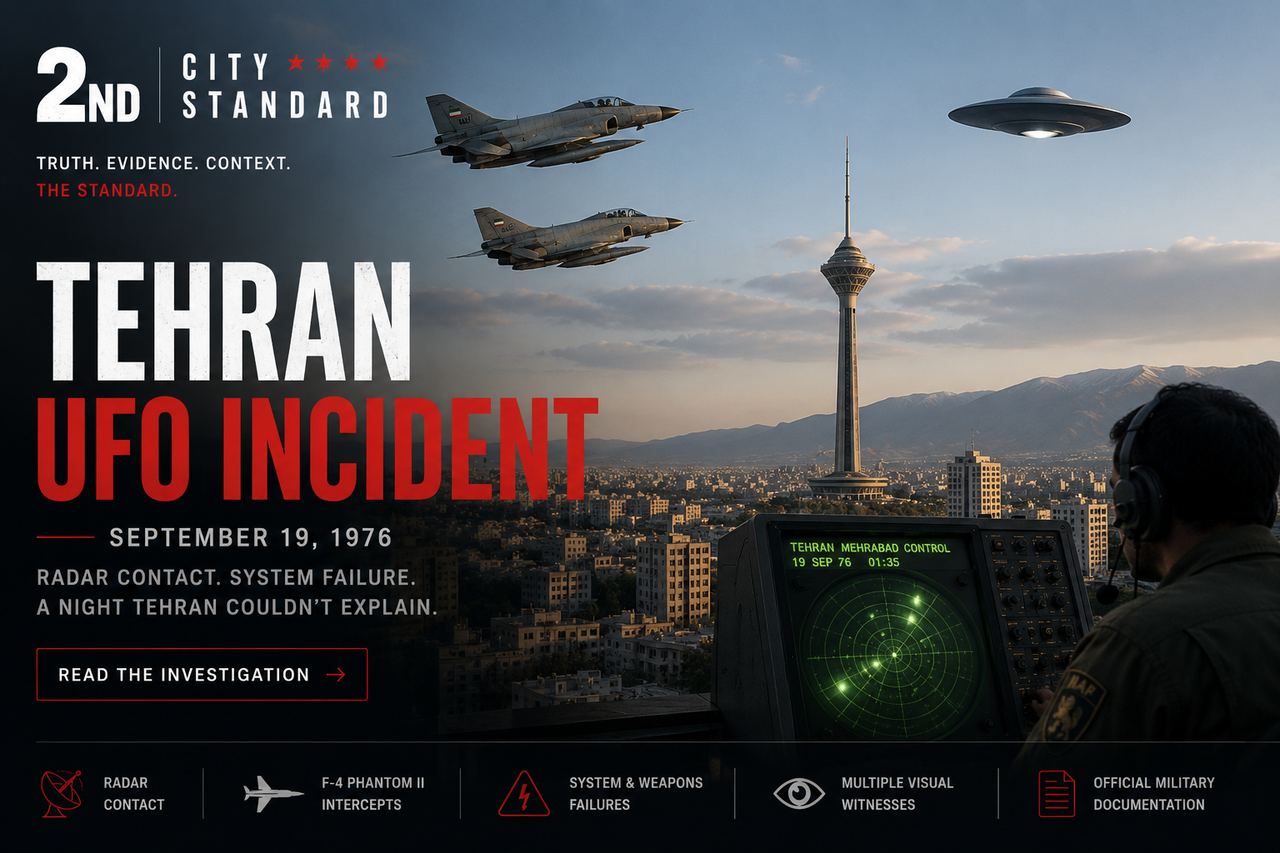
The Tehran UFO Incident refers to a series of reported radar and visual contacts with an unidentified aerial object (UAO) over Tehran, Iran, during the early morning hours of September 19, 1976. The event involved multiple Iranian Imperial Air Force (IIAF) F-4 Phantom II jet inte
By Erik Chambers
Founder, Creator & Editorial Architect
The Standard take
The Standard
Evidence rating: Emerging.
Key Findings
Evidence: Emerging- The chronology below is deliberately reconstructed from the surviving military documentation rather than later Internet timelines.
- Verified An authentic declassified United States military document records an incident involving unidentified aerial observations over Iran on September 19, 1976.
- Reported Citizens in the Tehran area described strange airborne objects, with some accounts comparing what they saw to birds or brightly illuminated helicopters.
Two fighter jets were sent into the night over Tehran. Their crews reported a brilliantly illuminated object, radar contact and aircraft systems failing during portions of the intercept. Nearly fifty years later, the paperwork is real. The explanation remains considerably less cooperative.
The 1976 Tehran UFO incident occupies an unusual place in the history of unidentified aerial phenomena because we are not working exclusively from a newspaper clipping, somebody's recollection at a convention or a story that somehow gained another flashing light every decade it survived.
There is an official United States military record.
The surviving military report describes civilian observations near Tehran, the dispatch of two Imperial Iranian Air Force F-4 Phantom II interceptors, radar contact reported by the second aircraft and temporary aircraft-system failures reported by both crews. SOURCE 1 ↗
That makes Tehran interesting. It does not automatically make it extraterrestrial. Official paperwork proves that an encounter was reported through military channels. It does not transform an unidentified light into an interstellar visitor simply because the story is considerably more entertaining that way.
The Second City Standard approach is therefore straightforward: separate what the documents actually establish from what witnesses reported, what later accounts added and what the surviving evidence still cannot answer.
The Incident
Documented The surviving U.S. military report concerns unidentified aerial observations in the Tehran area during the early morning of September 19, 1976. It records civilian reports followed by the dispatch of two Imperial Iranian Air Force F-4 Phantom II aircraft. SOURCE 1 ↗
The first F-4 crew reported losing instrumentation and UHF/intercom communications while approaching the object. According to the military report, the affected systems returned after the pilot abandoned the intercept and turned back toward Shahrokhi Air Force Base. SOURCE 1 ↗
A second F-4 was then dispatched. Its crew reported obtaining a radar lock and later described another illuminated object apparently separating from the primary light and moving toward the aircraft. SOURCE 1 ↗
When the second pilot attempted to use an AIM-9 missile, the report states that his weapons-control panel became inoperative and his communications were lost. The pilot maneuvered away rather than firing. SOURCE 1 ↗
Timeline of Events
The chronology below is deliberately reconstructed from the surviving military documentation rather than later Internet timelines. That matters because apparently UFOs are not the only things capable of drifting over time.
The military report states that the Tehran-area command post received four telephone calls from citizens in the Shemiran area reporting strange objects in the sky. Witness descriptions reportedly included bird-like objects and brightly illuminated objects resembling helicopters. SOURCE 1 ↗
A senior Iranian Air Force officer reportedly went outside and personally observed an object north of Tehran that resembled a star but appeared larger and brighter. The decision was then made to send an F-4 to investigate. SOURCE 1 ↗
The first Imperial Iranian Air Force F-4 took off and proceeded toward a point roughly forty nautical miles north of Tehran. SOURCE 1 ↗
At an estimated range of approximately twenty-five nautical miles from the object, the first F-4 crew reported losing instrumentation and UHF/intercom communications. The pilot abandoned the intercept and headed back toward Shahrokhi; the report states that the affected systems returned as the aircraft moved away. SOURCE 1 ↗
A second F-4 was launched. The military report states that its crew later obtained a radar lock on the object at approximately twenty-seven nautical miles. SOURCE 1 ↗
The crew reported that the object remained visible on the aircraft's radar scope while maintaining separation. The radar return was described in the report as comparable in apparent size to that of a large tanker aircraft, although the object's intense brightness prevented a useful visual size estimate. SOURCE 1 ↗
The second crew reported seeing another bright object apparently emerge from the primary object and move toward the F-4. The pilot attempted to fire an AIM-9 missile, but the report states that the weapons-control panel became inoperative and UHF/intercom communications were lost. SOURCE 1 ↗
The report describes another luminous object apparently descending toward the ground and illuminating an area approximately two to three kilometers across. The crew later attempted to identify the location from the air. SOURCE 1 ↗
The F-4 crew reported communication interference in the Mehrabad area. The report also states that a civilian airliner experienced a communications failure in the same general vicinity, although the civilian crew did not report seeing an unusual object. SOURCE 1 ↗
The report states that the F-4 crew returned to the suspected ground area by helicopter. Nothing unusual was visibly identified at the location they believed the luminous object had approached, although the crew reported detecting an unusual beeping signal nearby. SOURCE 1 ↗
Verified Facts
Verified An authentic declassified United States military document records an incident involving unidentified aerial observations over Iran on September 19, 1976. SOURCE 1 ↗
The report records the dispatch of two Imperial Iranian Air Force F-4 aircraft in response to the sightings. SOURCE 1 ↗
The first crew reported losing instrumentation and communications while approaching the unidentified object and reported that the affected systems returned after the aircraft moved away. SOURCE 1 ↗
The second crew reported obtaining an airborne radar lock on the object. SOURCE 1 ↗
The same crew reported a weapons-control malfunction and loss of communications when the pilot attempted to employ an AIM-9 missile. SOURCE 1 ↗
A later official U.S. Air Force publication summarized the same episode, including the citizen reports, first F-4 system failures, second F-4 radar contact and subsequent weapons-system malfunction. SOURCE 2 ↗
Reported Claims
Reported Citizens in the Tehran area described strange airborne objects, with some accounts comparing what they saw to birds or brightly illuminated helicopters. The military report notes that no helicopters were believed to be airborne in the relevant area at the time. SOURCE 1 ↗
The second F-4 crew described the primary object as intensely brilliant, with flashing blue, green, red and orange lights arranged in what the report describes as a rectangular pattern. SOURCE 1 ↗
The crew also reported observing multiple smaller illuminated objects that appeared to separate from the primary object during different portions of the encounter. SOURCE 1 ↗
These descriptions matter because they establish the nature of the testimony preserved in the official record. They should not, however, be converted into independently verified measurements of dimensions, velocity, propulsion or material properties that the documents themselves do not provide.
Radar & Instrument Evidence
Documented Report The second F-4 crew reportedly acquired an airborne radar lock at roughly twenty-seven nautical miles. The military document describes a radar return with an apparent size comparable to that produced by a large tanker aircraft. SOURCE 1 ↗
That wording deserves some restraint. A radar return being described as comparable to another aircraft's return does not establish that the unidentified object was physically the same size as that aircraft. Radar cross-section and apparent return strength are not the same thing as putting a tape measure around whatever was in the sky.
Reported The first F-4 crew reported instrumentation and communications loss during its approach. The second crew later reported a weapons-control failure and communications loss during its own encounter. SOURCE 1 ↗
Witness Testimony
Reported The military record begins with multiple civilian telephone reports from the Shemiran area and states that a senior Iranian Air Force officer personally observed a bright object before ordering the first intercept. SOURCE 1 ↗
The second F-4 crew described alternating blue, green, red and orange lights flashing rapidly enough that the colors appeared visible at the same time. SOURCE 1 ↗
Later public testimony by Iranian pilot Parviz Jafari became a major part of the modern telling of the case. Retrospective statements can be historically useful, but they should be distinguished from details documented in the contemporary military record.
That distinction is not an accusation that a witness is lying. Memory, terminology and storytelling can evolve across decades. For an evidence-driven investigation, contemporary records receive greater weight unless later details can be independently corroborated.
Official Investigations
Verified The principal surviving official source used for this investigation is the U.S. military document titled Report Concerning the Sighting of a UFO in Iran on 19 September 1976. SOURCE 1 ↗
The National Security Agency's public digital archive independently hosts a record identifying the Joint Chiefs of Staff report concerning the September 19, 1976 sighting in Iran. SOURCE 3 ↗
An additional official U.S. Air Force publication written by Captain Henry S. Shields later summarized the encounter under the title Now You See It, Now You Don't. That account describes the unusual episode involving two Imperial Iranian Air Force F-4 crews and discusses the difficulty of explaining the encounter from the information then available. SOURCE 2 ↗
Research Scope Within the three official sources reviewed for this article, Second City Standard did not identify a separately published Iranian government investigation containing the complete underlying radar data, avionics records and witness files. That statement describes the boundaries of our reviewed source set; it does not establish that additional internal records never existed. SOURCE 1 ↗ SOURCE 2 ↗ SOURCE 3 ↗
Scientific Analysis
Analysis The principal source is an operational military incident report rather than a controlled scientific experiment. It records observations and events reported by witnesses and aircrews, but it was not designed as a modern scientific dataset. SOURCE 1 ↗
Research Limitation For this investigation, Second City Standard reviewed the three official sources identified in our source ledger. Those reviewed materials do not provide the underlying raw radar records, calibrated optical measurements or comprehensive aircraft diagnostic data that would be necessary for us to independently reconstruct every technical element of the encounter. SOURCE 1 ↗ SOURCE 2 ↗ SOURCE 3 ↗
That creates the central evidence problem. The case contains several forms of reported observation — civilian visual sightings, military visual observations, airborne radar contact and aircraft-system anomalies — but the technical datasets necessary to independently test how those observations relate to one another are not supplied in the three reviewed documents. SOURCE 1 ↗ SOURCE 2 ↗
The surviving evidence can therefore support the narrower statement that an unusual military encounter was officially reported. It cannot establish the object's composition, propulsion system, exact dimensions or origin from the records reviewed here.
And yes, this is usually the point where both sides become irritated. Saying the case contains unresolved evidence is not the same as saying aliens did it. Saying aliens have not been proven is also not the same as saying nothing happened. Reality occasionally refuses to join anybody's team.
Skeptical Explanations
Analysis Reasonable conventional hypotheses for portions of the encounter include bright astronomical objects, conventional aircraft, meteors, visual misperception, radar interpretation errors and unrelated aircraft electrical or communications problems.
The initial object was described in the military report as star-like but larger and brighter. That makes astronomical misidentification a reasonable hypothesis to test against the earliest observation, although that explanation by itself would not automatically account for every event later reported by the F-4 crews. SOURCE 1 ↗
Aircraft lights, meteors or other transient luminous phenomena could potentially account for some of the smaller lights described during the encounter. Equipment faults could potentially account for some or all of the communications, instrumentation or weapons-control anomalies.
The problem is not coming up with conventional possibilities. Humans are spectacularly good at that. The problem is demonstrating from the surviving evidence that one specific explanation accounts for the entire sequence.
The three official sources reviewed for this article do not themselves establish one conventional explanation for every major reported component of the incident. SOURCE 1 ↗ SOURCE 2 ↗ SOURCE 3 ↗
That absence is a limitation of the available evidence. It is not affirmative evidence of extraterrestrial technology.
What Remains Unexplained
Unresolved The publicly available military documentation reviewed here does not conclusively identify the bright object observed by citizens, the Iranian officer and the F-4 crews. SOURCE 1 ↗
The surviving report does not establish what produced the radar return reported by the second F-4 crew. SOURCE 1 ↗
It does not establish why the first F-4 reportedly lost instrumentation and communications during its approach. SOURCE 1 ↗
It does not establish why the second aircraft reportedly experienced a weapons-control failure and communications loss during the later intercept. SOURCE 1 ↗
Nor does the report conclusively identify the smaller illuminated objects the second crew reported seeing during the encounter. SOURCE 1 ↗
The Standard
The Tehran incident clears an important evidentiary threshold: an authentic government record confirms that a serious military encounter involving unidentified aerial observations was formally reported. SOURCE 1 ↗
The same record documents the dispatch of two military aircraft, reported visual observations, reported airborne radar contact and reported aircraft-system anomalies. SOURCE 1 ↗
What the evidence does not establish is equally important. The reviewed documents do not prove that the object was extraterrestrial, nonhuman, interdimensional or representative of technology beyond human capability.
That leaves us somewhere less cinematic but more useful: trained military crews reported an encounter they could not identify, the event entered official military channels, and the surviving public record reviewed here does not contain enough technical evidence to conclusively determine what produced every reported observation.
The responsible conclusion is neither automatic dismissal nor unsupported certainty. Something unusual was reported. We have the paperwork. We do not have the answer.
Research Methodology
Methodology For this investigation, Second City Standard applied four editorial classifications to the evidence: documented, reported, analysis and unresolved. These classifications are part of our editorial methodology rather than claims made by the government sources. Contemporary official records were given greater evidentiary weight than later retrospective testimony, while recorded witness statements were treated as evidence of what witnesses reported rather than automatic proof that their interpretations were physically correct.
Primary Sources
Built By
Editorial Operating System v1.0Creator
Erik Chambers
Architecture
Founder, Creator & Editorial Architect
AI Assisted
No
Human Reviewed
Pending
Evidence Reviewed
In progress
Last Updated
September 27, 2026
Confidence
Evergreen high/10
Research Status
Living investigation
We do not claim perfection. We promise transparency. Every investigation shows its work — the question, the evidence, the tools, the humans, and the updates.
Editorial Transparency
This article contains a combination of reporting, publicly available research, and editorial analysis.
Analysis and interpretation. Facts are sourced; conclusions are the author's. Evidence before opinion — facts require sources, analysis requires transparency, opinions require labels.
Meet the creator
Erik Chambers
Founder, Creator & Editorial Architect
Erik originated the central idea, directed the investigation, reviewed the evidence, and approved the final published work.
Read the founder profile →Challenge This
We welcome disagreement
A different way to read the evidence. Research that points in another direction. Where specialists diverge.
Loading challenges…
Submit a challenge
Sign in to submit a challenge. All submissions are reviewed before appearing publicly.
Comments
Ask A Question
What would you ask an editor about this piece?
Reader questions feed our coverage map. The most-asked ones become our next investigations.
Continue Exploring
Guided by the evidenceWhere should this take you next?
Part of a cluster
UAP Evidence
What does the documentary record actually support?
See the whole clusterTehran UFO Incident (1976)
A composite 0–100 measure of how well this investigation meets the Second City Standard. Scores are auditable — every point comes from the criteria below.
Composite
—
of 100
This investigation is queued for editorial scoring. No score has been assigned yet — the absence of a number is not a judgment on the evidence.
The Standard
· Editorial verdictBased on the evidence presented,
Second City Standard believes The Tehran UFO Incident refers to a series of reported radar and visual contacts with an unidentified aerial object (UAO) over Tehran, Iran, during the early morning hours of September 19, 1976. The event involved multiple Iranian Imperial Air Force (IIAF) F-4 Phantom II jet inte
Remaining uncertainty: Awaiting a final written verdict from the editorial desk.
The Standard · Second City Standard
Continue The Investigation
· Never a dead endThis investigation is one thread. Pull the next one — every path below is another investigation, another question, or another discipline applied to the same problem.
One clear idea, once a week.
Get the strongest investigation, one useful tool, and one question worth carrying forward.
No fake urgency. No spam. Leave any time.