Quantum Computers Are Coming. Nobody Agrees on Exactly When.
Real hardware is getting better at fixing its own errors, but the gap between a lab milestone and a machine that outperforms your laptop at anything useful remains wide and contested.
By Erik Chambers
Founder, Creator & Editorial Architect
In this articleThe Question
The Standard take
Real hardware is getting better at fixing its own errors, but the gap between a lab milestone and a machine that outperforms your laptop at anything useful remains wide and contested.
Key Findings
- Do quantum computers work, are they getting meaningfully better, and how close are we to them doing something classical machines can't — cheaply enough to matter?
- A classical bit is a switch: on or off, 1 or 0, no ambiguity.
- The clearest, least hype-adjacent progress of the last few years has been in error correction itself.
The pitch always sounds the same: a machine that thinks in parallel universes, cracks every password on Earth, and discovers miracle drugs by Tuesday. Somewhere in a cleanroom in Santa Barbara or a lab in Maryland, a chip cooled colder than deep space hums along at a tiny fraction of that promise, doing something that is genuinely remarkable and almost nothing like the pitch.
Quantum computing is one of the rare fields where the underlying physics is both wildly counterintuitive and, when you cut through the marketing, fairly well understood. What's not well understood — what nobody, including the physicists building these machines, actually agrees on — is when, or even whether, quantum computers will do something a classical computer can't do more cheaply. That disagreement isn't a communications problem. It's the honest state of the science.
This is the story of what's real, what's rounding error dressed up as revolution, and why the timeline keeps sliding without the enterprise being a con.
The Question
Do quantum computers work, are they getting meaningfully better, and how close are we to them doing something classical machines can't — cheaply enough to matter? Three different questions, frequently conflated in press releases.
What We Know
A classical bit is a switch: on or off, 1 or 0, no ambiguity. A qubit is built from something quantum — a trapped ion, a supercooled superconducting loop, a photon — that can be placed into superposition, a state that isn't "somewhere in between" 0 and 1 so much as a mathematical combination of both possibilities that only resolves into one or the other when measured. This isn't a metaphor for ignorance about the qubit's state; it's a real physical difference in how the system behaves before measurement, confirmed by decades of experiments in quantum mechanics going back to the double-slit experiment and Bell inequality tests.
Entanglement compounds this. Two or more qubits can be correlated so that measuring one instantly tells you something about the others, no matter the distance between them — a phenomenon Einstein famously distrusted and called "spooky action at a distance," and which subsequent experiments (including the 2022 Nobel Prize-winning work of Alain Aspect, John Clauser, and Anton Zeilinger) have confirmed is real, while also confirming it cannot be used to send information faster than light. Entangled qubits let a quantum computer represent and manipulate a combinatorial space of possibilities that grows exponentially with the number of qubits — the theoretical source of any quantum speedup.
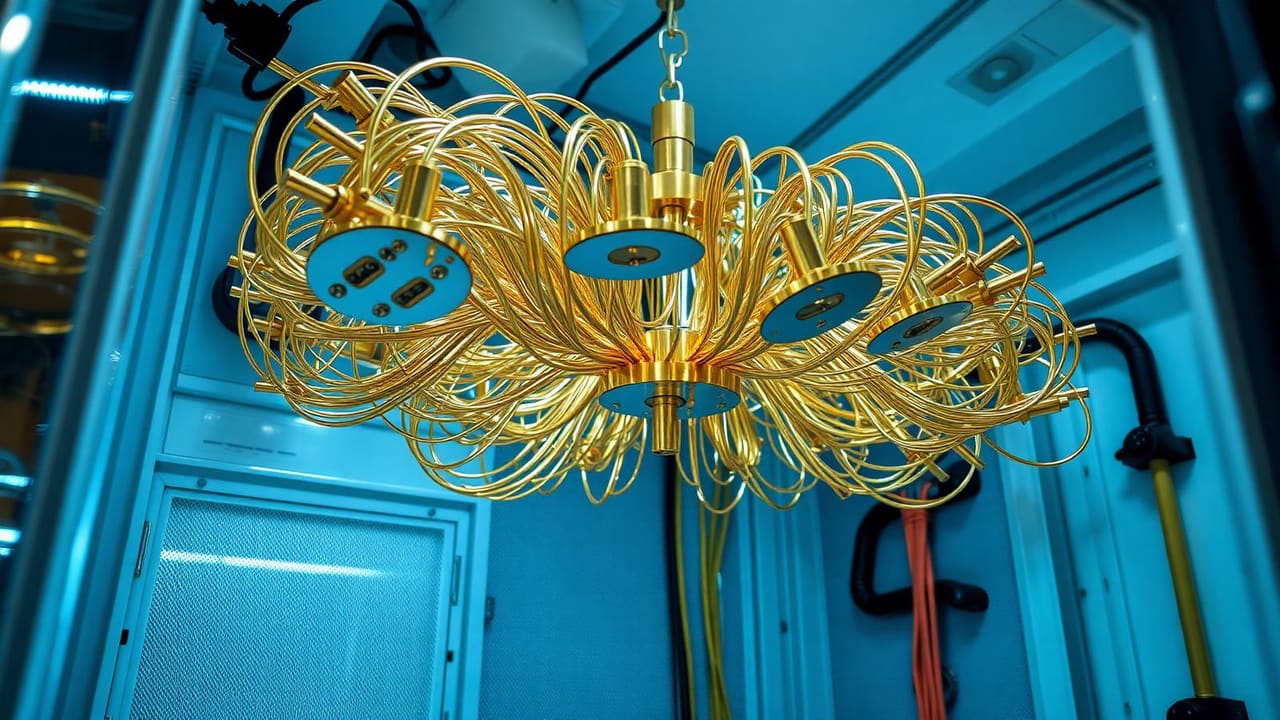
The catch is decoherence. Qubits are exquisitely fragile; a stray vibration, a photon of stray heat, or a nearby electromagnetic field can collapse the delicate superposition and introduce an error, often in a fraction of a millisecond. This is why quantum processors live inside dilution refrigerators colder than outer space, isolated from vibration, and why the entire field's central engineering problem for the past two decades has been error correction rather than raw qubit count.
Error correction in the quantum world doesn't work like classical error correction, because you can't just copy a qubit's state to check it (measuring destroys the superposition, and a "no-cloning theorem" forbids copying an unknown quantum state outright). Instead, researchers spread the information across many physical qubits in patterns called codes — the surface code being the current favorite — so that errors can be detected and corrected without ever directly measuring the protected information. A "logical qubit" is the resulting stable, error-corrected unit; it might require dozens or hundreds of noisy physical qubits to sustain one reliable logical qubit. This is the number that actually matters, and it is not the number usually splashed across headlines.
What the Data Says
The clearest, least hype-adjacent progress of the last few years has been in error correction itself. In 2023 and 2024, groups including Google Quantum AI and Harvard/QuEra published results showing that as they added more physical qubits to a surface-code logical qubit, the error rate went down rather than up — a long-sought inflection point called operating "below threshold." That sounds bureaucratic, but it's the physics equivalent of proving a bridge design actually gets stronger as you add more supports, rather than just heavier. Before this, there was a real possibility that noise would always outrun error correction as systems scaled, making the whole enterprise a dead end. That risk has not been eliminated, but it has been meaningfully reduced.
Two hardware platforms currently lead the field, using different physical qubits and each with real tradeoffs. Superconducting qubits, used by Google and IBM, are fast and built with adapted semiconductor fabrication techniques, but need extreme cooling and tend to have shorter coherence times. Trapped-ion qubits, used by IonQ and Quantinuum, hold their quantum states longer and have higher-fidelity operations, but are slower to operate and harder to scale to large numbers. Neutral-atom platforms, like QuEra's, are a newer entrant showing promise for scaling logical qubit counts. None of these has established clear, permanent superiority, and it is entirely plausible the winning architecture in ten years doesn't exist in a lab yet.
Google's "below threshold" surface code milestone
Error rate roughly halvedwith each step up in code size
Demonstrated in Google Quantum AI's 2024 Nature paper, a long-sought inflection point for scalable error correction
The "quantum advantage" or "quantum supremacy" claims — Google's 2019 Sycamore result and subsequent experiments — showed a quantum processor completing a specific sampling task faster than an estimated classical supercomputer runtime. These are real, peer-reviewed, replicated demonstrations of quantum mechanical behavior doing computational work no classical machine has matched on that exact task. But the tasks were deliberately chosen because they're hard for classical computers and easy for quantum ones — they have no known practical application. Classical algorithms have since been improved and narrowed some of the claimed gaps, an ordinary and healthy part of scientific back-and-forth, not evidence of fraud on either side.
| Domain | Outlook |
|---|---|
| Simulating molecules and materials (drug discovery, battery chemistry, catalysts) | Most promising near-to-medium-term application; quantum systems are naturally good at simulating other quantum systems |
| Optimization problems (logistics, scheduling) | Plausible modest speedups; classical algorithms remain highly competitive and often win |
| Cryptography (factoring large numbers via Shor's algorithm) | Theoretically devastating to current public-key encryption, but requires millions of stable logical qubits — likely a decade-plus away, if achievable |
| Everyday computing (spreadsheets, browsing, gaming, most AI training) | No plausible advantage now or in any foreseeable future; classical computers remain superior by design |
| Database search (Grover's algorithm) | Real theoretical speedup but only quadratic, not exponential — modest at best |
Source: Second City Standard synthesis of NIST, National Academies, and peer-reviewed literature
Where the Evidence Gets Messy
Here is where honest disagreement lives. IBM has published roadmaps suggesting fault-tolerant, practically useful quantum computers within this decade. Others, including prominent skeptics like Microsoft's own hardware struggles with topological qubits (a promising approach that has faced retracted claims and delayed timelines) and academic critics such as physicist Mikhail Dyakonov, argue that the engineering challenges of maintaining millions of coherent, error-corrected qubits may prove far harder than current roadmaps assume, comparing some optimistic projections to historical predictions about fusion power that have slipped by decades.
"Useful quantum computing is perpetually ten years away — and has been for twenty years."
Part of the disagreement is definitional. "Useful" quantum advantage could mean beating classical computers at a narrow scientific simulation used by three research labs, or it could mean breaking modern encryption — those are wildly different bars, and different experts are answering different questions when they offer a timeline. Part of it is also structural: companies with billions in venture and government funding have an incentive to describe incremental engineering progress in the most sweeping language available, and journalists (present company included) have an incentive to write the exciting version of the story rather than the accurate one.
The practical policy world has already hedged its bets regardless of the hardware debate. In 2024, the National Institute of Standards and Technology finalized the first set of post-quantum cryptography standards — new encryption algorithms designed to resist attack even from a future large-scale quantum computer. This wasn't a declaration that quantum computers can break today's encryption; none can. It was a "harvest now, decrypt later" hedge: adversaries can record encrypted traffic today and decrypt it once quantum hardware catches up, so the migration to quantum-resistant algorithms is happening years ahead of the actual capability, purely as insurance. That NIST — an agency not prone to hype — treats the threat as worth planning for now is itself meaningful evidence that credentialed experts see the eventual capability as plausible, even if the timeline is unknown.
Second City Analysis
Strip away the marketing copy and what's left is a research field behaving the way real, hard research fields behave: slow, uneven, occasionally thrilling progress punctuated by setbacks, with genuine scientific disagreement about how far away the finish line is because nobody has run this particular race before. That's not a scandal. It's what science under genuine uncertainty looks like from the outside, and it's less satisfying than either the breathless "quantum revolution is here" press release or the cynical "it's all vaporware" dismissal.
The below-threshold error correction results are the single most important data point for anyone trying to gauge real progress, because they address the specific worry — that noise scales faster than correction — that would have made the entire enterprise a dead end. That worry hasn't been retired, but it has been meaningfully weakened by actual peer-reviewed data, not by roadmap slides.
- Evidence strength
- 62
- Source quality
- 80
- Replication
- 55
- Sample quality
- 50
- Causation
- 45
- Scientific consensus
- 50
- Uncertainty
- 70
The underlying quantum mechanics is extremely well established; the engineering trajectory toward large-scale fault-tolerant machines is genuinely uncertain, and credentialed experts disagree substantially on timelines, which is reflected in the low consensus and high uncertainty scores.
The Verdict
The physics is real, the error-correction progress is real and independently verifiable, and the eventual arrival of some useful quantum computing capability is plausible enough that a notoriously conservative federal standards agency is already hedging against it. But "plausible eventually" is a very different claim from "coming soon," and anyone giving you a confident year is selling something — a stock, a grant proposal, or a magazine subscription. The honest position, and the one the evidence actually supports, is that this is a real, slow-moving scientific frontier whose timeline nobody currently knows, including the people building it.
- 1."Quantum error correction below the surface code threshold", Google Quantum AI / Nature (2024 —) Link
- 2."Post-Quantum Cryptography Standardization", National Institute of Standards and Technology (NIST) (2024 —) Link
- 3."Quantum supremacy using a programmable superconducting processor", Google AI / Nature (2019 —) Link
- 4."The Nobel Prize in Physics 2022" (Aspect, Clauser, Zeilinger, entanglement), The Nobel Foundation (2022 —) Link
- 5."Quantum Computing: Progress and Prospects", National Academies of Sciences, Engineering, and Medicine (2019 —) Link
- 6."What is Quantum Computing?", IBM Research — Link
- 7."Logical quantum processor based on reconfigurable atom arrays", Harvard / QuEra / Nature (2023 —) Link
- 8."Shor's Algorithm and cryptographic implications", NIST Post-Quantum Cryptography FAQ — Link
How We Measured This
- Question investigated
- Is quantum computing progress real, and when might it produce practically useful advantages over classical computers?
- Evidence considered
- Peer-reviewed physics papers on error correction and quantum advantage demonstrations, National Academies consensus reports, and the practical policy response (NIST post-quantum cryptography standards) as an indicator of institutional risk assessment.
- Sources prioritized
- Nature, NIST, National Academies of Sciences, and public technical roadmaps from Google Quantum AI, IBM, and IonQ, cross-checked against independent physicist commentary and critique.
- Known limitations
- The field moves quickly and company-published roadmaps are not independently verified; timelines for fault-tolerant, large-scale machines remain genuinely disputed among credentialed experts, and this analysis reflects that disagreement rather than resolving it.
- How the verdict was set
- Rated PLAUSIBLE because the core physics and recent error-correction milestones are well-supported by peer-reviewed evidence, while claims about near-term practical, widespread quantum advantage remain speculative and contested, warranting caution rather than either dismissal or hype.
Built By
Editorial Operating System v1.0Creator
Erik Chambers
Architecture
Founder, Creator & Editorial Architect
AI Assisted
No
Human Reviewed
Pending
Evidence Reviewed
In progress
Last Updated
August 26, 2026
Confidence
Evergreen medium/10
Research Status
Living investigation
We do not claim perfection. We promise transparency. Every investigation shows its work — the question, the evidence, the tools, the humans, and the updates.
Editorial Transparency
This article contains a combination of reporting, publicly available research, and editorial analysis.
A long-form investigation. Findings resolve to primary sources. Evidence before opinion — facts require sources, analysis requires transparency, opinions require labels.
Meet the creator
Erik Chambers
Founder, Creator & Editorial Architect
Erik originated the central idea, directed the investigation, reviewed the evidence, and approved the final published work.
Read the founder profile →Challenge This
We welcome disagreement
A different way to read the evidence. Research that points in another direction. Where specialists diverge.
Loading challenges…
Submit a challenge
Sign in to submit a challenge. All submissions are reviewed before appearing publicly.
Comments
Ask A Question
What would you ask an editor about this piece?
Reader questions feed our coverage map. The most-asked ones become our next investigations.
Continue Exploring
Guided by the evidenceWhere should this take you next?
Part of a cluster
Origins Evidence
What does the material record actually support about the deep past?
See the whole clusterWhat the evidence actually allows
PLAUSIBLE
Quantum Computers Are Coming. Nobody Agrees on Exactly When.
A composite 0–100 measure of how well this investigation meets the Second City Standard. Scores are auditable — every point comes from the criteria below.
Composite
—
of 100
This investigation is queued for editorial scoring. No score has been assigned yet — the absence of a number is not a judgment on the evidence.
The Standard
· Editorial verdictBased on the evidence presented,
Second City Standard believes Real hardware is getting better at fixing its own errors, but the gap between a lab milestone and a machine that outperforms your laptop at anything useful remains wide and contested.
Remaining uncertainty: Awaiting a final written verdict from the editorial desk.
The Standard · Second City Standard
Continue The Investigation
· Never a dead endThis investigation is one thread. Pull the next one — every path below is another investigation, another question, or another discipline applied to the same problem.
One clear idea, once a week.
Get the strongest investigation, one useful tool, and one question worth carrying forward.
No fake urgency. No spam. Leave any time.