Concrete Is Strong. Until You Pull on It.
Concrete can hold up a skyscraper but can't hold itself together against a stretch — the question is why the same material can be a champion in compression and a pushover in tension.
By Erik Chambers
Founder, Creator & Editorial Architect
In this articleThe Question
The Standard take
Concrete can hold up a skyscraper but can't hold itself together against a stretch — the question is why the same material can be a champion in compression and a pushover in tension.
Key Findings
- Why does ordinary concrete resist compressive forces so well — routinely tested in the thousands of pounds per square inch — while its tensile strength lags an order of magnitude behind, and what does the materials science say about how engineers get around t…
- Concrete starts as a slurry: cement powder, water, sand, and coarse aggregate like crushed stone or gravel.
- Where the physics gets genuinely elegant is in the pairing of concrete with steel reinforcement — rebar.
Stand under an overpass on the Dan Ryan and you're trusting a paradox. The concrete above your head can support the weight of thousands of cars a day, stacked lanes of steel and rubber and impatience, without so much as flexing. Yet take a chunk of that same concrete, clamp it in a lab, and pull the two ends apart, and it will snap with startling ease — at a fraction of the force it shrugged off when squeezed. Concrete is, structurally speaking, superb at being crushed and terrible at being stretched. That's not a design flaw. It's chemistry, and engineers have spent more than a century building an entire discipline around compensating for it.
The mismatch is large enough to matter to anyone who has ever wondered why bridges are full of steel bars, why parking garages develop rust stains that bloom into cracks, or why a sidewalk slab pops up and splits along a perfectly straight, uniform-looking edge. It also explains, more mundanely, why a Chicago winter is a concrete structure's worst enemy and why the words "chloride" and "freeze-thaw" show up in nearly every serious inspection report on aging infrastructure in cold climates.
This is a story about crystals, water ratios, and a very old marriage between concrete and steel that works precisely because of a few coincidences of physics and chemistry that didn't have to align, but did.
The Question
Why does ordinary concrete resist compressive forces so well — routinely tested in the thousands of pounds per square inch — while its tensile strength lags an order of magnitude behind, and what does the materials science say about how engineers get around that weakness without simply making a stronger slab?
What We Know
Concrete starts as a slurry: cement powder, water, sand, and coarse aggregate like crushed stone or gravel. The transformation into a rock-hard building material is not drying, as many assume, but a chemical reaction called hydration. Cement's core compounds, mainly calcium silicates, react with water to form calcium silicate hydrate, often abbreviated C-S-H, an amorphous-to-nanocrystalline gel that interlocks over hours, days, and weeks into a dense, load-bearing matrix. This is why concrete keeps gaining strength for weeks after it's poured, and why proper curing — keeping it moist so hydration can continue — matters as much as the initial mix design.
C-S-H is what gives concrete its compressive muscle. Under a squeezing load, the tightly bonded gel and the aggregate particles it surrounds work together, transferring force through a huge number of contact points distributed across the material. Cracks that do exist tend to close up or get compressed shut rather than grow, because compression is, mechanically, a forgiving kind of stress for a brittle material.
Tension is the opposite story. Pulling concrete apart puts its many microscopic flaws — air voids, shrinkage cracks, and especially the interfacial transition zone around each piece of aggregate — into a role where they concentrate stress rather than dissipate it. That interfacial zone forms because water in the fresh mix tends to migrate toward and pool against aggregate surfaces, creating a band of cement paste there that is more porous and has a different, weaker crystal structure than the bulk paste a few millimeters away. Under tensile load, cracks preferentially start in this zone and propagate along it, and because concrete is brittle, once a crack starts it doesn't need much additional energy to keep going. The American Concrete Institute and organizations like the Portland Cement Association have documented for decades that the tensile strength of typical concrete mixes lands at roughly one-tenth of the compressive strength, a ratio that holds up across a wide range of mix designs.
Typical strength ratio
~10"to 1 (compressive : tensile)"
Ordinary concrete resists compression roughly ten times better than it resists tension, a ratio confirmed across decades of standardized testing.
The water-cement ratio is one of the biggest levers engineers pull to influence this behavior. Excess water beyond what's needed for hydration reactions eventually evaporates or remains as capillary pore space, and every one of those pores is a tiny stress concentrator waiting for a tensile load. Lower water-cement ratios, generally achieved with the help of chemical admixtures that keep the mix workable without extra water, produce denser paste, a thinner interfacial transition zone, and measurably higher tensile as well as compressive strength. NIST's concrete and structural materials research groups have spent years modeling exactly how pore structure at the microscale governs macroscale strength and durability, work that underlies much of modern concrete mix design.
What the Data Says
Where the physics gets genuinely elegant is in the pairing of concrete with steel reinforcement — rebar. Two coincidences make this partnership work rather than just patch over a weakness. First, steel and concrete have very similar coefficients of thermal expansion, meaning that as a structure heats up in a Chicago summer and contracts in a Chicago winter, the embedded steel and the surrounding concrete expand and shrink at nearly matching rates. If they didn't, decades of thermal cycling would tear the bond between them apart regardless of how well the concrete was poured.
Second, concrete's chemistry actively protects the steel inside it. Fresh and cured concrete is highly alkaline, typically with a pH in the range of 12 to 13, largely due to calcium hydroxide produced as a byproduct of cement hydration. That alkalinity causes a thin, tenacious oxide film to form on the surface of embedded steel, a phenomenon called passivation, which is the same basic principle that keeps stainless steel from rusting. As long as that alkaline environment holds and chlorides or carbonation don't disrupt it, steel rebar can sit inside concrete for a very long time without corroding.
Reinforced concrete puts steel bars where tensile stress will concentrate — the underside of a beam spanning a gap, for instance — so that the steel, which is excellent in tension, carries the pulling forces while the concrete around it carries the compression. Post-tensioned and prestressed concrete take this further: steel tendons are tensioned, either before the concrete cures (pretensioning, common in precast beams) or after (post-tensioning, common in bridge decks and parking structures), squeezing the concrete into a permanent state of compression. Because concrete handles compression so well, this preloading effectively cancels out tensile stresses before service loads ever get the chance to open a crack. The technique, pioneered in usable form by French engineer Eugène Freyssinet in the early 20th century, is why long-span bridges and thin, elegant concrete slabs are structurally possible at all.
Where the Evidence Gets Messy
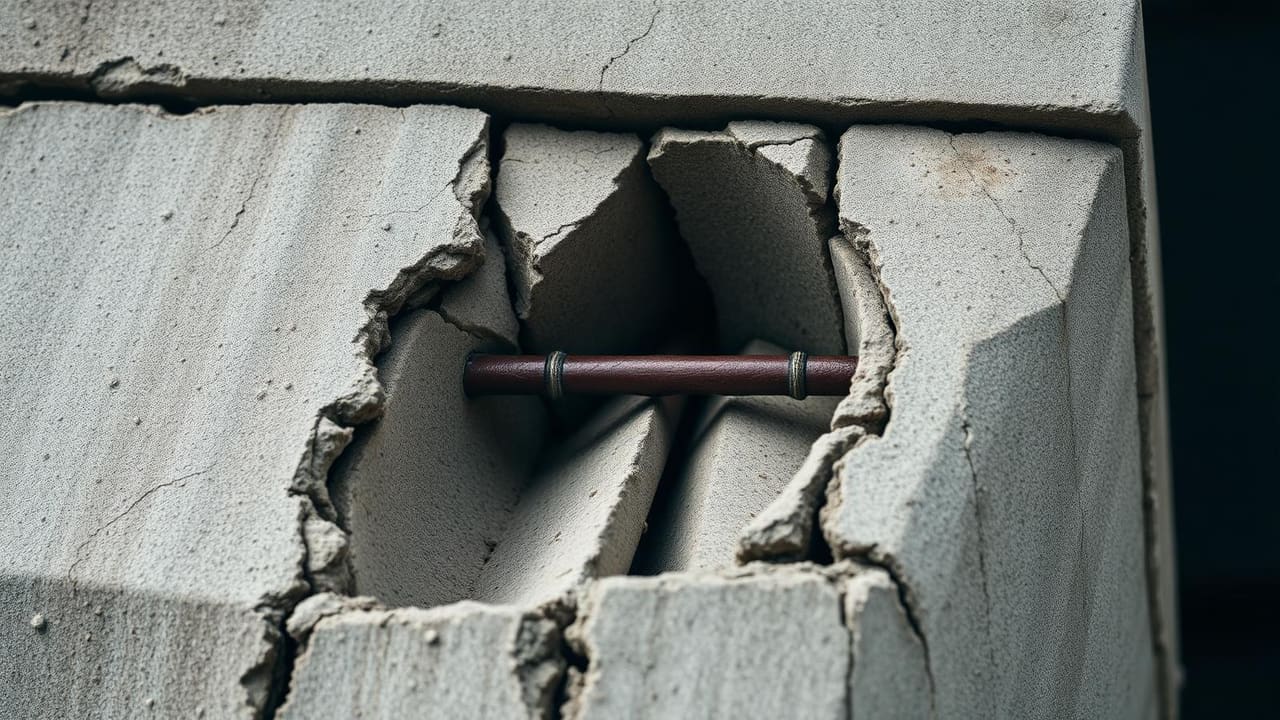
None of this protection is permanent, and durability failure is where concrete science gets genuinely contentious among engineers arguing over inspection intervals and repair budgets. Chloride-induced corrosion is the big one in cold climates: road salt, sea spray, or de-icing chemicals introduce chloride ions that, given enough time and enough exposure, penetrate through concrete's pore network and reach the embedded steel. Once chloride concentration at the steel surface crosses a threshold, it destroys the passive oxide layer, and the steel begins to corrode. Corroding steel forms iron oxide, which occupies significantly more volume than the original metal, and that expansion cracks and eventually spalls the surrounding concrete from the inside out — the reddish-brown staining and crumbling edges familiar to anyone who has looked closely at an aging Chicago parking garage or an older highway overpass.
Freeze-thaw damage compounds the problem in exactly the climate Chicago has. Water that has worked its way into concrete's capillary pores expands roughly nine percent in volume when it freezes, and repeated freeze-thaw cycling generates internal pressure that gradually fractures the paste, particularly near the surface. Air-entrained concrete, which incorporates deliberately engineered microscopic air bubbles as pressure-relief valves for that expanding ice, is now standard practice for pavement and exposed structures in northern climates specifically because of this failure mode, a practice grounded in research going back to postwar-era studies by organizations including the Portland Cement Association and reinforced by ongoing NIST and university lab work on pore structure and freeze-thaw resistance.
The messiness comes from the fact that these failure modes interact, and predicting service life for any specific structure involves a lot of uncertainty about exposure history, mix quality, and construction quality that isn't fully knowable from a single inspection. Two overpasses built the same year with nominally similar specifications can age at dramatically different rates depending on how well they were cured, how much salt they've actually been exposed to, and whether cracks let water and chloride in early. Structural engineers manage this with probabilistic service-life models rather than fixed guarantees, and disagreement over how conservative those models should be is a live, ongoing debate in the field rather than settled science.
Concrete does not fail because it is weak. It fails because water, salt, and time eventually find the one place it was always going to be weak.
Second City Analysis
What makes this a satisfying materials-science story rather than a dry engineering footnote is how much of concrete's behavior traces back to decisions made in the first few hours after it's poured — water content, curing conditions, air entrainment — decisions that are largely invisible in the finished structure but determine its fate decades later. The compressive strength that makes concrete useful and the tensile weakness that makes it dangerous without reinforcement aren't two separate properties to be balanced; they're two expressions of the same microstructure, the same C-S-H gel and the same interfacial transition zones, just responding to different kinds of stress.
The steel-concrete pairing also deserves more credit than it usually gets as a materials-science achievement rather than just a construction convenience. It's not obvious, a priori, that a metal and a mineral-based composite would share a thermal expansion coefficient closely enough to survive a century of Chicago winters bonded together, or that the by-product chemistry of cement hydration would happen to pacify steel against corrosion. Engineers exploited both facts, but they didn't invent them.
- Evidence strength
- 88
- Source quality
- 90
- Replication
- 85
- Sample quality
- 80
- Causation
- 82
- Scientific consensus
- 92
- Uncertainty
- 20
The compressive-versus-tensile strength disparity in concrete is extremely well established through decades of standardized ASTM testing and is consensus science within structural and materials engineering; remaining uncertainty concerns predicting individual structure service life under variable real-world exposure.
The Verdict
The claim that concrete is fundamentally strong in compression and fundamentally weak in tension is about as well supported as materials science gets, grounded in cement hydration chemistry, decades of standardized mechanical testing, and consistent findings from NIST, ACI, and PCA research. What remains genuinely uncertain is not the underlying mechanism but the long-term durability trajectory of any specific structure, which depends on mix quality, curing, and decades of unpredictable exposure to water, salt, and temperature swings.
- 1."Reinforced Concrete", Portland Cement Association (ongoing —) Link
- 2."Building Materials and Structural Systems Division", National Institute of Standards and Technology (NIST) (ongoing —) Link
- 3.ACI 318 "Building Code Requirements for Structural Concrete", American Concrete Institute (ongoing —) Link
- 4."Corrosion of Reinforcing Steel", Portland Cement Association (ongoing —) Link
- 5."Freeze-Thaw Resistance", Portland Cement Association (ongoing —) Link
- 6."Concrete Materials Research", National Institute of Standards and Technology (NIST) (ongoing —) Link
- 7."History of Prestressed Concrete", Precast/Prestressed Concrete Institute (ongoing —) Link
- 8."Chloride-Induced Corrosion of Steel Reinforcement", Federal Highway Administration (ongoing —) Link
How We Measured This
- Question investigated
- Why is concrete strong in compression but weak in tension, and how do engineers compensate for that weakness?
- Evidence considered
- Cement hydration chemistry (calcium silicate hydrate formation), interfacial transition zone microstructure research, standardized ASTM compressive and tensile/flexural testing data, and durability research on chloride ingress and freeze-thaw cycling from NIST, ACI, and PCA.
- Sources prioritized
- NIST materials and structural systems research, American Concrete Institute code and technical documents, Portland Cement Association durability literature, Federal Highway Administration corrosion research, and Precast/Prestressed Concrete Institute historical technical resources.
- Known limitations
- Individual structure service life depends on unpredictable real-world exposure history, construction quality variance, and maintenance, which standardized lab testing cannot fully capture.
- How the verdict was set
- Rated SUPPORTED because the underlying mechanism — brittle crystalline microstructure favoring compressive over tensile load paths — is consensus science confirmed by decades of independent, replicated testing across the concrete engineering field.
Built By
Editorial Operating System v1.0Creator
Erik Chambers
Architecture
Founder, Creator & Editorial Architect
AI Assisted
No
Human Reviewed
Pending
Evidence Reviewed
In progress
Last Updated
August 26, 2026
Confidence
Evergreen medium/10
Research Status
Living investigation
We do not claim perfection. We promise transparency. Every investigation shows its work — the question, the evidence, the tools, the humans, and the updates.
Editorial Transparency
This article contains a combination of reporting, publicly available research, and editorial analysis.
A long-form investigation. Findings resolve to primary sources. Evidence before opinion — facts require sources, analysis requires transparency, opinions require labels.
Meet the creator
Erik Chambers
Founder, Creator & Editorial Architect
Erik originated the central idea, directed the investigation, reviewed the evidence, and approved the final published work.
Read the founder profile →Challenge This
We welcome disagreement
A different way to read the evidence. Research that points in another direction. Where specialists diverge.
Loading challenges…
Submit a challenge
Sign in to submit a challenge. All submissions are reviewed before appearing publicly.
Comments
Ask A Question
What would you ask an editor about this piece?
Reader questions feed our coverage map. The most-asked ones become our next investigations.
Continue Exploring
Guided by the evidenceWhere should this take you next?
What the evidence actually allows
SUPPORTED
Concrete Is Strong. Until You Pull on It.
A composite 0–100 measure of how well this investigation meets the Second City Standard. Scores are auditable — every point comes from the criteria below.
Composite
—
of 100
This investigation is queued for editorial scoring. No score has been assigned yet — the absence of a number is not a judgment on the evidence.
The Standard
· Editorial verdictBased on the evidence presented,
Second City Standard believes Concrete can hold up a skyscraper but can't hold itself together against a stretch — the question is why the same material can be a champion in compression and a pushover in tension.
Remaining uncertainty: Awaiting a final written verdict from the editorial desk.
The Standard · Second City Standard
Continue The Investigation
· Never a dead endThis investigation is one thread. Pull the next one — every path below is another investigation, another question, or another discipline applied to the same problem.
One clear idea, once a week.
Get the strongest investigation, one useful tool, and one question worth carrying forward.
No fake urgency. No spam. Leave any time.