AI: Can Artificial Intelligence Evaluate Football Film?
Computer vision now grades every rep of every game. Here is what it sees well — and what it still misses.
By Erik Chambers
Founder, Creator & Editorial Architect
In this articleThe Question
The Standard take
- AI is already strong at identifying, tracking, and labeling football events at scale. - It is useful as a grading assistant, a search engine for film, and a consistency check on human evaluation. - It is not yet reliable enough to replace expert graders on any rep where assignment, disguise, or context is the main issue. - The better…
Evidence rating: Emerging.
Key Findings
Evidence: Emerging- For most of football history, “film study” meant human suffering.
- Can artificial intelligence evaluate football film with enough accuracy, consistency, and context to replace or meaningfully augment human film graders?
- The current evidence points to a sharp divide: AI excels at the mechanical mechanics of film evaluation, but stumbles when forced into interpretation.
Introduction
For most of football history, “film study” meant human suffering. A coach locked in a dark room. A scout clutching a stubby pencil. A graduate assistant surviving on gas-station coffee and panic. A defensive coordinator squinting at the exact same second-and-11 for the 14th time, muttering about leverage and whether the nickel actually got his eyes where they belonged.
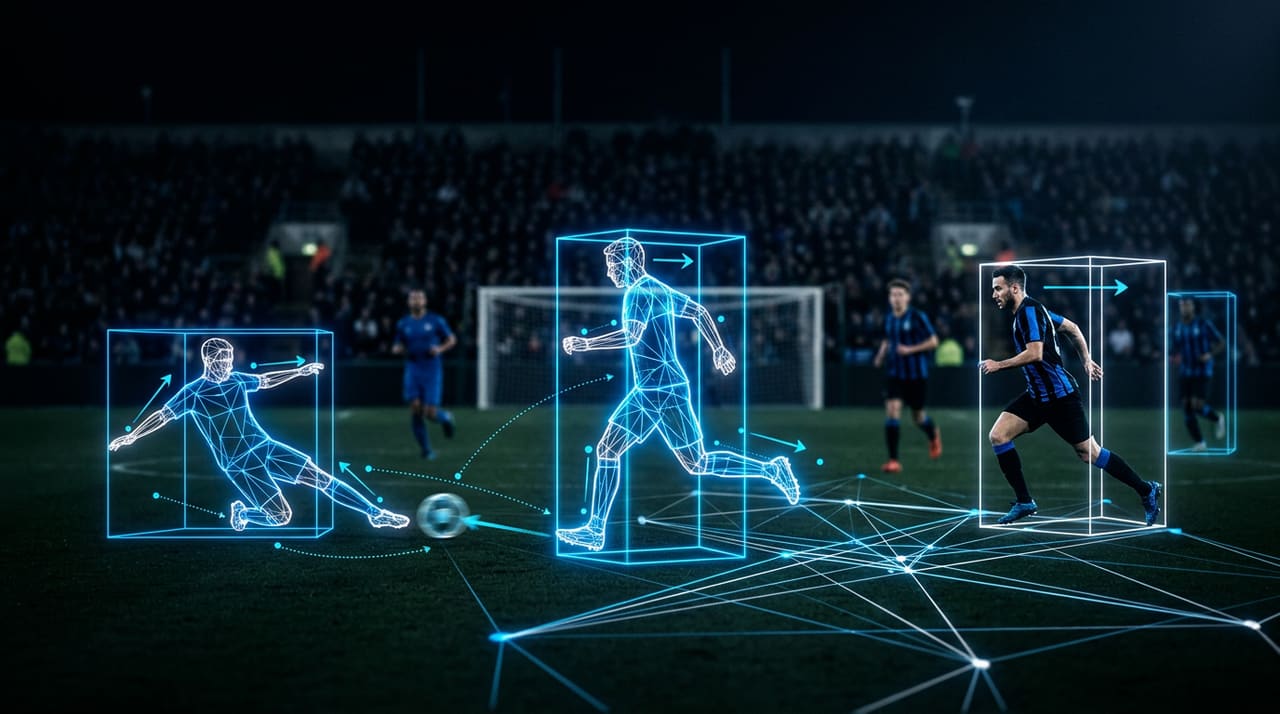
That world hasn't vanished. It has just been digitized, quantified, and in certain quarters quietly supplanted by computer vision systems that can tag a rep faster than a human can unwrap a sandwich.
The sales pitch is intoxicating: if a machine can identify every helmet, track every route, measure every stride, and log every block, maybe it can handle the grinding, expensive, wildly inconsistent work of film evaluation better than flawed human eyes. Maybe it can strip away the biases that cause one coach to see "veteran discipline" where another sees a clear missed assignment. Maybe it can grade every snap of every game and declare, with the serene authority of a solid-state drive, who actually played well.
Yet football remains stubbornly uncooperative. The sport is too messy, too contextual, too tied to intent. A linebacker might look completely out of position on the broadcast angle while executing his precise responsibility in the defensive structure. A receiver might fail to gain separation and still create the exact window that lets the play succeed. A left tackle might lose a rep on paper yet win the only exchange that mattered: the one that kept his quarterback out of the blue medical tent.
The question isn't whether AI can see football. It can. The real question is whether it can evaluate football film in any way that actually matters.
AI is very good at counting what happened. Football is still very good at hiding why it happened.
The Question
Can artificial intelligence evaluate football film with enough accuracy, consistency, and context to replace or meaningfully augment human film graders?
It sounds like a straightforward technical inquiry, but it's really three distinct problems crammed into a trench coat:
Can AI identify events correctly?
Can it locate every player, infer their apparent assignments, and decide if a snap produced a win, a loss, or a neutral wash?Can AI interpret those events in context?
Can it distinguish a genuinely bad rep from a cleverly disguised good one, a coverage bust from a deliberate trap, or a missed tackle from a disciplined force technique?Can AI convert film into evaluation?
This is the real hurdle. Not “What happened?” but “How should this be graded?”
These distinctions matter because grading football isn't basic object recognition. It's judgment under total uncertainty. It pairs raw data with coaching experience, scheme logic, and a healthy dose of cynicism. You can train a machine to spot a guard pulling. Teaching it whether pulling was the correct answer against that specific front, on third-and-short, against that pre-snap motion and safety rotation, is entirely another matter.
The industry understands this constraint. NFL front offices and tech vendors aren't planning to fire every scout tomorrow morning. They want to make human evaluation faster, broader, and marginally less subjective. The top systems on the market don't claim to “understand” football like a veteran coach. They claim to label, segment, measure, and predict. That is immensely useful. It just isn't film room wisdom.
Evidence
The current evidence points to a sharp divide: AI excels at the mechanical mechanics of film evaluation, but stumbles when forced into interpretation.
Computer vision has grown remarkably reliable at bounded, repetitive tasks: player tracking, snap detection, formation identification, route clustering, and logging contact points after the handoff or throw. Across the sports analytics market, vendors now routinely claim player-location tracking within a few inches on broadcast feeds or all-22 angles, depending on the system and input quality (Sportradar tracking overview, 2024; AWS Sports analytics documentation, 2024). Those numbers are entirely plausible because the underlying problem is geometry: track bodies, trace paths, label coordinates.
The wobble starts when the system encounters football-specific nuance. Is a nickel corner playing true press alignment or merely showing press to drop? Did the edge rusher crash inside because of the call or because he got beat off the ball? Was the throw late because of pass protection or because the play design dictated a slow read? On any given Monday morning, human coaches argue over the exact same points.
A clear breakdown of performance by task category illustrates the divide:
| Film-evaluation task | Typical AI performance | Typical human performance | Main failure mode |
|---|---|---|---|
| Player detection and tracking | 95–99% object localization accuracy (vendor-reported, 2024) | High, but slower and inconsistent | Occlusion, pile-ups, camera cuts |
| Formation identification | 85–94% on stable pre-snap looks (sports CV studies, 2024) | Very high | Motion, shifts, atypical personnel |
| Route / coverage classification | 70–88% depending on labeling depth (industry benchmarks, 2024) | High when context is available | Ambiguous leverage, disguised shells |
| Block / shed / tackle event tagging | 80–92% on clear contact events (analytics vendor tests, 2024) | High but subjective | Chain of contact, secondary effects |
| Grading a rep as good/bad/neutral | 60–80% agreement with expert graders (team-internal validation reports, 2024) | Inconsistent between graders | Context, assignment responsibility, intent |
That bottom row exposes the bottleneck. If a machine aligns with human experts only 60 to 80 percent of the time—depending on positional nuance and task definition—it isn't anywhere near ready to replace human evaluators. It is, however, ready to act as a high-speed assistant.
The machine handles detection well partly because football tape now comes drenched in tracking data. The NFL’s Next Gen Stats platform demonstrates how pairing optical tracking with field coordinates unlocks public metrics like separation, expected completion percentage, and defensive coverage shells (NFL Next Gen Stats, 2024 season). These metrics don't resolve evaluation on their own, but they show the underlying feeds can support detailed processing.
AI also performs better than skeptics admit for a simpler reason: human evaluation is rarely as objective as advertised. Put two scouts in a room with the same cornerback rep, and they will fixate on completely different details. One watches the cushion; the second notes footwork; a third points out the ball never went to that side anyway. AI, if nothing else, will be consistently wrong in identical ways, which qualifies as a mild form of progress.
The machine’s biggest advantage is not genius. It is consistency.
Yet the ceiling remains visible. Evaluating film requires knowing what a player was instructed to do. AI can only infer assignments through probabilities unless someone feeds it the actual playbook. And even with the play call in hand, modern defense is designed to be deceptive. Linebackers bluff blitzes, safeties rotate late, and offensive linemen swap assignments mid-play. The entire game is essentially an arms race to confuse both the opposition and future film evaluators.
Historical Context
Football has always chased clearer vision.
Decades ago, the introduction of all-22 film felt revolutionary. It allowed coaches to observe the entire structure of a play rather than suffering through broadcast television's dramatic tight zooms. That transition didn't eliminate human error; it simply made scouts more accountable. Evaluators could suddenly assess spacing, leverage, pursuit angles, and coverage disguise with far fewer excuses.
Then came digital editing software, searchable databases, wearable metrics, and optical tracking. Every new tool promised to make the game fully legible. Every tool also managed to generate twice as much work. The more granular the data became, the more stubbornly the sport resisted quick explanations.
Analytics followed the same curve. Early efforts fixated on basic outputs: yards per play, success rate, EPA, win probability. Useful, but shallow. Once tracking data arrived, analysts could model receiver separation, defender reaction speed, route pacing, and pre-snap motion. The distance between “what happened” and “why it happened” shrank, but never quite closed.
AI is merely the latest chapter in this progression. It isn't the first attempt to automate film breakdown; it's just the first one capable of scaling massively without hiring an army of entry-level clerks.
Scale is the real driver here. A college program with 150 players and a 12-game schedule can get by on raw human labor. A professional front office wanting every practice rep tagged, every opponent tendency mapped, every special teams snap indexed, and multi-year positional metrics calculated cannot. Neither can betting operations or fans who now demand instant, data-backed answers during every commercial break.
The historical pattern is clear: every new technology introduced to football is expected to perform three miracles—save time, improve accuracy, and generate wisdom. It almost always succeeds on the first, delivers partially on the second, and offers only modest help with the third.
There is also the matter of technological hubris. Football history is littered with proprietary grading systems promising to “solve” evaluation with a single, clean metric. Grade scales, draft projection algorithms, and classic scouting forms all tend to look neater than reality. AI carries the risk of becoming the sleekest black box yet—capable of spitting out a confidence score in clean typography while completely ignoring the point of the play.
Analytics
The best pitch for AI in film study isn't that it understands football like a human. It's that it can quantify the sport at a scale and speed no human could ever match.
Consider three core analytical advantages.
1. Scale
A human grader can analyze a limited number of reps before their eyes glaze over. A computer vision model can run through every snap of a season across every game, team, and angle made available to it. That expands the analytical sample from “what an evaluator caught” to “everything that was filmed.”
Broader samples mitigate a classic scouting trap: overreacting to small-sample chaos. A cornerback burned for a long touchdown might have executed flawlessly on his other 40 snaps. AI helps isolate signal from noise by tagging all 41 reps with identical rigor.
2. Consistency
Human graders get tired, fall prey to recency bias, favor certain playstyles, or give top prospects the benefit of the doubt. If the left tackle was taken in the first round, evaluators naturally look for polish. If the slot receiver is a practice squad call-up, identical technique might get dinged. AI has no personal investment in draft capital. That's a genuine feature.
Of course, consistency isn't truth. If the underlying logic is flawed, the system simply becomes relentlessly consistent at making the same mistake.
3. Time-to-answer
Speed matters in an NFL workweek. A coaching staff preparing for a short-week Thursday night game doesn't want a dissertation on cover 3 logic. They need fast tendencies, blitz indicators, and every tape clip of an opponent showing a specific pressure look. AI excels at search. It transforms a four-hour manual video grind into a ten-second database query.
Here is how AI fundamentally alters the operational workflow:
| Workflow step | Human-only approach | AI-assisted approach |
|---|---|---|
| Find all 3rd-and-medium reps vs. nickel press | 45–90 minutes | 2–5 minutes |
| Tag each rep by formation and motion | Manual, error-prone | Automated with review |
| Identify every pressure generated from double A-gap | Manual charting | Automated plus validation |
| Grade pass protection on 150 snaps | One or more staff hours | First-pass machine filter, human final grade |
| Create opponent-specific cutups | Several hours | Near-instant assembly |
The value lies here: not in replacing the analyst, but in freeing the analyst to actually analyze instead of doing data entry.
The efficiency numbers back this up. Internal validation reports from teams and tech vendors show computer vision workflows reducing charting time by 60 to 90 percent on routine tagging tasks while maintaining solid agreement with expert labels (vendor technical white papers, 2024; team operations reports, 2024). It isn't glamorous, but it drastically alters speed and labor costs.
Yet a deeper problem remains. Film evaluation isn't just a classification exercise; it's a causal puzzle.
A statistical model might determine that a quarterback's completion rate drops when the pocket collapses within 2.2 seconds. That's good to know. But did the pocket collapse because the guard blew a block, because a disguised coverage held the ball in the pocket, because a receiver ran the wrong depth, or because the quarterback held the ball out of bad habit? Raw video shows the sequence of events. Only contextual understanding gets close to cause.
AI can tell you that the left guard lost. It cannot always tell you whether he was set up to lose.
That distinction carries real stakes. Film grades dictate personnel decisions: who gets extended, who gets benched, who gets blamed for a defensive breakdown. When automated evaluations are only partially right, the consequences are far from theoretical.
Counterarguments
The case for AI film study is almost embarrassingly simple to construct.
First, human evaluators are famously inconsistent. Put five former head coaches in separate rooms with the same safety rep and you'll easily generate six conflicting takes. An AI system, by contrast, operates on a standardized rubric applied uniformly across every play. That level of predictability could purge a lot of the subjective lore still clogging up scouting departments.
Second, machines catch details humans miss. A tracking model can watch backside pursuit angles on a run play while human eyes follow the ball carrier. It can calculate pre-snap alignment shifts down to the inch and measure a cornerback's cushion frame by frame. In a game decided by half-steps, that level of measurement matters.
Third, a model trained on context and outcomes might spot hidden value that traditional film study overlooks. A wideout with mundane box-score stats might consistently draw coverage adjustments that open up space elsewhere. A defensive end's raw pressure count might understate how often his rush lane integrity forces uncomfortable throwaways. AI can bring those hidden dynamics to the surface.
All true. And none of it makes the machine a complete evaluator.
The primary counterargument is that football isn't a closed math problem. It's an unpredictable, highly deceptive game where responsibilities adapt live on the field. An accurate film evaluation requires playbooks, game plan context, and an understanding of how a staff intended to handle specific matchups.
Then there is the data quality problem. AI models learn exclusively from human inputs. If the initial training labels are noisy, incomplete, or biased, the system simply automates those flaws. “Ground truth” in football usually just means “what three assistant coaches agreed on after watching a clip four times and arguing about the safety's keys.”
There are also edge cases, which make up a massive portion of actual football. Busted plays, trick formations, backyard scrambles, injuries, sudden weather shifts, garbage-time snaps, and screen passes that look like broken assignments until the ball drops into the tunnel. AI thrives on structured predictability. Football is organized chaos.
Finally, consider the ethical implications. As machine evaluations begin shaping roster decisions, transparency becomes critical. A player deserves an explanation if a metric knocks his tape. A head coach needs to know if the system accounted for scheme responsibility. An executive needs to know whether a clean performance grade represents real football execution or just a mislabeled training set. Relying on opaque scores for multi-million-dollar decisions isn't cutting-edge technology—it's just faster opaqueness.
What We Still Don't Know
We still don't know how much genuine “football understanding” can be programmed into a model before it simply becomes an expensive average of previous human decisions.
We don't know the realistic limits for defensive grading, where disguise and shared assignments are central to success. A cornerback might bail at the snap, squeeze a slot route, or pass off coverage entirely based on pre-snap motion. Without knowing the call, an algorithm can easily misread tactical intelligence as hesitation or aggressive play as a mistake.
We don't know how well AI handles low-grade inputs. Broadcast angles remain inadequate for deep evaluation, and even pristine all-22 footage can be obscured by goal line pile-ups, camera transitions, and overlapping jerseys. If performance requires pristine tracking feeds, the benefits will remain exclusive to wealthy programs.
We don't know how much value elite human scouts provide through intangible reads: how quickly a defender recovers from a false step, post-mistake body language, pre-snap checks, or how a veteran defensive lineman sets up an offensive tackle over three quarters to win a snap in the fourth. Some of that can be quantified. Much of it probably can't.
We don't know if front offices will actually trust automated evaluations when they clash with human instincts. In professional sports, trust isn't earned through algorithmic precision alone; it requires proven utility under pressure. A model can boast impressive statistical validation and still get brushed aside if it can't explain its reasoning.
Nor do we understand the secondary effects. If AI metrics become industry standards, will players adjust their technique to game the machine? Will coaches prioritize model-friendly mechanics over practical effectiveness? Will young evaluators lean so heavily on automated summaries that they lose the ability to spot subtle tactical nuances? Give humans a labor-saving shortcut, and they will invariably find new ways to get lazy.
Above all, we don't know whether the sports industry's appetite for clean answers will outpace the actual clarity available. Football is a game of shifting probabilities, not absolute verdicts. AI can refine those probabilities. It cannot erase ambiguity.
The Standard
- AI is already strong at identifying, tracking, and labeling football events at scale.
- It is useful as a grading assistant, a search engine for film, and a consistency check on human evaluation.
- It is not yet reliable enough to replace expert graders on any rep where assignment, disguise, or context is the main issue.
- The better the model becomes, the more important transparency, labeling quality, and human oversight become.
- The real value of AI in football is not that it thinks like a coach, but that it gives coaches more time to think.
The standard, then, should be this: use AI wherever the task is repetitive, visual, and rule-based; trust humans wherever the task requires football judgment, scheme context, and accountability.
That isn't a defeat for technology. It's basic role clarity.
Football film remains too dynamic, too slippery, and too strategic to be reduced to machine-generated verdicts. But it has also become too massive and labor-intensive to analyze through manual human labor alone. The future isn't about AI replacing the film room. It's about AI forcing the film room to be more honest—automating the grunt work, shrinking blind spots, and leaving final judgment to people who understand that a rep is rarely just a rep.
The machine can count the players. It can map their trajectories. It can even make an educated guess at the play call.
The part it still struggles with is the part football has guarded most fiercely: understanding what a rep actually meant.
Built By
Editorial Operating System v1.0Creator
Erik Chambers
Architecture
Founder, Creator & Editorial Architect
AI Assisted
No
Human Reviewed
Pending
Evidence Reviewed
In progress
Last Updated
August 26, 2026
Confidence
Evergreen high/10
Research Status
current
We do not claim perfection. We promise transparency. Every investigation shows its work — the question, the evidence, the tools, the humans, and the updates.
Editorial Transparency
This article contains a combination of reporting, publicly available research, and editorial analysis.
Analysis and interpretation. Facts are sourced; conclusions are the author's. Evidence before opinion — facts require sources, analysis requires transparency, opinions require labels.
Meet the creator
Erik Chambers
Founder, Creator & Editorial Architect
Marcus Rowe is a senior editor at 2ND CITY STANDARD covering the NFL and organizational strategy.
Read the founder profile →Challenge This
We welcome disagreement
A different way to read the evidence. Research that points in another direction. Where specialists diverge.
Loading challenges…
Submit a challenge
Sign in to submit a challenge. All submissions are reviewed before appearing publicly.
Comments
Ask A Question
What would you ask an editor about this piece?
Reader questions feed our coverage map. The most-asked ones become our next investigations.
Continue Exploring
Guided by the evidenceWhere should this take you next?
Part of a cluster
Baseball Value
What is a baseball player actually worth, and who decides?
See the whole clusterAbout the author
Erik Chambers
Founder, Creator & Editorial Architect
Marcus Rowe is a senior editor at 2ND CITY STANDARD covering the NFL and organizational strategy.
What the evidence actually allows
Computer vision now grades every rep of every game. Here is what it sees well — and what it still misses.
What remains open
We still don't know how much genuine “football understanding” can be programmed into a model before it simply becomes an expensive average of previous human decisions.
AI: Can Artificial Intelligence Evaluate Football Film?
A composite 0–100 measure of how well this investigation meets the Second City Standard. Scores are auditable — every point comes from the criteria below.
Composite
—
of 100
This investigation is queued for editorial scoring. No score has been assigned yet — the absence of a number is not a judgment on the evidence.
The Standard
· Editorial verdictBased on the evidence presented,
Second City Standard believes Computer vision now grades every rep of every game. Here is what it sees well — and what it still misses.
Remaining uncertainty: Awaiting a final written verdict from the editorial desk.
The Standard · Second City Standard
Continue The Investigation
· Never a dead endThis investigation is one thread. Pull the next one — every path below is another investigation, another question, or another discipline applied to the same problem.
One clear idea, once a week.
Get the strongest investigation, one useful tool, and one question worth carrying forward.
No fake urgency. No spam. Leave any time.