The $9 Billion Bears Problem: Why Are Taxpayers Still Being Asked to Help?
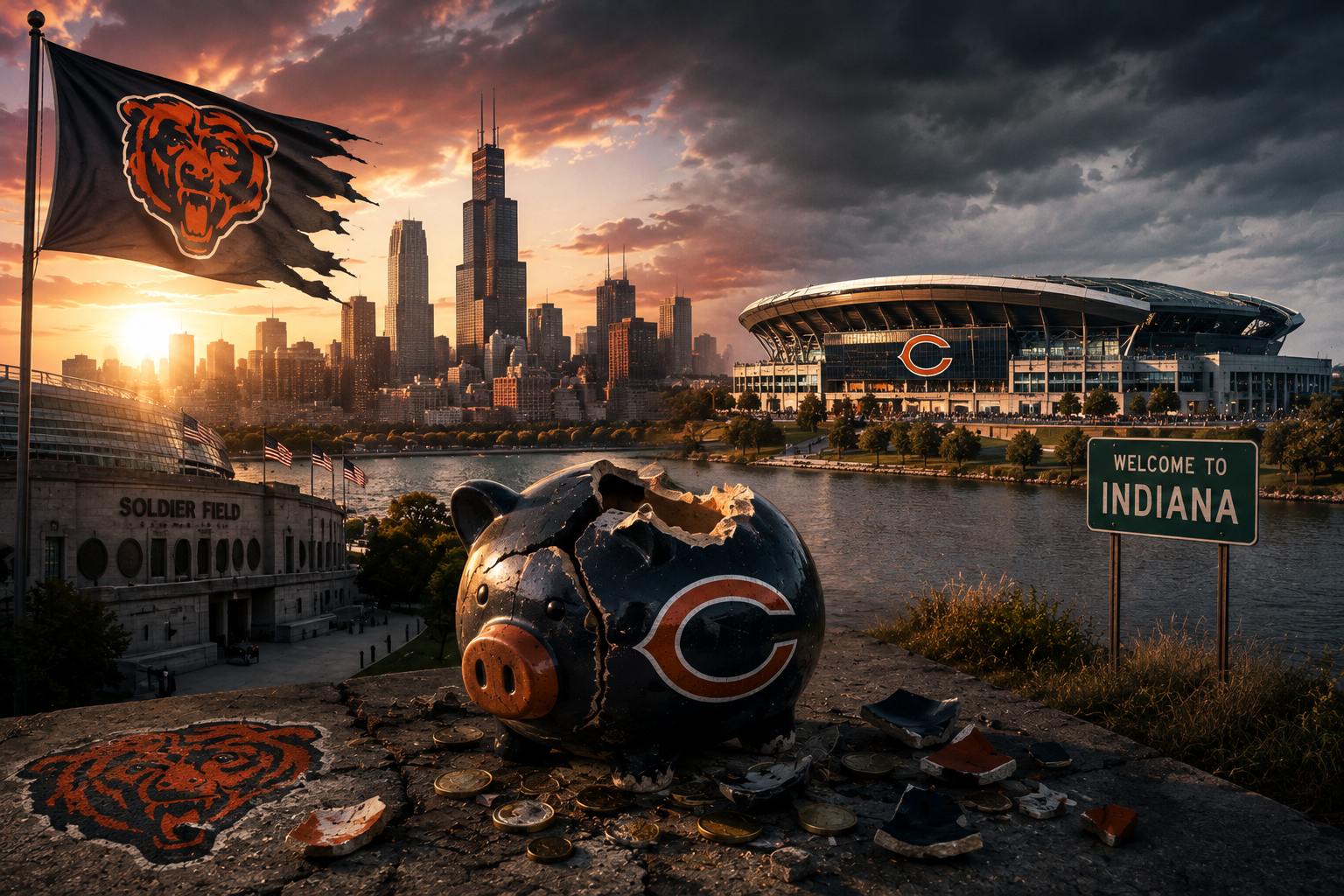
The Bears’ Indiana threat isn’t just a stadium story. It exposes a bigger problem in professional sports: franchise values are exploding, taxpayers are pushing back on subsidies, and private equity may become the inevitable answer.
By The Standard
Built By
Editorial Operating System v1.0Creator
Erik Chambers
Architecture
Founder, Creator & Editorial Architect
AI Assisted
No
Human Reviewed
Pending
Evidence Reviewed
In progress
Last Updated
August 26, 2026
Confidence
Evergreen medium/10
Research Status
Living investigation
We do not claim perfection. We promise transparency. Every investigation shows its work — the question, the evidence, the tools, the humans, and the updates.
They may be showing us what happens when billion-dollar sports franchises outgrow the family-business financing model that created them.
I'm a Bears fan. I live in Chicagoland. And after watching this stadium conversation bounce from Soldier Field to Arlington Heights, back toward Chicago, back toward Arlington Heights and now toward Indiana, I'm exhausted by it.
1. I've heard about property taxes.
2. I've heard about infrastructure.
3. I've heard about Springfield.
4. I've heard about the lakefront.
5. I've heard about Arlington Heights.
6. I've heard about Hammond.
At this point Bears fans should qualify for continuing-education credits in municipal finance. A sign of a good con or ruse is to have somebody look over here then look over here the whole entire time never having their eyes focused on one thing. And that's what the Chicago Bears are doing and that's where we are all at with the beloved.
I know Hammond is close.
I know Northwest Indiana is part of the larger Chicagoland orbit.
I know crossing the state line isn't the same thing as moving the franchise to another region.
I don't care.
Sports aren't completely rational.
They're geography. They're memory. They're identity.
George Halas. Walter Payton. Soldier Field. The lakefront. Cold Sundays. Your dad complaining about the quarterback. Your kid wearing the jersey. Generations of Chicago families organizing fall weekends around this football team.
They're the Chicago Bears.
And after everything this organization has put Bears fans through on the football field, finally getting the beautiful modern stadium we've been talking about for years — only to put it in another state — would somehow feel perfectly Bears.
Of course we'd finally get the palace.
It would just be in Indiana.
The Bears' board voted in June 2026 to move forward with plans for a stadium in Hammond, Indiana, marking the first time the board had voted on a stadium site. Source: Reuters
By August 13, Reuters reported that Hammond had become the organization's stadium focus and that Indiana was offering incentives exceeding $1 billion, while Illinois had not produced a comparable formal offer. Source: Reuters
George McCaskey has also said the franchise would remain the Chicago Bears even if the team ultimately played in Indiana. Source: Reuters
Fine.
The name survives.
That doesn't mean nothing changes.
This is what makes the whole situation especially maddening.
The Bears reached a $197.2 million agreement for the 326-acre Arlington Park property, a massive suburban site approximately 30 miles northwest of downtown Chicago. Source: NFL
That's enough land to imagine something substantially larger than a football stadium.
A stadium. Restaurants. Hotels. Retail. Entertainment. Parking. Commercial development. A year-round Bears district.
The team had the land.
It had Chicagoland.
It had the brand.
And years later we're talking about Indiana.
This is where I think the Bears discussion needs more nuance.
A franchise valuation isn't the same thing as cash sitting in the owner's bank account.
A family can control an extraordinarily valuable asset without possessing several billion dollars of liquid capital ready to deploy into a stadium and surrounding development.
There is nothing embarrassing about that.
What frustrates me is the assumption that if ownership needs capital, the missing capital should automatically become a taxpayer problem.
Need money?
Then let's talk about capital.
Not just taxes.
A comprehensive academic survey published in the Journal of Economic Surveys examined more than 130 studies covering more than three decades of research into professional sports franchises, stadiums and local economies. Source: Journal of Economic Surveys
The researchers concluded that the modern literature continues to find very limited broad economic effects from professional sports teams and stadiums and that estimated welfare gains generally fall well short of the public money spent subsidizing venues. Source: Journal of Economic Surveys
That doesn't mean a stadium has zero value.
That's too simplistic.
Sports create entertainment. Civic identity has value. Infrastructure can create lasting benefits. A successful mixed-use district can change a neighborhood.
But that's different from saying hundreds of millions of dollars in public subsidies automatically create an equivalent amount of new economic wealth.
If somebody spends $400 on a Bears Sunday, some of that money may be spending that would otherwise have gone toward another restaurant, concert or entertainment purchase in the same region.
Moving entertainment spending around isn't necessarily the same thing as creating new regional wealth.
THE PUBLIC RETURN TEST
Instead of asking whether a stadium creates economic activity, ask something harder:
What does the taxpayer actually receive for the taxpayer's investment?
How much cash, infrastructure, tax preference, land or government-backed financing is being committed?
How much genuinely new tax revenue does the project generate?
What else could that public capital have funded?
Who receives franchise appreciation, real-estate appreciation and operating revenue?
Which roads, transit improvements, utilities or public assets remain useful independent of the football team?
The Kansas City Chiefs have committed to leave Arrowhead Stadium in Missouri and move to a new domed stadium in Kansas for the 2031 NFL season. Kansas describes the stadium portion of the project as approximately $3 billion. Source: Kansas Department of Commerce
Kansas government materials describe the stadium financing as a 60% public / 40% private partnership, with the public portion financed through STAR bonds and the Attracting Professional Sports to Kansas Fund. Source: Kansas Department of Commerce
This is the Bears nightmare sitting right in front of us.
A historic franchise doesn't necessarily have to abandon its metropolitan fan base to create relocation leverage.
It can cross a state line.
The Chiefs can still be the Kansas City Chiefs.
The Bears could still be the Chicago Bears.
And suddenly two governments can find themselves competing economically for essentially the same regional sports property.
That's fantastic leverage for an NFL owner.
I'm less convinced it's fantastic for taxpayers.
Buffalo offers another warning — but for a different reason.
New York State committed $600 million and Erie County committed $250 million toward construction of the Bills' new stadium, for a combined $850 million public contribution. Source: Erie County Stadium Corporation / New York State
Then fans actually got inside.
At an August 8, 2026 public event at the new Highmark Stadium, fans raised complaints about limited or obstructed views from some upper-deck locations, small video boards, audio problems and traffic. Source: People
And this is where we need to be fair.
The Bills say fewer than 1% of PSL holders contacted the organization with sightline complaints. Team officials also said fully obstructed seats were not sold for football games and that limited-view conditions were represented to buyers through virtual seat previews. Source: People
So no, the evidence doesn't justify saying the entire Buffalo stadium is some $2 billion disaster.
But it does justify asking how a brand-new modern NFL stadium can reach its first major fan events with customers immediately talking about sightlines.
Put it somewhere on the checklist between plumbing and goalposts.
Buffalo is important for Chicago because spending enormous amounts of money doesn't automatically produce a perfect building.
The financing deal isn't the finish line.
The rendering isn't the finish line.
The groundbreaking isn't the finish line.
The stadium actually has to work for the people paying to use it.
In August 2024, NFL owners approved institutional private-equity investment for the first time, allowing approved funds to collectively hold up to 10% of a franchise. The investments are passive and do not carry voting control. Source: NFL
More importantly for this investigation, the NFL explicitly identified liquidity as a reason for the policy and said owners could use the resulting cash for stadium projects, facility upgrades and other franchise investments. Source: NFL
There it is.
The league itself has acknowledged the problem.
Even extremely wealthy owners can need liquidity.
And now there is another mechanism for obtaining it.
So why should every stadium conversation begin with the taxpayer?
The bigger sports-business story isn't really about the Bears.
It's about what happens as professional sports franchises become more and more valuable while stadiums become more and more expensive.
The traditional model was a wealthy individual or family controlling the franchise.
But as franchise values climb into extraordinary territory, the number of individual families capable of buying teams, inheriting teams and simultaneously funding massive infrastructure projects naturally gets smaller.
Eventually something has to change.
More minority partners.
More institutional investors.
More private equity.
More sophisticated project financing.
More real-estate partnerships.
Maybe someday leagues even reconsider broader forms of public ownership or publicly accessible sports equity.
Not because Wall Street suddenly loves football tradition.
Because the assets are becoming too expensive for the ownership structures that created them.
I don't want to pretend private equity is some magical fan-friendly solution.
Investors want returns.
And those returns eventually come from the economics of the franchise.
Tickets. Suites. Sponsorships. Parking. Hospitality. Real estate. Media. Concerts. Premium experiences.
Private capital could make the monetization of sports even more aggressive.
That deserves scrutiny too.
But there's an important difference.
An investor voluntarily buying equity receives upside because that investor also puts capital at risk.
That's a much cleaner relationship than asking taxpayers to provide capital while the franchise equity remains private.
If the McCaskey family wants to maintain control, maintain control.
I'm not asking them to sell the Bears.
I'm asking why maintaining control has to mean refusing outside capital while simultaneously asking governments for help.
That is how enormous developments get financed.
Different investors take different risks in exchange for different returns.
The fact that the development happens to contain a football field shouldn't suspend basic investment logic.
I know it's emotional.
That's the point.
Arlington Heights feels like Chicagoland to me.
Soldier Field obviously feels like Chicago.
Another Illinois solution could feel like Chicago.
Indiana doesn't.
Maybe somebody in Hammond reads that and thinks I'm being ridiculous.
Fair enough.
Sports fandom is ridiculous.
We wear another grown man's name on our backs.
We yell at televisions.
We allow a missed field goal to ruin an otherwise perfectly good Sunday.
We're allowed to care about where our team plays.
If place didn't matter, teams wouldn't put cities in their names.
They have a capital-structure problem disguised as a location problem.
Illinois versus Indiana is the visible fight.
The deeper fight is over who supplies the capital necessary to turn one of America's great football brands into a modern stadium, entertainment and real-estate enterprise.
For decades, taxpayers helped close those gaps.
But the academic evidence supporting stadium subsidies as broad economic-development investments is weak. Source: Journal of Economic Surveys
Meanwhile, the NFL has now opened franchises to limited institutional private-equity investment specifically in part to give owners access to liquidity that can be reinvested in teams, facilities and stadiums. Source: NFL
Those two trends are going to collide.
If Bears ownership doesn't possess enough liquid capital to independently finance the future this franchise requires, there is no shame in admitting it.
Bring in partners.
Use minority equity.
Bring institutional capital into the development.
Use private financing.
Build the damn stadium correctly.
And keep the Bears here.
Don't tell me our only choices are taxpayer subsidies or Indiana.
They're not.
The NFL itself has already created another source of capital.
Kansas City shows us what can happen when a neighboring state realizes it can buy its way into the stadium conversation.
Buffalo shows us why writing the check and cutting the ribbon aren't enough.
And Chicago is now sitting in the middle of both lessons.
The Bears have the history.
They have the market.
They have the fans.
They have the brand.
They already bought the land.
Franchise value doesn't build a stadium.
Capital does.
And when you own something private investors desperately want access to, finding capital should not require threatening taxpayers with Indiana.
SUPPORTED: The Bears are pursuing Hammond; the Chiefs are moving their stadium from Missouri to Kansas; Buffalo's new stadium received $850 million in state and county contributions; the NFL permits limited private-equity investment; and a large academic literature questions the economic-development justification for substantial stadium subsidies.
NOT CLAIMED: Every stadium subsidy loses money, Buffalo's entire stadium is defective, private equity is automatically good for fans, or the Bears' ownership lacks wealth.
THE QUESTION: If professional franchises increasingly require multibillion-dollar infrastructure while institutional investors now want access to franchise equity, why should taxpayers remain the default source of outside capital?
Editorial Transparency
This article contains a combination of reporting, publicly available research, and editorial analysis.
Analysis and interpretation. Facts are sourced; conclusions are the author's. Evidence before opinion — facts require sources, analysis requires transparency, opinions require labels.
Meet the creator
Erik Chambers
Founder, Creator & Editorial Architect
Erik originated the central idea, directed the investigation, reviewed the evidence, and approved the final published work.
Read the founder profile →Challenge This
We welcome disagreement
A different way to read the evidence. Research that points in another direction. Where specialists diverge.
Loading challenges…
Submit a challenge
Sign in to submit a challenge. All submissions are reviewed before appearing publicly.
Comments
Ask A Question
What would you ask an editor about this piece?
Reader questions feed our coverage map. The most-asked ones become our next investigations.
Continue Exploring
Guided by the evidenceWhere should this take you next?
The $9 Billion Bears Problem: Why Are Taxpayers Still Being Asked to Help?
A composite 0–100 measure of how well this investigation meets the Second City Standard. Scores are auditable — every point comes from the criteria below.
Composite
—
of 100
This investigation is queued for editorial scoring. No score has been assigned yet — the absence of a number is not a judgment on the evidence.
The Standard
· Editorial verdictBased on the evidence presented,
Second City Standard believes The Bears’ Indiana threat isn’t just a stadium story. It exposes a bigger problem in professional sports: franchise values are exploding, taxpayers are pushing back on subsidies, and private equity may become the inevitable answer.
Remaining uncertainty: Awaiting a final written verdict from the editorial desk.
The Standard · Second City Standard
Continue The Investigation
· Never a dead endThis investigation is one thread. Pull the next one — every path below is another investigation, another question, or another discipline applied to the same problem.
Signal over noise.
One weekly dispatch. The best of 2ND CITY STANDARD, straight to your inbox.
No spam. Unsubscribe anytime.